Oxford University Clinical Research Unit, Ho Chi Minh City, Vietnam.
Centre for Tropical Medicine and Global Health, Nuffield Department of Medicine, University of Oxford, Oxford, UK.
Microb Genom. 2023 Feb;9(2). doi: 10.1099/mgen.0.000955.
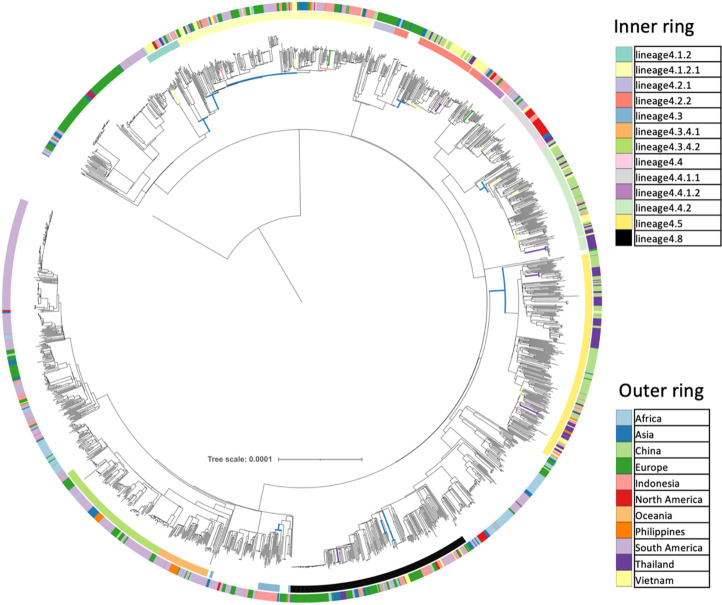
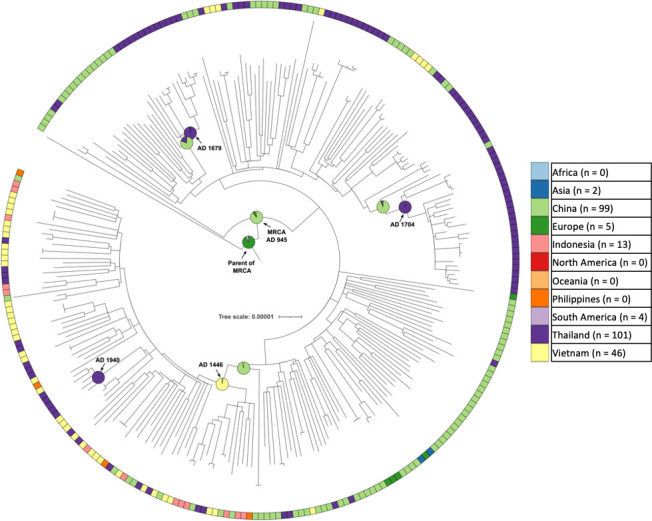
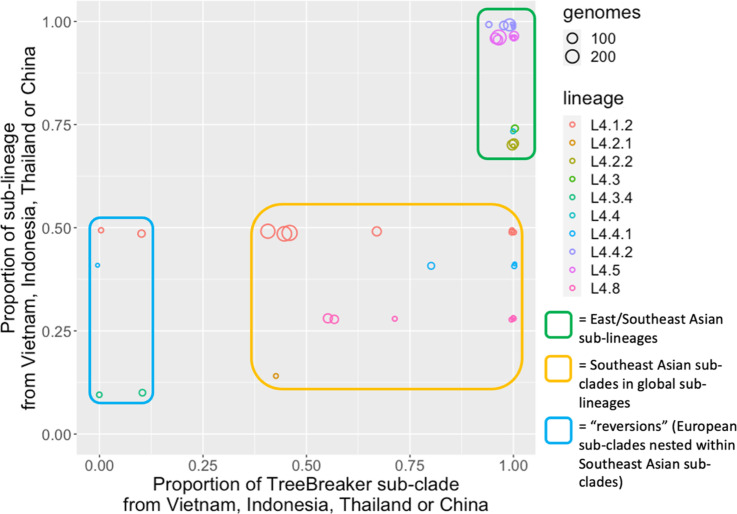
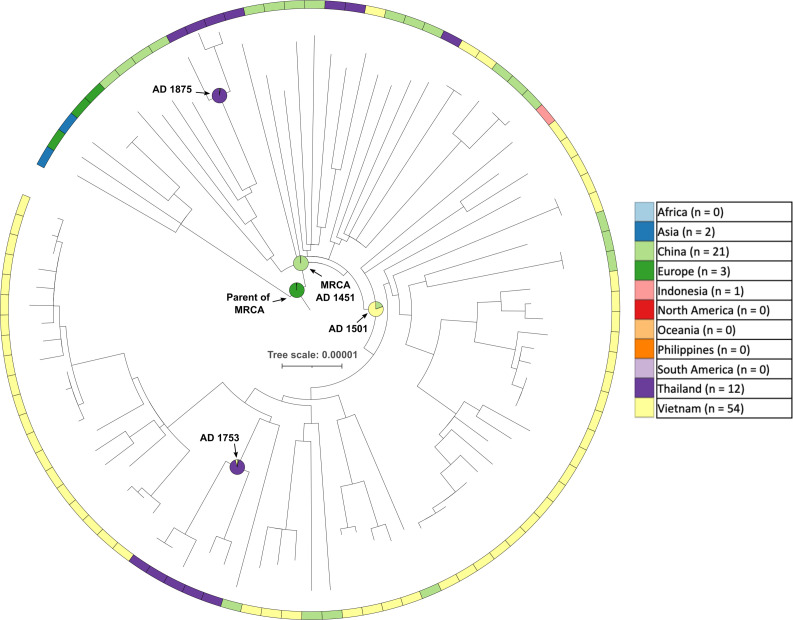
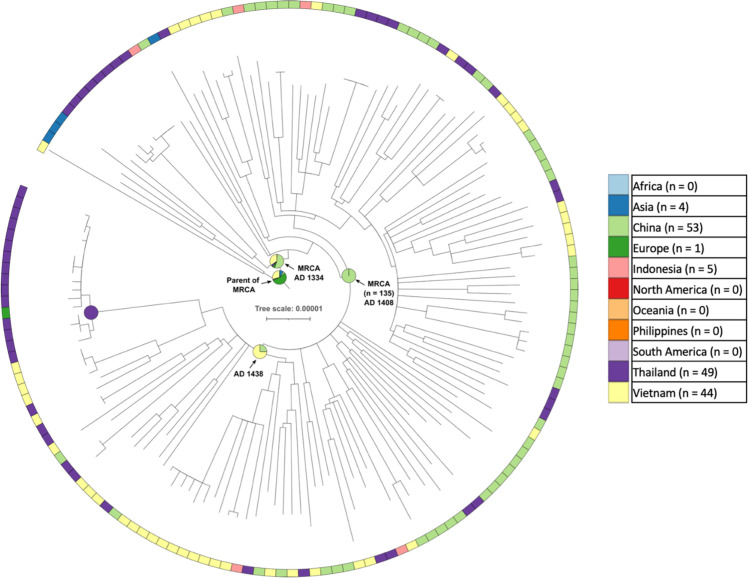
Molecular and genomic studies have revealed that Lineage 4 (L4, Euro-American lineage) emerged in Europe before becoming distributed around the globe by trade routes, colonial migration and other historical connections. Although L4 accounts for tens or hundreds of thousands of tuberculosis (TB) cases in multiple Southeast Asian countries, phylogeographical studies have either focused on a single country or just included Southeast Asia as part of a global analysis. Therefore, we interrogated public genomic data to investigate the historical patterns underlying the distribution of L4 in Southeast Asia and surrounding countries. We downloaded 6037 genomes associated with 29 published studies, focusing on global analyses of L4 and Asian studies of . We identified 2256 L4 genomes including 968 from Asia. We show that 81 % of L4 in Thailand, 51 % of L4 in Vietnam and 9 % of L4 in Indonesia belong to sub-lineages of L4 that are rarely seen outside East and Southeast Asia (L4.2.2, L4.4.2 and L4.5). These sub-lineages have spread between East and Southeast Asian countries, with no recent European ancestor. Although there is considerable uncertainty about the exact direction and order of intra-Asian dispersal, due to differing sampling frames between countries, our analysis suggests that China may be the intermediate location between Europe and Southeast Asia for two of the three predominantly East and Southeast Asian L4 sub-lineages (L4.2.2 and L4.5). This new perspective on L4 in Southeast Asia raises the possibility of investigating host population-specific evolution and highlights the need for more structured sampling from Southeast Asian countries to provide more certainty of the historical and current routes of dispersal.
分子和基因组研究表明,谱系 4(L4,欧美谱系)在通过贸易路线、殖民迁移和其他历史联系在全球传播之前,就已经出现在欧洲。尽管 L4 在多个东南亚国家造成了数万甚至数十万例结核病(TB)病例,但系统地理学研究要么只关注单个国家,要么只将东南亚作为全球分析的一部分。因此,我们利用公共基因组数据来调查 L4 在东南亚及周边国家分布的历史模式。我们下载了与 29 项已发表研究相关的 6037 个基因组,重点是对 L4 的全球分析和亚洲 L4 的研究。我们确定了 2256 个 L4 基因组,其中包括 968 个来自亚洲的基因组。研究结果表明,泰国 81%的 L4、越南 51%的 L4 和印度尼西亚 9%的 L4 属于 L4 的亚谱系,这些亚谱系在东亚和东南亚以外很少见(L4.2.2、L4.4.2 和 L4.5)。这些亚谱系在东亚和东南亚国家之间传播,没有最近的欧洲祖先。尽管由于国家之间的采样框架不同,关于亚洲内部传播的确切方向和顺序存在相当大的不确定性,但我们的分析表明,中国可能是两个主要分布在东亚和东南亚的 L4 亚谱系(L4.2.2 和 L4.5)中,L4 从欧洲到东南亚的中间位置。这种东南亚 L4 的新视角提出了研究宿主特定种群进化的可能性,并强调需要从东南亚国家进行更有组织的采样,以更确定传播的历史和当前路径。