Paediatric Department, Stavanger University Hospital, Stavanger, Norway.
Department of Clinical Science, University of Bergen, Bergen, Hordaland, Norway.
Arch Dis Child Fetal Neonatal Ed. 2023 Sep;108(5):478-484. doi: 10.1136/archdischild-2022-324977. Epub 2023 Feb 2.
To evaluate epidemiology and outcomes among very preterm infants (<32 weeks' gestation) with culture-positive and culture-negative late-onset sepsis (LOS).
Cohort study using a nationwide, population-based registry.
21 neonatal units in Norway.
All very preterm infants born 1 January 2009-31 December 2018 and admitted to a neonatal unit.
Incidences, pathogen distribution, LOS-attributable mortality and associated morbidity at discharge.
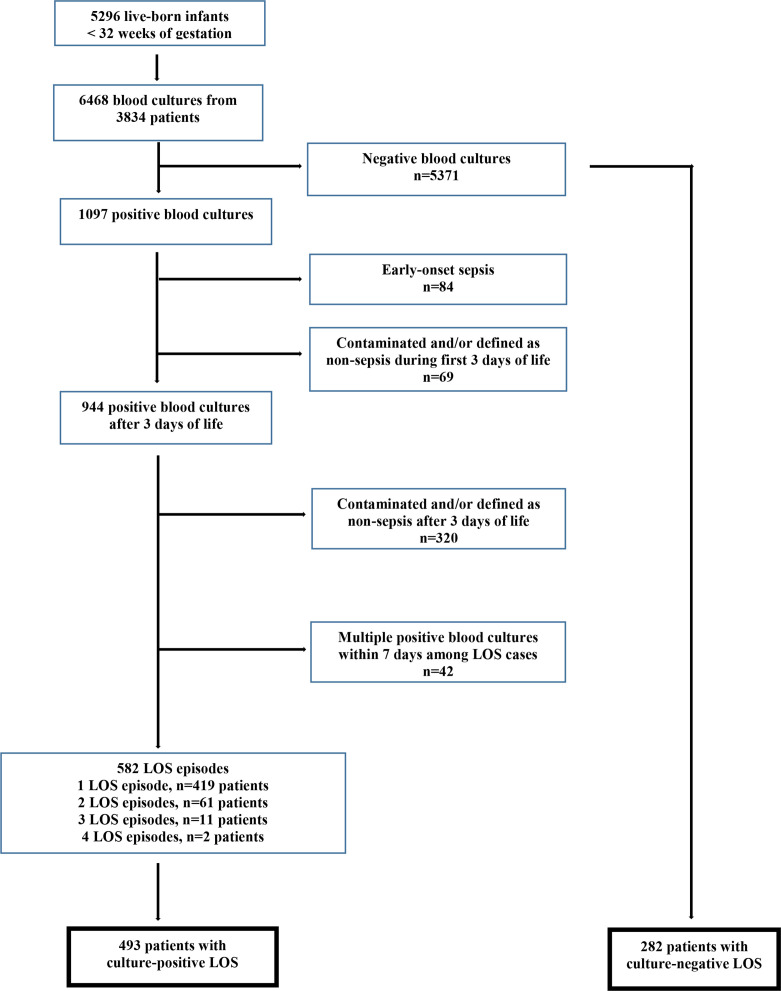
Among 5296 very preterm infants, we identified 582 culture-positive LOS episodes in 493 infants (incidence 9.3%) and 282 culture-negative LOS episodes in 282 infants (incidence 5.3%). Extremely preterm infants (<28 weeks' gestation) had highest incidences of culture-positive (21.6%) and culture-negative (11.1%) LOS. The major causative pathogens were coagulase-negative staphylococci (49%), (15%), group B streptococci (10%) and (8%). We observed increased odds of severe bronchopulmonary dysplasia (BPD) associated with both culture-positive (adjusted OR (aOR) 1.7; 95% CI 1.3 to 2.2) and culture-negative (aOR 1.6; 95% CI 1.3 to 2.6) LOS. Only culture-positive LOS was associated with increased odds of cystic periventricular leukomalacia (cPVL) (aOR 2.2; 95% CI 1.4 to 3.4) and severe retinopathy of prematurity (ROP) (aOR 1.8; 95% CI 1.2 to 2.8). Culture-positive LOS-attributable mortality was 6.3%, higher in Gram-negative (15.8%) compared with Gram-positive (4.1%) LOS, p=0.009. Among extremely preterm infants, survival rates increased from 75.2% in 2009-2013 to 81.0% in 2014-2018, p=0.005. In the same period culture-positive LOS rates increased from 17.1% to 25.6%, p<0.001.
LOS contributes to a significant burden of disease in very preterm infants and is associated with increased odds of severe BPD, cPVL and severe ROP.
评估培养阳性和培养阴性晚发性败血症( LOS)极低早产儿(<32 周)的流行病学和结局。
使用全国性、基于人群的登记处进行队列研究。
挪威的 21 个新生儿病房。
2009 年 1 月 1 日至 2018 年 12 月 31 日出生并入住新生儿病房的所有极低早产儿。
发病率、病原体分布、 LOS 相关死亡率和出院时相关发病率。
在 5296 名极低早产儿中,我们在 493 名婴儿中发现了 582 例培养阳性 LOS 发作(发病率为 9.3%),在 282 名婴儿中发现了 282 例培养阴性 LOS 发作(发病率为 5.3%)。极早产儿(<28 周)的培养阳性(21.6%)和培养阴性(11.1%) LOS 发生率最高。主要病原体为凝固酶阴性葡萄球菌(49%)、(15%)、B 组链球菌(10%)和(8%)。我们观察到,与培养阳性(调整比值比[aOR]1.7;95%置信区间[CI]1.3 至 2.2)和培养阴性(aOR 1.6;95%CI 1.3 至 2.6)LOS 相关,严重支气管肺发育不良(BPD)的发生风险增加。只有培养阳性的 LOS 与囊性室管膜下白质软化(cPVL)(aOR 2.2;95%CI 1.4 至 3.4)和严重早产儿视网膜病变(ROP)(aOR 1.8;95%CI 1.2 至 2.8)的发生风险增加相关。培养阳性 LOS 相关死亡率为 6.3%,革兰氏阴性(15.8%)高于革兰氏阳性(4.1%),p=0.009。在极早产儿中,存活率从 2009-2013 年的 75.2%增加到 2014-2018 年的 81.0%,p=0.005。在同一时期,培养阳性 LOS 的发生率从 17.1%增加到 25.6%,p<0.001。
LOS 导致极低早产儿疾病负担显著增加,并与严重 BPD、cPVL 和严重 ROP 的发生风险增加相关。