Division of Neonatology, Department of Women's and Children's Health, University of Leipzig Medical Center, Leipzig, Germany.
Department of Pediatrics, University Hospital of Würzburg, Würzburg, Germany.
JAMA Netw Open. 2024 Jul 1;7(7):e2423933. doi: 10.1001/jamanetworkopen.2024.23933.
Retinopathy of prematurity (ROP) is a major morbidity of preterm infants causing visual impairment, including blindness, for which timely treatment is vital and prevention is key. Increasing evidence suggests that exposure to neonatal sepsis contributes to ROP development.
To investigate the association between neonatal sepsis and ROP in 2 large-scale cohorts of preterm infants born at less than 29 weeks' gestation.
DESIGN, SETTING, AND PARTICIPANTS: This retrospective cohort study was conducted using data from the German Neonatal Network (GNN) and Norwegian Neonatal Network (NNN). The GNN involves 68 and the NNN includes 21 level III neonatal intensive care units. Participants were infants born at a gestation of 22 weeks and 0 days to 28 weeks and 6 days and enrolled in the GNN between January 1, 2009, and December 31, 2022, and NNN between January 1, 2009, and December 31, 2018. Data were analyzed from February through September 2023.
Single or multiple episodes of culture-proven sepsis.
Any ROP and treatment-warranted ROP.
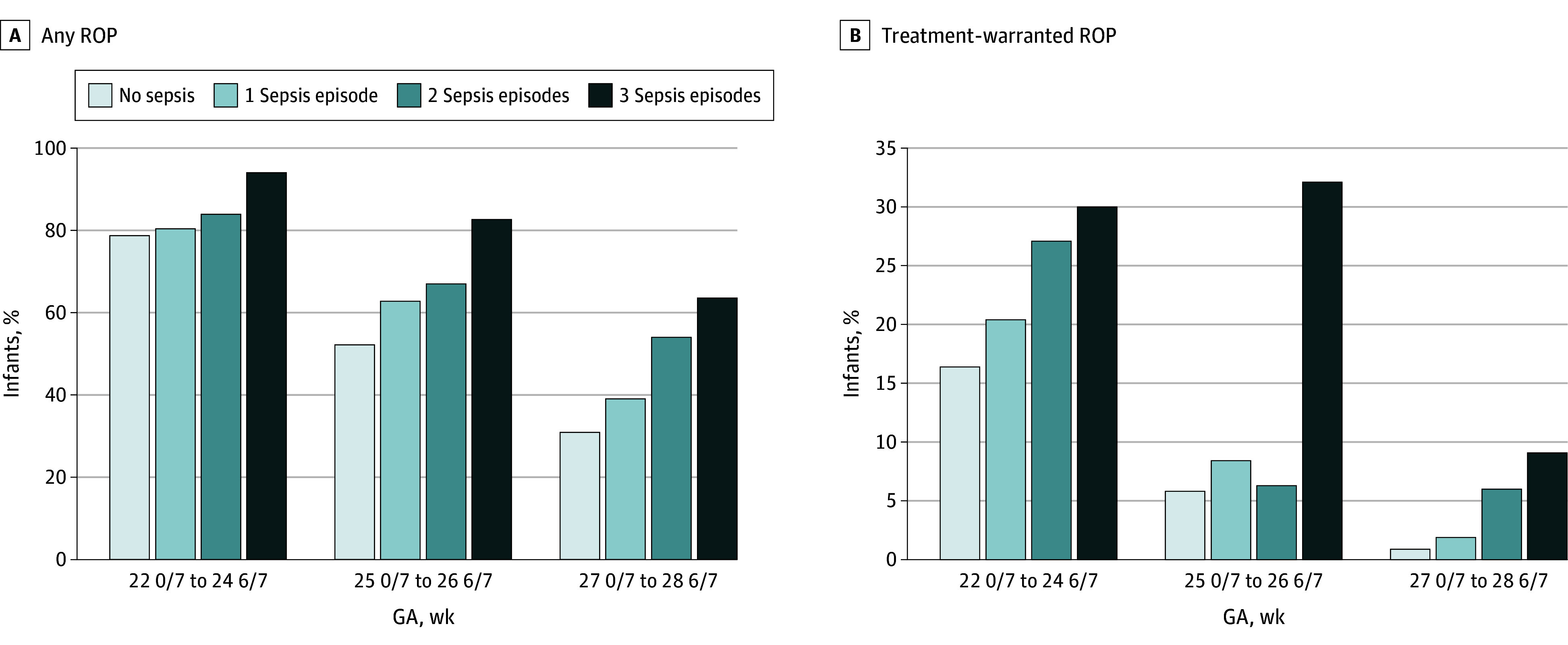
Among 12 794 infants in the GNN (6043 female [47.2%] and 6751 male [52.8%]; mean [SD] gestational age, 26.4 [1.5] weeks) and 1844 infants in the NNN (866 female [47.0%] and 978 male [53.0%]; mean [SD] gestational age, 25.6 [1.5] weeks), the mean (SD) birth weight was 848 (229) g and 807 (215) g, respectively. Any ROP was present in 6370 infants (49.8%) in GNN and 620 infants (33.6%) in NNN, and treatment-warranted ROP was present in 840 infants (6.6%) in GNN and 140 infants (7.6%) in NNN. In both cohorts, there were increasing rates of treatment-warranted ROP with each sepsis episode (no sepsis: 572 of 10 658 infants [5.4%] in GNN and 85 of 1492 infants (5.7%) in NNN; 1 episode: 190 of 1738 infants in GNN [10.9%] and 29 of 293 infants [9.9%] in NNN; 2 episodes: 53 of 314 infants in GNN [16.9%] and 13 of 49 infants [26.5%] in NNN; 3 episodes: 25 of 84 infants [29.8%] in GNN and 3 of 10 infants [30.0%] in NNN). After adjusting for multiple confounders in the GNN dataset, the number of sepsis episodes was associated with ROP and treatment-warranted ROP compared with 0 episodes (1 episode: adjusted odds ratio [aOR], 1.44 [95% CI, 1.27-1.63]; P < .001 and OR, 1.60 [95% CI, 1.31-1.96]; P < .001, respectively; 2 episodes: OR, 1.81 [95% CI, 1.35-2.42]; P < .001 and OR, 2.38 [95% CI, 1.68-3.37]; P < .001, respectively; 3 episodes: OR, 4.39 [95% CI, 2.19-8.78]; P < .001 and OR, 3.88 [95% CI, 2.29-6.55]; P < .001, respectively). These associations were confirmed for any ROP by propensity score matching (for example, the aOR with propensity score matching was 1.76 [95% CI, 1.54-2.02]; P < .001 for 1 episode vs 0 episodes and 1.58 [95% CI, 1.12-2.22]; P = .007 for 3 episodes vs 0 or 1 episode). In the NNN dataset, surgical NEC was associated with treatment-warranted ROP (multivariable analysis: aOR, 3.37 [95% CI, 1.78-6.37]; P < .001).
This study found that in the large-scale GNN cohort, recurrent culture-proven sepsis was associated with ROP and treatment-warranted ROP in infants born at less than 29 weeks.
早产儿视网膜病变(ROP)是一种主要的早产儿疾病,会导致视力障碍,包括失明,因此及时治疗至关重要,预防是关键。越来越多的证据表明,新生儿败血症的暴露会导致 ROP 的发展。
在两个大规模的早产儿队列中,研究新生儿败血症与 ROP 之间的关联,这些早产儿的胎龄均小于 29 周。
设计、地点和参与者:这是一项回顾性队列研究,使用了德国新生儿网络(GNN)和挪威新生儿网络(NNN)的数据。GNN 涉及 68 个和 NNN 包括 21 个三级新生儿重症监护病房。参与者是胎龄为 22 周零 0 天至 28 周零 6 天且在 GNN 登记的婴儿,登记时间为 2009 年 1 月 1 日至 2022 年 12 月 31 日,在 NNN 登记的婴儿为 2009 年 1 月 1 日至 2018 年 12 月 31 日。数据分析时间为 2023 年 2 月至 9 月。
单一或多次经培养证实的败血症发作。
任何 ROP 和需要治疗的 ROP。
在 GNN 的 12794 名婴儿(6043 名女性[47.2%]和 6751 名男性[52.8%];平均[SD]胎龄,26.4[1.5]周)和 NNN 的 1844 名婴儿(866 名女性[47.0%]和 978 名男性[53.0%];平均[SD]胎龄,25.6[1.5]周)中,平均(SD)出生体重分别为 848(229)g 和 807(215)g。在 GNN 中,6370 名婴儿(49.8%)存在任何 ROP,NNN 中有 620 名婴儿(33.6%)存在任何 ROP,GNN 中有 840 名婴儿(6.6%)需要治疗的 ROP,NNN 中有 140 名婴儿(7.6%)需要治疗的 ROP。在两个队列中,随着每次败血症发作,需要治疗的 ROP 发生率都在增加(无败血症:GNN 中有 10658 名婴儿中的 572 名[5.4%]和 NNN 中有 1492 名婴儿中的 85 名[5.7%];1 次发作:GNN 中有 1738 名婴儿中的 190 名[10.9%]和 NNN 中有 293 名婴儿中的 29 名[9.9%];2 次发作:GNN 中有 314 名婴儿中的 53 名[16.9%]和 NNN 中有 49 名婴儿中的 13 名[26.5%];3 次发作:GNN 中有 84 名婴儿中的 25 名[29.8%]和 NNN 中有 10 名婴儿中的 3 名[30.0%])。在 GNN 数据集调整了多个混杂因素后,与无败血症发作相比,败血症发作次数与 ROP 和需要治疗的 ROP 相关(1 次发作:校正优势比[OR],1.44[95%CI,1.27-1.63];P<0.001 和 OR,1.60[95%CI,1.31-1.96];P<0.001);2 次发作:OR,1.81[95%CI,1.35-2.42];P<0.001 和 OR,2.38[95%CI,1.68-3.37];P<0.001);3 次发作:OR,4.39[95%CI,2.19-8.78];P<0.001 和 OR,3.88[95%CI,2.29-6.55];P<0.001)。通过倾向评分匹配对任何 ROP 均证实了这些关联(例如,倾向评分匹配的校正 OR 为 1.76[95%CI,1.54-2.02];P<0.001,1 次发作与 0 次发作相比;3 次发作与 0 次或 1 次发作相比,OR 为 1.58[95%CI,1.12-2.22];P=0.007)。在 NNN 数据集,手术 NEC 与需要治疗的 ROP 相关(多变量分析:OR,3.37[95%CI,1.78-6.37];P<0.001)。
本研究发现,在大规模的 GNN 队列中,经培养证实的复发性败血症与胎龄小于 29 周的婴儿的 ROP 和需要治疗的 ROP 相关。