Department of Mechanical and Process Engineering, Offenburg University of Applied Sciences, Offenburg, Germany.
Institute of Biomechanics and Orthopaedics, German Sport University Cologne, Cologne, Germany.
Am J Sports Med. 2023 Mar;51(3):715-722. doi: 10.1177/03635465221146294. Epub 2023 Feb 3.
Ankle braces aim to reduce lateral ankle sprains. Next to protection, factors influencing user compliance, such as sports performance, motion restriction, and users' perceptions, are relevant for user compliance and thus injury prevention. Novel adaptive protection systems claim to change their mechanical behavior based on the intensity of motion (eg, the inversion velocity), unlike traditional passive concepts of ankle bracing.
To compare the performance of a novel adaptive brace with 2 passive ankle braces while considering protection, sports performance, freedom of motion, and subjective perception.
Controlled laboratory study.
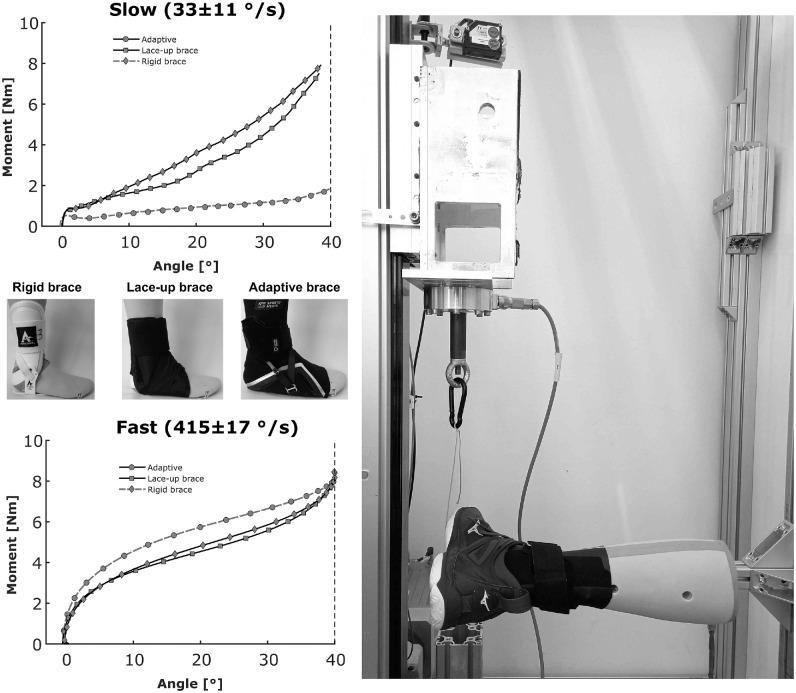
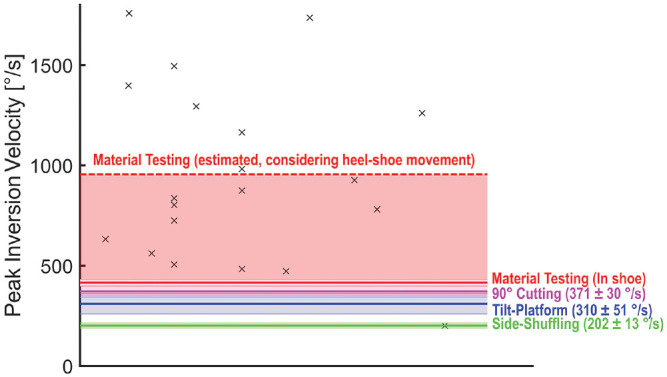
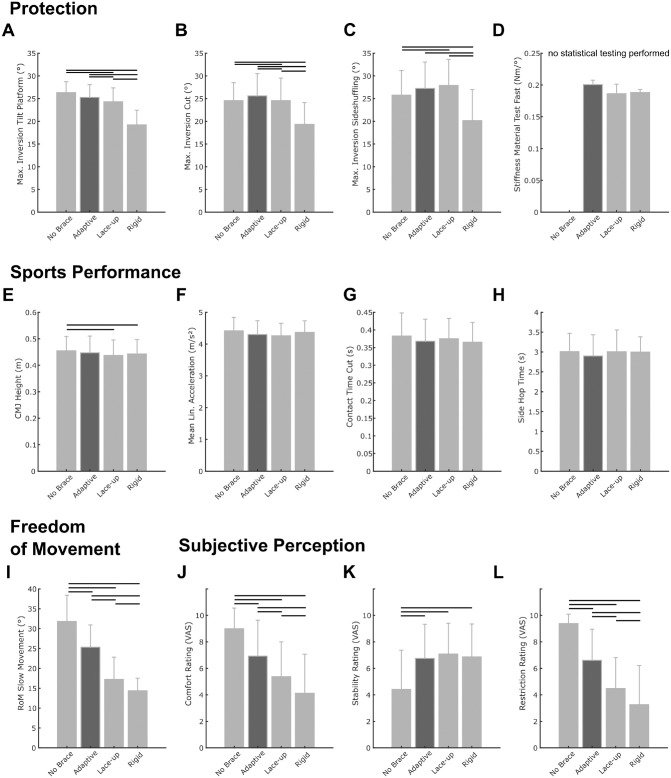
The authors analyzed 1 adaptive and 2 passive (one lace-up and one rigid brace) ankle braces, worn in a low-cut, indoor sports shoe, which was also the no-brace reference condition. We performed material testing using an artificial ankle joint system at high and low inversion velocities. Further, 20 male, young, healthy team sports athletes were analyzed using 3-dimensional motion analysis in sports-related movements to address protection, sports performance, and active range of motion dimensions. Participants rated subjective comfort, stability, and restriction experienced when using the products.
Subjective stability rating was not different between the adaptive and passive systems. The rigid brace was superior in restricting peak inversion during the biomechanical testing compared with the passive braces. However, in the material test, the adaptive brace increased its stiffness by approximately 400% during the fast compared with the slow inversion velocities, demonstrating its adaptive behavior and similar stiffness values to passive braces. We identified minor differences in sports performance tasks. The adaptive brace improved active ankle range of motion and subjective comfort and restriction ratings.
The adaptive brace offered similar protective effects in high-velocity inversion situations to those of the passive braces while improving range of motion, comfort, and restriction rating during noninjurious motions.
Protection systems are only effective when used. Compared with traditional passive ankle brace technologies, the novel adaptive brace might increase user compliance by improving comfort and freedom of movement while offering similar protection in injurious situations.
脚踝护具旨在减少外踝扭伤。除了保护作用外,影响用户依从性的因素,如运动表现、运动限制和用户感知,与用户依从性和因此的预防损伤有关。新型自适应保护系统声称能够根据运动强度(例如,外翻速度)改变其机械性能,这与传统的被动脚踝支撑概念不同。
在考虑保护、运动表现、运动自由度和主观感知的情况下,比较一种新型自适应护具与 2 种被动护具的性能。
对照实验室研究。
作者分析了 1 种自适应和 2 种被动(1 种系带式和 1 种刚性护具)脚踝护具,这些护具都在低帮、室内运动鞋中穿着,这也是无护具的参考条件。我们使用人工踝关节系统在高和低外翻速度下进行材料测试。此外,20 名男性、年轻、健康的团队运动运动员进行了三维运动分析,以解决运动相关运动中的保护、运动表现和主动活动范围维度。参与者对使用产品时的主观舒适度、稳定性和限制进行了评分。
自适应系统和被动系统的主观稳定性评分没有差异。刚性护具在生物力学测试中限制峰值外翻的能力优于被动护具。然而,在材料测试中,自适应护具在快速与慢速外翻速度相比时,其刚度增加了约 400%,表现出其自适应行为和与被动护具相似的刚度值。我们发现运动表现任务存在细微差异。自适应护具改善了主动踝关节活动范围和主观舒适度和限制评分。
自适应护具在高速度外翻情况下提供了与被动护具相似的保护效果,同时在非损伤性运动中改善了活动范围、舒适度和限制评分。
保护系统只有在使用时才有效。与传统的被动脚踝支撑技术相比,新型自适应支撑可能会通过提高舒适度和运动自由度来提高用户依从性,同时在受伤情况下提供类似的保护。