Department of Medicine, University of Texas Medical Branch, Galveston.
Sealy Center on Aging, University of Texas Medical Branch, Galveston.
JAMA Netw Open. 2023 Feb 1;6(2):e2255589. doi: 10.1001/jamanetworkopen.2022.55589.
Several studies reported sharp decreases in screening mammography for breast cancer and low-dose computed tomographic screening for lung cancer in the early months of the COVID-19 pandemic, followed by a return to normal or near-normal levels in the summer of 2020.
To determine the observed vs expected mammography and low-dose computed tomographic scan rates from the beginning of the pandemic through April 2022.
DESIGN, SETTING, AND PARTICIPANTS: In this retrospective cohort study assessing mammography and low-dose computed tomography rates from January 2017 through April 2022, data for January 2016 to February 2020 were used to generate expected rates for the period March 2020 to April 2022. The study included a 20% national sample of Medicare fee-for-service enrollees among women aged 50 to 74 years for mammography, and men and women aged 55 to 79 years for low-dose computed tomographic scan.
Receipt of screening mammography or low-dose computed tomographic scan.
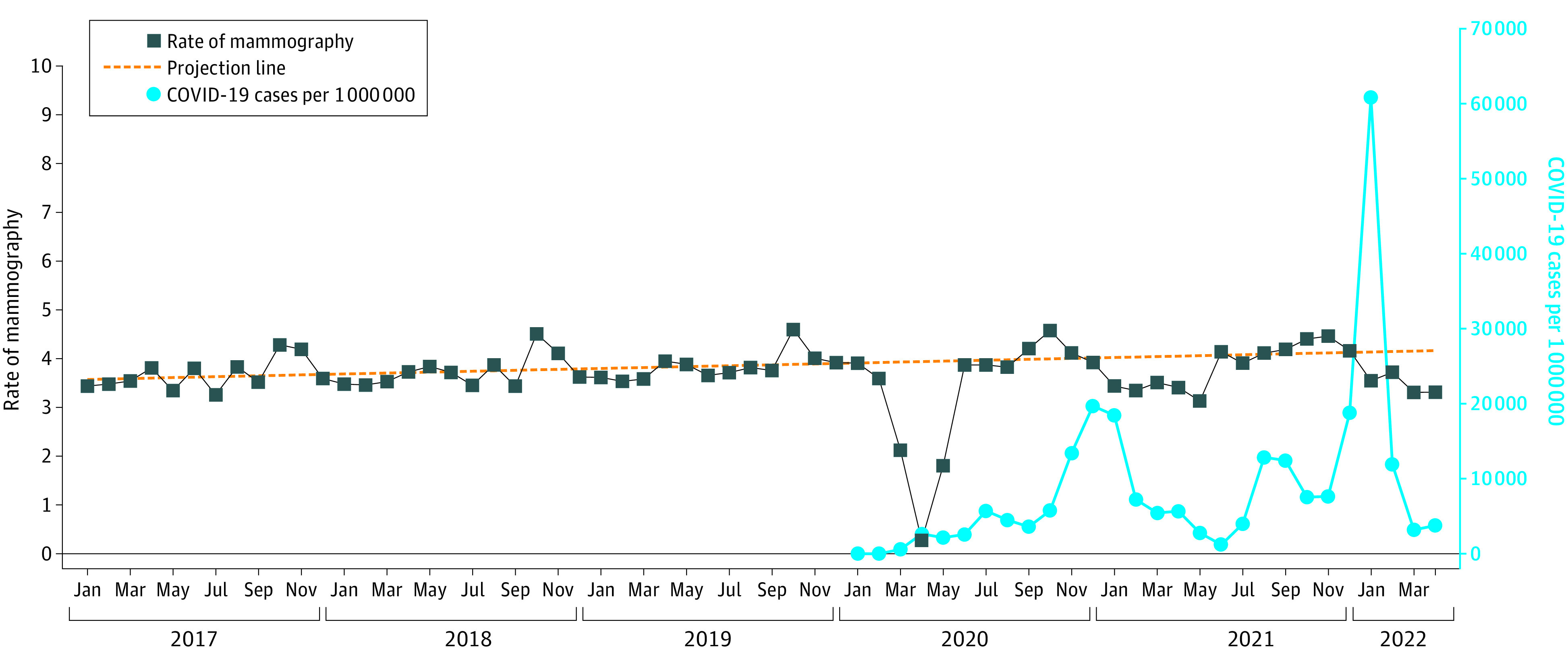
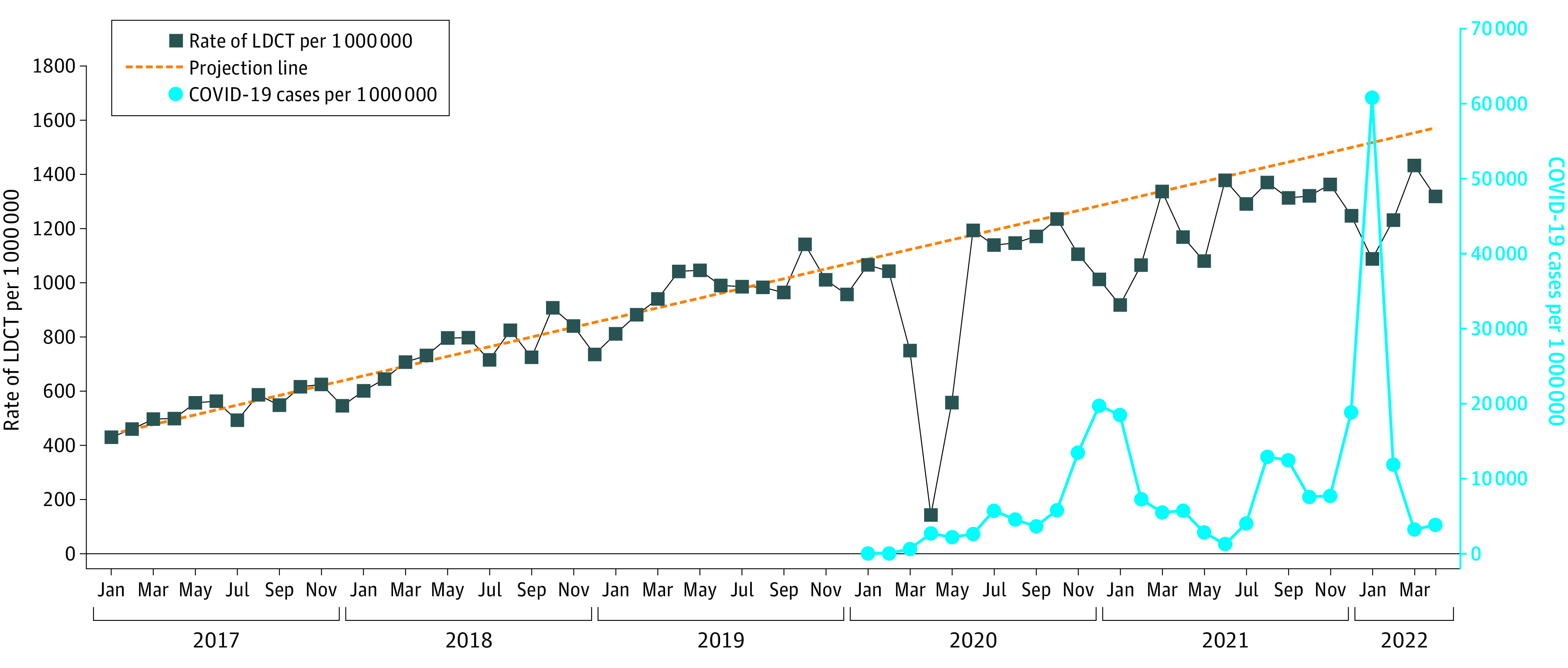
The yearly cohorts for the mammography rates included more than 1 600 000 women aged 50 to 74 years, and the cohorts for the low-dose computed tomographic scan rates included more than 3 700 000 men and women aged 55 to 79 years. From January 2017 through February 2020, monthly mammography rates were flat, whereas there was a monotonic increase in low-dose computed tomographic scan rates, from approximately 500 per million per month in early 2017 to 1100 per million per month by January 2020. Over the period from March 2020 to April 2022, there were episodic drops in both mammography and low-dose computed tomographic scan rates, coincident with increases in national COVID-19 infection rates. For the periods from March 2020 to February 2020 and March 2021 to February 2022, the observed low-dose computed tomographic scan rates were 24% (95% CI, 23%-24%) and 14% (95% CI, 13%-15%) below expected rates, whereas mammography rates were 17% (95% CI, 17%-18%) and 4% (95% CI, 4%-3%) below expected.
In this cohort study, the decreases in cancer screening during the early phases of the COVID-19 pandemic did not resolve after the initial pandemic surges. Successful interventions to improve screening rates should address pandemic-specific reasons for low screening participation.
有几项研究报告称,在 COVID-19 大流行的早期,乳腺癌筛查的乳房 X 光检查和肺癌低剂量计算机断层扫描显著减少,随后在 2020 年夏季恢复到正常或接近正常水平。
确定从大流行开始到 2022 年 4 月期间观察到的与预期的乳房 X 光检查和低剂量计算机断层扫描率。
设计、设置和参与者:在这项回顾性队列研究中,评估了 2017 年 1 月至 2022 年 4 月期间的乳房 X 光检查和低剂量计算机断层扫描率,使用 2016 年 1 月至 2020 年 2 月的数据生成 2020 年 3 月至 2022 年 4 月期间的预期率。该研究包括了全国范围内 20%的医疗保险付费服务参保者,其中 50 至 74 岁的女性接受乳房 X 光检查,55 至 79 岁的男性和女性接受低剂量计算机断层扫描。
接受筛查性乳房 X 光检查或低剂量计算机断层扫描。
乳房 X 光检查率的每年队列包括超过 160 万 50 至 74 岁的女性,低剂量计算机断层扫描率的队列包括超过 370 万 55 至 79 岁的男性和女性。从 2017 年 1 月至 2020 年 2 月,每月乳房 X 光检查率持平,而低剂量计算机断层扫描率呈单调递增,从 2017 年初的每月每百万约 500 例增加到 2020 年 1 月的每月每百万 1100 例。在 2020 年 3 月至 2022 年 4 月期间,乳房 X 光检查和低剂量计算机断层扫描率都出现了间歇性下降,同时全国 COVID-19 感染率也有所上升。在 2020 年 3 月至 2020 年 2 月和 2021 年 3 月至 2022 年 2 月期间,观察到的低剂量计算机断层扫描率分别比预期低 24%(95%CI,23%-24%)和 14%(95%CI,13%-15%),而乳房 X 光检查率分别比预期低 17%(95%CI,17%-18%)和 4%(95%CI,4%-3%)。
在这项队列研究中,COVID-19 大流行早期癌症筛查的减少在最初的大流行高峰后并未得到解决。为提高筛查率而采取的成功干预措施应针对大流行期间参与率低的具体原因。