Department of Thoracic Surgery, University Hospitals Leuven, Leuven, Belgium.
Department of Chronic Diseases and Metabolism, Laboratory of Respiratory Diseases and Thoracic Surgery (BREATHE), KU Leuven, Leuven, Belgium.
Ann Surg. 2023 Sep 1;278(3):e641-e649. doi: 10.1097/SLA.0000000000005813. Epub 2023 Feb 3.
To describe our experience with lung transplantation (LTx) from donors ≥70 years and compare short and long-term outcomes to a propensity-matched cohort of donors <70 years.
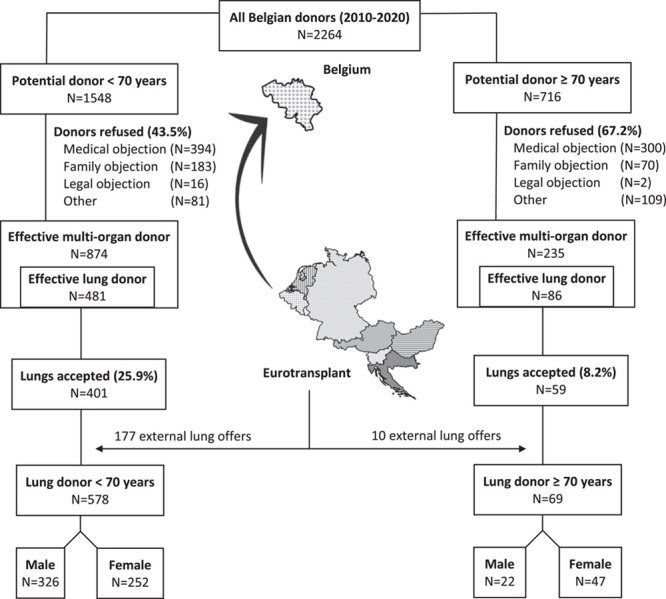
Although extended-criteria donors have been widely used to enlarge the donor pool, the experience with LTx from older donors (≥70 years) remains limited.
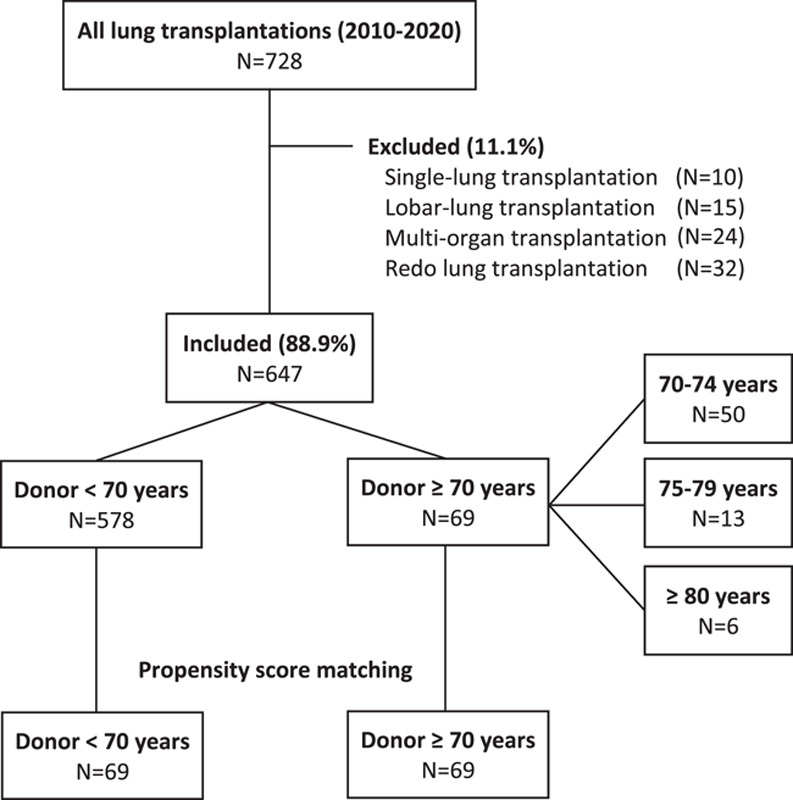
All single-center bilateral LTx between 2010 and 2020 were retrospectively analyzed. Matching (1:1) was performed for the donor (type, sex, smoking history, x-ray abnormalities, partial pressure of oxygen/fraction of inspired oxygen ratio, and time on ventilator) and recipient characteristics (age, sex, LTx indication, perioperative extracorporeal life support, and cytomegalovirus mismatch). Primary graft dysfunction grade-3, 5-year patient, and chronic lung allograft dysfunction-free survival were analyzed.
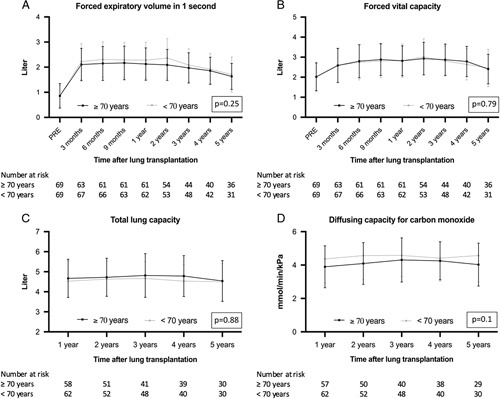
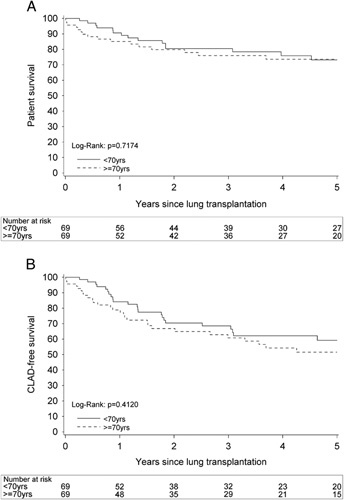
Out of 647 bilateral LTx, 69 were performed from donors ≥70 years. The mean age in the older donor cohort was 74 years (range: 70-84 years) versus 49 years (range: 12-69 years) in the matched younger group. No significant differences were observed in the length of ventilatory support, intensive care unit, or hospital stay. Primary graft dysfunction-3 was 26% in the older group versus 29% in younger donor recipients ( P = 0.85). Reintervention rate was comparable (29% vs 16%; P = 0.10). Follow-up bronchoscopy revealed no difference in bronchial anastomotic complications ( P = 1.00). Five-year patient and chronic lung allograft dysfunction-free survivals were 73.6% versus 73.1% ( P = 0.72) and 51.5% versus 59.2% ( P = 0.41), respectively.
LTx from selected donors ≥70 years is feasible and safe, yielding comparable short and long-term outcomes in a propensity-matched analysis with younger donors (<70 years).
描述我们在≥70 岁供体中进行肺移植(LTx)的经验,并与<70 岁供体的倾向性匹配队列进行比较,评估短期和长期结果。
尽管扩展标准的供体已被广泛用于扩大供体库,但来自年龄较大(≥70 岁)供体的 LTx 经验仍然有限。
回顾性分析了 2010 年至 2020 年期间所有的单中心双侧 LTx。供体(类型、性别、吸烟史、X 射线异常、氧分压/吸入氧分数比、呼吸机使用时间)和受者特征(年龄、性别、LTx 适应证、围手术期体外生命支持、巨细胞病毒错配)进行 1:1 匹配。分析了原发性移植物功能障碍 3 级、5 年患者生存率和慢性肺移植物功能障碍无生存。
在 647 例双侧 LTx 中,有 69 例来自≥70 岁的供体。年龄较大供体组的平均年龄为 74 岁(范围:70-84 岁),而匹配的年轻组的平均年龄为 49 岁(范围:12-69 岁)。两组呼吸机支持时间、重症监护病房或住院时间无显著差异。年龄较大组的原发性移植物功能障碍 3 级发生率为 26%,年轻供体组为 29%(P=0.85)。再次干预率相似(29%vs16%;P=0.10)。随访支气管镜检查显示支气管吻合口并发症无差异(P=1.00)。5 年患者生存率和慢性肺移植物功能障碍无生存分别为 73.6%和 73.1%(P=0.72)和 51.5%和 59.2%(P=0.41)。
在与年轻供体(<70 岁)的倾向性匹配分析中,选择≥70 岁的供体进行 LTx 是可行和安全的,可获得相似的短期和长期结果。