Faculty of Sport and Health Education, Universitas Pendidikan Indonesia, Bandung, Indonesia.
Sydney School of Education and Social Works, The University of Sydney, Sydney, Australia.
BMC Psychol. 2023 Feb 3;11(1):35. doi: 10.1186/s40359-023-01073-x.
The psychological strategies of self-talk (S.T.) and mental imagery (MI) have an essential role in training and sports performance, but their implementation, particularly in combination, is still limited. This study aimed to examine badminton motor skills (BMS) and self-confidence (S.C.) mastery after a psychological strategy intervention of S.T. and MI, which were integrated into the BMS training process in both independent and interactive functions. The S.T. strategy consisted of instructional (I-S.T.) and motivational (M-S.T.) functions, while the MI consisted of cognitive (C-MI) and motivational (M-MI) aspects.
Eighty youth beginner badminton student-athletes aged 10-12 years (male = 40, female = 40) were divided through a disproportional stratified sampling into four experimental groups (EG: 2-function S.T. × 2-function MI) and one control group (CG). The intervention program lasted eight weeks (three meetings a week for a total of 24 meetings). The participants completed a fidelity check at each session. At the end of the intervention, they took a BMS test and completed a self-confidence scale.
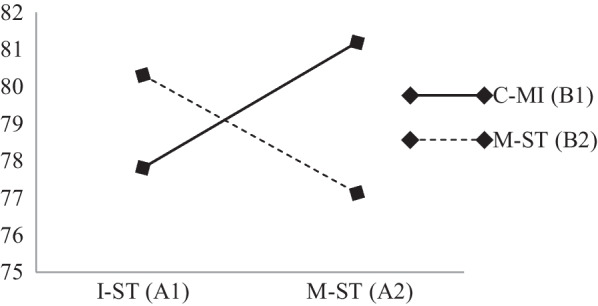
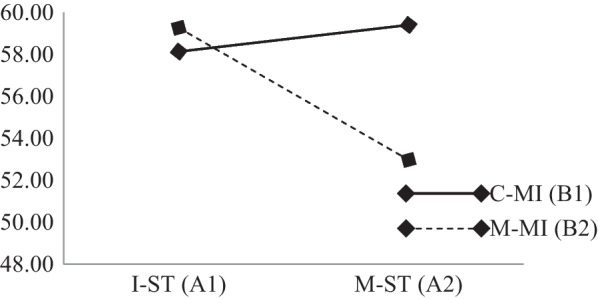
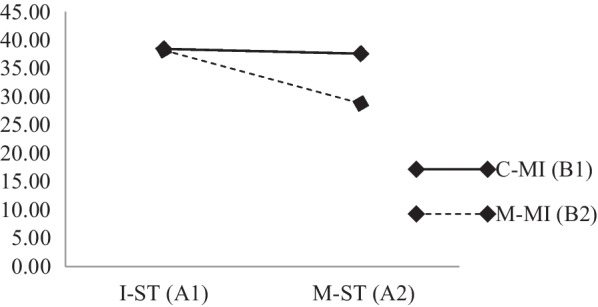
The S.T. and MI strategies had a significant effect on BMS and S.C. mastery (independent and interaction functions) in multivariate and univariate ways; however, independently, they had no significant effect on S.C. The effect of I-S.T. > M-S.T. and the effect of C-MI > M-MI on BMS, but there was no difference in S.C. In the I-S.T. condition, the C-MI and M-MI strategies did not have a different interaction effect on BMS mastery, but the effect of M-MI > C-MI on S.C. In the M-S.T. condition, the effect of C-MI > M-MI on the BMS and S.C. mastery. In the C-MI condition, the I-S.T. and M-S.T. strategies did not have a different interaction effect on BMS mastery, but the effect of M-S.T. > I-ST on S.C. In the M-MI condition, the effect of I-S.T. > M-S.T. on the BMS and S.C. mastery.
The results of this study contribute to the existing evidence on the effectiveness of S.T. and MI strategies in the motor skill mastery and psychological skill development of beginner student-athletes. Thus, S.T. and MI strategies can be adapted as psychological strategies that coaches and physical educators can use to improve beginner student-athlete learning, sports performance, and psychological skills.
自我对话(ST)和心理意象(MI)的心理策略在训练和运动表现中起着重要作用,但它们的实施,特别是结合实施,仍然有限。本研究旨在检验 ST 和 MI 心理策略干预后羽毛球运动技能(BMS)和自信(SC)掌握情况,这些策略被整合到 BMS 训练过程中,具有独立和交互功能。ST 策略包括指导性(I-ST)和激励性(M-ST)功能,而 MI 包括认知(C-MI)和激励(M-MI)方面。
80 名 10-12 岁的青年初学者羽毛球运动员(男性=40 名,女性=40 名)通过不成比例的分层抽样分为四个实验组(EG:2 功能 ST×2 功能 MI)和一个对照组(CG)。干预计划持续八周(每周三次,共 24 次)。参与者在每次会议上完成一次保真度检查。干预结束时,他们进行了 BMS 测试并完成了自信量表。
ST 和 MI 策略在多元和单变量方面对 BMS 和 SC 掌握(独立和交互功能)有显著影响;然而,独立地,它们对 SC 没有显著影响。I-ST>M-S-T 对 BMS 的影响>C-MI>M-MI,但 SC 没有差异。在 I-ST 条件下,C-MI 和 M-MI 策略对 BMS 掌握的交互作用没有不同的效果,但 M-MI>C-MI 对 SC 的影响。在 M-S-T 条件下,C-MI>M-MI 对 BMS 和 SC 掌握的影响。在 C-MI 条件下,I-ST 和 M-S-T 策略对 BMS 掌握的交互作用没有不同的效果,但 M-S-T>I-ST 对 SC 的影响。在 M-MI 条件下,I-ST>M-S-T 对 BMS 和 SC 掌握的影响。
本研究的结果为 ST 和 MI 策略在初学者运动员运动技能掌握和心理技能发展中的有效性提供了现有证据。因此,ST 和 MI 策略可以作为教练和体育教育工作者可以用来提高初学者运动员学习、运动表现和心理技能的心理策略。