Translational Research Center for Hemato-Oncology, Faculty of Medicine, University of Geneva, Geneva, Switzerland.
Swiss Cancer Center Leman, Lausanne, Switzerland.
Leukemia. 2023 Apr;37(4):765-775. doi: 10.1038/s41375-023-01835-x. Epub 2023 Feb 4.
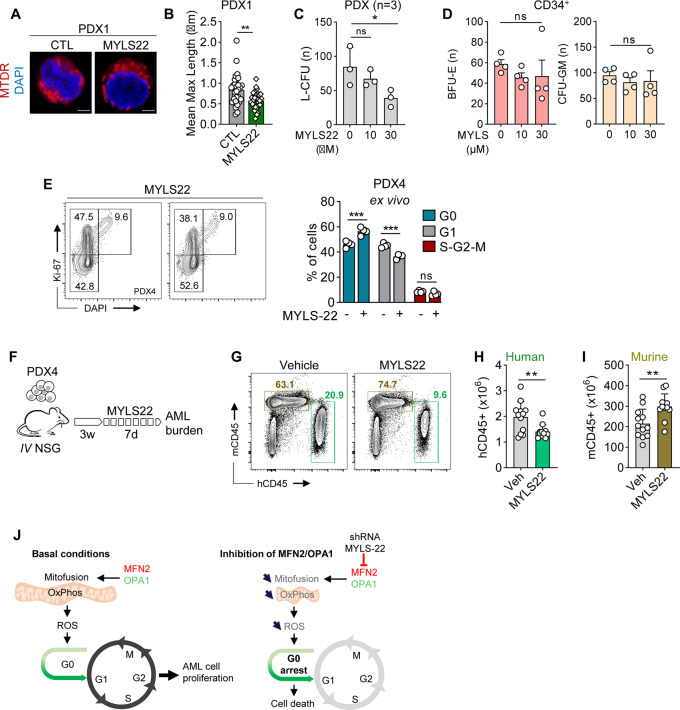
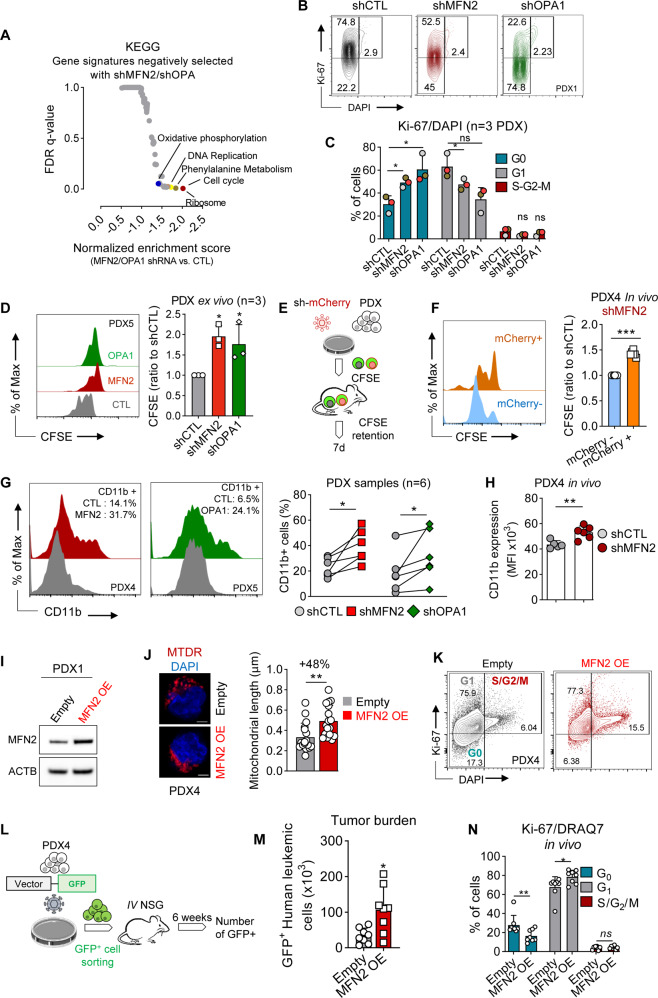
Mitochondrial metabolism recently emerged as a critical dependency in acute myeloid leukemia (AML). The shape of mitochondria is tightly regulated by dynamin GTPase proteins, which drive opposing fusion and fission forces to consistently adapt bioenergetics to the cellular context. Here, we showed that targeting mitochondrial fusion was a new vulnerability of AML cells, when assayed in patient-derived xenograft (PDX) models. Genetic depletion of mitofusin 2 (MFN2) or optic atrophy 1 (OPA1) or pharmacological inhibition of OPA1 (MYLS22) blocked mitochondrial fusion and had significant anti-leukemic activity, while having limited impact on normal hematopoietic cells ex vivo and in vivo. Mechanistically, inhibition of mitochondrial fusion disrupted mitochondrial respiration and reactive oxygen species production, leading to cell cycle arrest at the G/G transition. These results nominate the inhibition of mitochondrial fusion as a promising therapeutic approach for AML.
线粒体代谢最近成为急性髓系白血病 (AML) 的一个关键依赖性。线粒体的形状由动力蛋白 GTPase 蛋白严格调节,该蛋白驱动相反的融合和裂变力,使生物能量学始终适应细胞环境。在这里,我们在患者来源的异种移植 (PDX) 模型中表明,靶向线粒体融合是 AML 细胞的一个新的脆弱性。线粒体融合蛋白 2 (MFN2) 或视神经萎缩症 1 (OPA1) 的基因缺失或 OPA1 的药理学抑制 (MYLS22) 阻断线粒体融合并具有显著的抗白血病活性,而对正常造血细胞在体外和体内的影响有限。从机制上讲,抑制线粒体融合会破坏线粒体呼吸和活性氧的产生,导致细胞周期在 G1/G0 期停滞。这些结果表明,抑制线粒体融合是治疗 AML 的一种很有前途的方法。