Almazov National Medical Research Centre, 197341, St. Petersburg, Russia.
The Republic of Karelia "The Republic TB Healthcare Dispensary", 185032, Petrozavodsk, Russia.
J Epidemiol Glob Health. 2023 Mar;13(1):11-22. doi: 10.1007/s44197-023-00085-5. Epub 2023 Feb 6.
Because of the COVID-19 pandemic, many support programs for tuberculosis (TB) patients have been discontinued and TB mass screening activities decreased worldwide, resulting in a decrease in new case detection and an increase in TB deaths (WHO, WHO global lists of high burden countries for TB, multidrug/rifampicin-resistant TB (MDR/RR-TB) and TB/HIV, 2021-2025, 2021). The study aimed to assess changes in epidemiological indicators of tuberculosis in the Russian Federation and to simulate these indicators in the post-COVID-19 period.
The main epidemiological indicators of tuberculosis were analyzed with the use of government statistical data for the period from 2009 to 2021. Further mathematical modeling of epidemiological indicators for the coming years was carried out, taking into account the TB screening by chest X-ray. Statistical analysis was carried out using the software environment R (v.3.5.1) for statistical computing and the commercial software Statistical Package for the Social Sciences (SPSS Statistics for Windows, version 24.0, IBM Corp., 2016). Time series forecasting was performed using the programming language for statistical calculations R, version 4.1.2 and the bsts package, version 0.9.8.
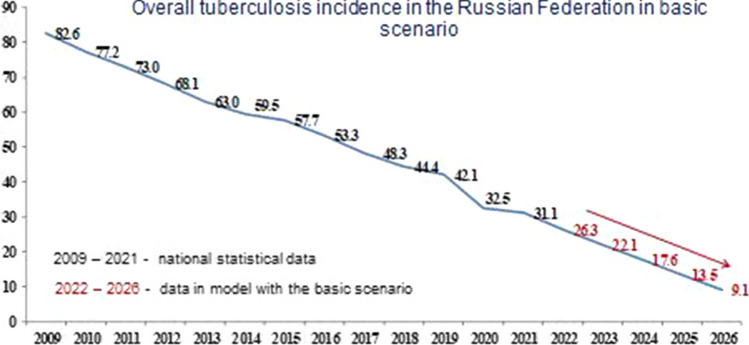
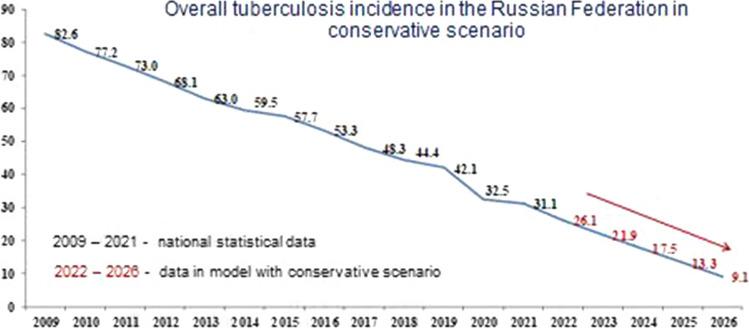
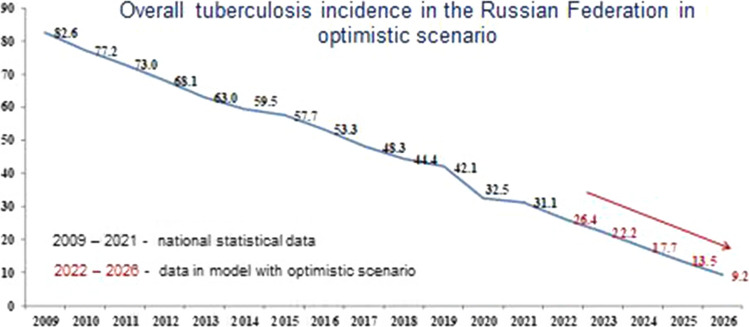
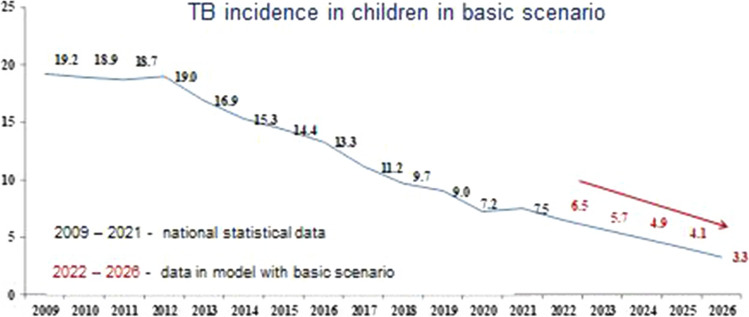
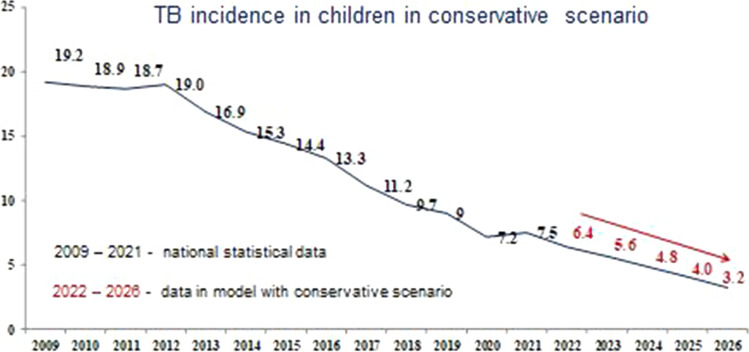
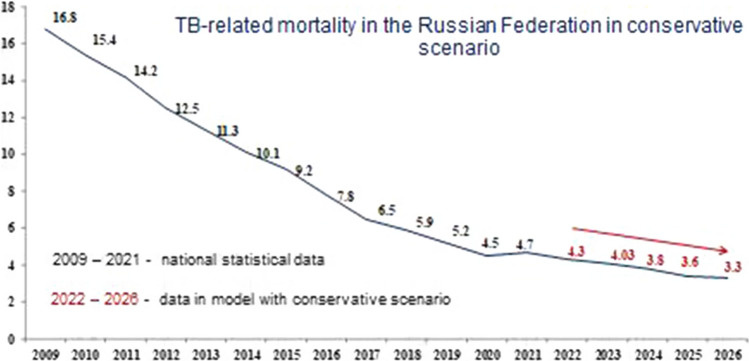
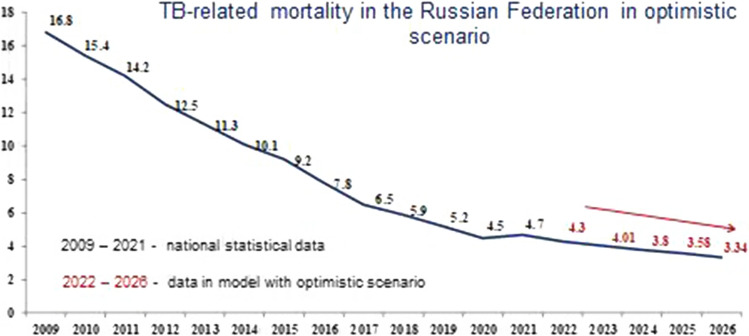
The study has found that the mean regression coefficient of a single predictor differs in the model for TB incidence and mortality (0.0098 and 0.0002, respectively). Forecast of overall incidence, the incidence of children and the forecast for mortality using the basic scenario (screening 75-78%) for the period from 2022 to 2026 was characterized by a mean decrease rate of 23.1%, 15.6% and 6.0% per year, respectively. A conservative scenario (screening 47-63%) of overall incidence indicates that the incidence of children and the forecast for mortality will continue to decrease with a mean decrease rate of 23.2%, 15.6% and 6.0% per year, respectively. Comparable data were obtained from the forecast of overall incidence, the incidence of children and the forecast for mortality using the optimistic scenario (screening 82-89%) with a mean decrease rate of 22.9%, 15.4% and 6.0% per year, respectively.
It has been proven that the significance of screening with chest X-ray as a predictor of mortality is minimal. However, TB screening at least 60% of the population (chest X-ray in adults and immunological tests in children) have provided relationship between the TB screening rate and TB mortality rate (TB mortality rate increases with an increase in the population coverage and, conversely, decreases with a decrease in the population coverage).
由于 COVID-19 大流行,许多结核病 (TB) 患者的支持计划已经停止,全球范围内的结核病大规模筛查活动减少,导致新发病例的检出率下降和结核病死亡人数增加(世卫组织,世卫组织高负担国家结核病、耐多药/利福平耐药结核病 (MDR/RR-TB) 和结核病/艾滋病全球清单,2021-2025 年,2021 年)。本研究旨在评估俄罗斯联邦结核病的主要流行病学指标的变化,并模拟 COVID-19 后时期的这些指标。
使用政府统计数据,对 2009 年至 2021 年期间结核病的主要流行病学指标进行了分析。进一步对未来几年的流行病学指标进行了数学建模,考虑到了胸部 X 光检查的结核病筛查。使用统计计算软件环境 R(v.3.5.1)和商业软件 Statistical Package for the Social Sciences(适用于 Windows 的 SPSS Statistics 版本 24.0,IBM Corp.,2016 年)进行了统计分析。使用编程语言 R for statistical calculations,版本 4.1.2 和 bsts 包,版本 0.9.8 进行时间序列预测。
研究发现,TB 发病率和死亡率模型中单预测因子的平均回归系数不同(分别为 0.0098 和 0.0002)。使用基本方案(筛查率 75-78%)对 2022 年至 2026 年期间的总体发病率、儿童发病率和死亡率进行预测,其平均每年下降率分别为 23.1%、15.6%和 6.0%。保守方案(筛查率 47-63%)的总体发病率表明,儿童发病率和死亡率预测将继续下降,平均每年下降率分别为 23.2%、15.6%和 6.0%。使用乐观方案(筛查率 82-89%)进行的总体发病率、儿童发病率和死亡率预测也得到了类似的数据,其平均每年下降率分别为 22.9%、15.4%和 6.0%。
已经证明,胸部 X 射线筛查作为死亡率预测因子的重要性微不足道。然而,TB 筛查至少 60%的人群(成人胸部 X 射线和儿童免疫测试)已经提供了 TB 筛查率和 TB 死亡率之间的关系(TB 死亡率随着人口覆盖率的增加而增加,反之亦然,随着人口覆盖率的降低而降低)。