Gransbury Gemma K, Réant Benjamin L L, Wooles Ashley J, Emerson-King Jack, Chilton Nicholas F, Liddle Stephen T, Mills David P
Department of Chemistry, The University of Manchester Oxford Road Manchester M13 9PL UK
Chem Sci. 2022 Dec 6;14(3):621-634. doi: 10.1039/d2sc04526e. eCollection 2023 Jan 18.
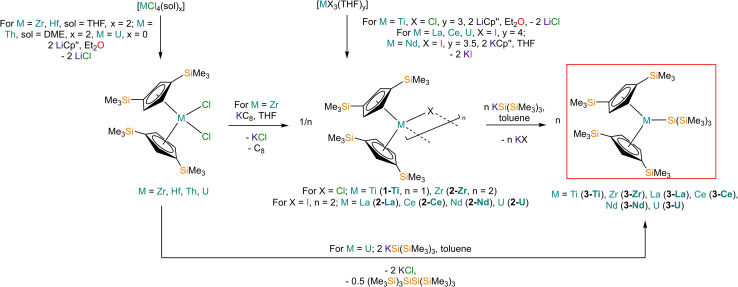
We report the synthesis of the U(iii) bis(cyclopentadienyl) hypersilanide complex [U(Cp''){Si(SiMe)}] (Cp'' = {CH(SiMe)-1,3}), together with isostructural lanthanide and group 4 M(iii) homologues, in order to meaningfully compare metal-silicon bonding between early d- and f-block metals. All complexes were characterised by a combination of NMR, EPR, UV-vis-NIR and ATR-IR spectroscopies, single crystal X-ray diffraction, SQUID magnetometry, elemental analysis and calculations. We find that for the [M(Cp''){Si(SiMe)}] (M = Ti, Zr, La, Ce, Nd, U) series the unique anisotropy axis is conserved tangential to ; this is governed by the hypersilanide ligand for the d-block complexes to give easy plane anisotropy, whereas the easy axis is fixed by the two Cp'' ligands in f-block congeners. This divergence is attributed to hypersilanide acting as a strong σ-donor and weak π-acceptor with the d-block metals, whilst f-block metals show predominantly electrostatic bonding with weaker π-components. We make qualitative comparisons on the strength of covalency to derive the ordering Zr > Ti ≫ U > Nd ≈ Ce ≈ La in these complexes, using a combination of analytical techniques. The greater covalency of 5f U(iii) 4f Nd(iii) is found by comparison of their EPR and electronic absorption spectra and magnetic measurements, with calculations indicating that uranium 5f orbitals have weak π-bonding interactions with both the silanide and Cp'' ligands, in addition to weak δ-antibonding with Cp''.
我们报道了铀(III)双(环戊二烯基)超硅化物配合物[U(Cp''){Si(SiMe)}](Cp'' = {CH(SiMe)-1,3})以及同结构的镧系和第4族M(III)同系物的合成,以便有意义地比较早期d区和f区金属之间的金属 - 硅键。所有配合物均通过核磁共振、电子顺磁共振、紫外 - 可见 - 近红外和衰减全反射红外光谱、单晶X射线衍射、超导量子干涉仪磁力测量、元素分析和计算等多种方法进行了表征。我们发现,对于[M(Cp''){Si(SiMe)}](M = Ti、Zr、La、Ce、Nd、U)系列,独特的各向异性轴与……相切保持不变;对于d区配合物,这由超硅化物配体决定,产生易平面各向异性,而对于f区同系物,易轴由两个Cp''配体固定。这种差异归因于超硅化物与d区金属作用时作为强σ供体和弱π受体,而f区金属主要表现为具有较弱π成分的静电键合。我们使用多种分析技术对共价性强度进行了定性比较,得出这些配合物中Zr > Ti ≫ U > Nd ≈ Ce ≈ La的顺序。通过比较它们的电子顺磁共振和电子吸收光谱以及磁性测量,发现5f的U(III)比4f的Nd(III)具有更大的共价性,计算表明铀的5f轨道除了与Cp''有弱的δ反键外,还与硅化物和Cp''配体有弱π键相互作用。