Department of Surgical Pathology, Affiliated Hangzhou First People's Hospital, Zhejiang University School of Medicine, Hangzhou, Zhejiang, China.
Pathol Oncol Res. 2023 Jan 20;29:1610785. doi: 10.3389/pore.2023.1610785. eCollection 2023.
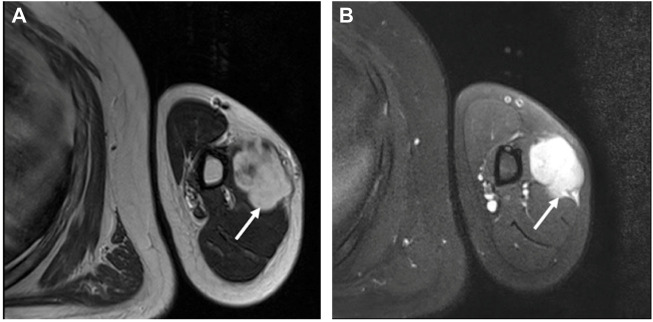
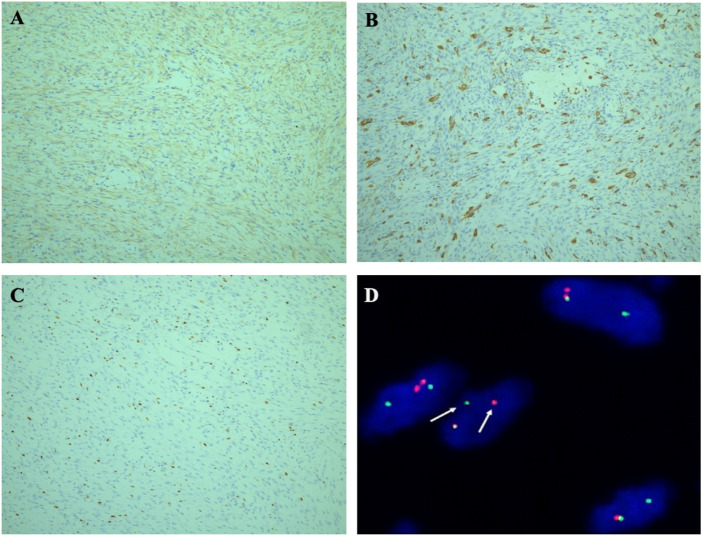
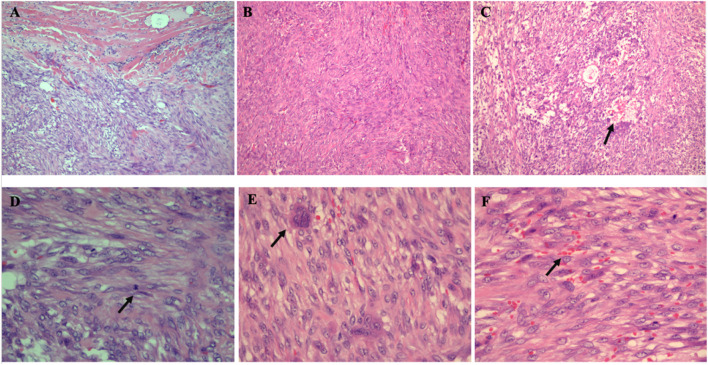
The intramuscular subtype of nodular fasciitis (NF) is rare with lesions normally not more than 2 cm in size and characterized by pseudosarcomatous morphology. We report a case of a 27-year-old man with a large-size intramuscular NF. The patient came for treatment complaining of an increasingly enlarged mass in the left upper arm for 4 months. Magnetic resonance imaging (MRI) confirmed the presence of a well-defined tumor measuring 5 cm within the outer edge of the middle humerus. Microscopically, the neoplasm was rich in fibroblasts and myofibroblasts in an interlaced pattern with high mitotic index and evident multinuclear giant cells. Erythrocyte extravasation was easily seen in the stroma. The tumor border was infiltrative. Immunohistochemically, the tumor cells were positive for smooth muscle actin (SMA) and negative for cytokeratin, desmin, H-Caldesmon, CD34, S100, ALK, and -catenin. Fibrosarcoma was highly suspected by histopathological and immunohistochemical examination. Molecular detection demonstrated evidence of ubiquitin-specific peptidase 6 (USP6) gene rearrangement in this tumor. Based on the findings, the tumor was diagnosed as intramuscular NF. At 56 months after the initial surgery, the patient had recovered with no evidence of recurrence or metastasis. Large-size intramuscular NF is very rare and easily overdiagnosed as malignant tumor due to its obvious pseudosarcomatoid pathological features. USP6 gene rearrangement detection can effectively avoid this major misdiagnosis.
肌内型结节性筋膜炎(NF)较为罕见,病变通常不超过 2cm,其特征为假肉瘤样形态。我们报告一例 27 岁男性患者,其患有大尺寸肌内型 NF。该患者因左上臂逐渐增大的肿块 4 个月来就诊。磁共振成像(MRI)证实肱骨中段外缘有一个边界清楚的肿瘤,大小为 5cm。显微镜下,该肿瘤富含成纤维细胞和肌纤维母细胞,呈交织模式,有高有丝分裂指数和明显的多核巨细胞。基质中易见红细胞外渗。肿瘤边界呈浸润性。免疫组织化学染色显示,肿瘤细胞 SMA 阳性,细胞角蛋白、结蛋白、H-Caldesmon、CD34、S100、ALK 和β-连环蛋白阴性。组织病理学和免疫组织化学检查高度怀疑纤维肉瘤。分子检测显示该肿瘤存在泛素特异性肽酶 6(USP6)基因重排。根据这些发现,诊断为肌内型 NF。在初次手术后 56 个月,患者恢复良好,无复发或转移证据。大尺寸肌内型 NF 非常罕见,由于其明显的假肉瘤样病理特征,很容易被误诊为恶性肿瘤。USP6 基因重排检测可有效避免这种主要误诊。