Mallah Santosh Ramagya, Behera Sachidananda, Sharma Atul, Agrawal Amit, Bhardwaj Rajneesh
Department of Mechanical Engineering, Indian Institute of Technology Bombay, Mumbai, 400076 India.
Trans Indian Natl Acad Eng. 2023;8(1):171-182. doi: 10.1007/s41403-023-00387-x. Epub 2023 Jan 31.
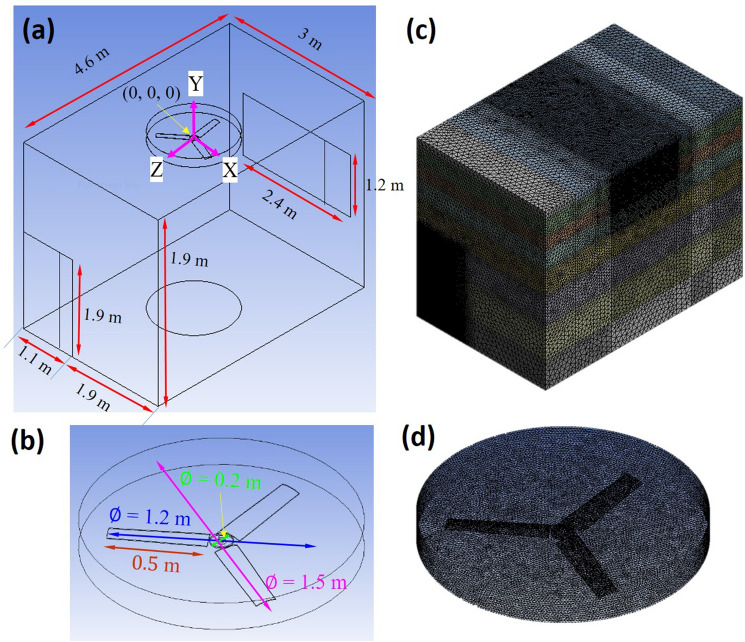
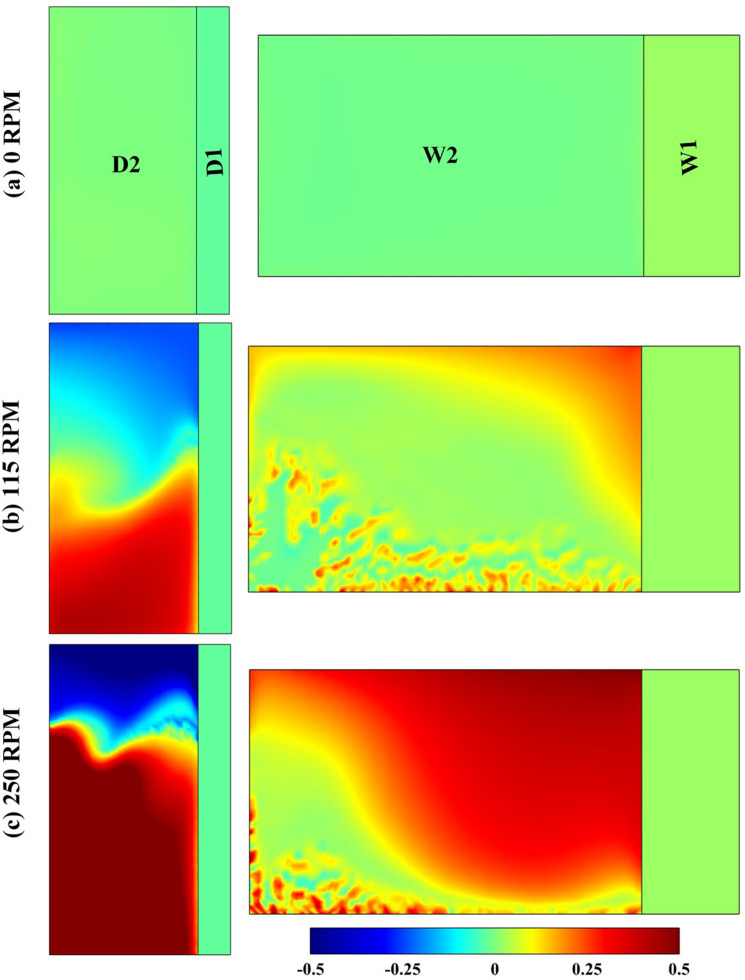
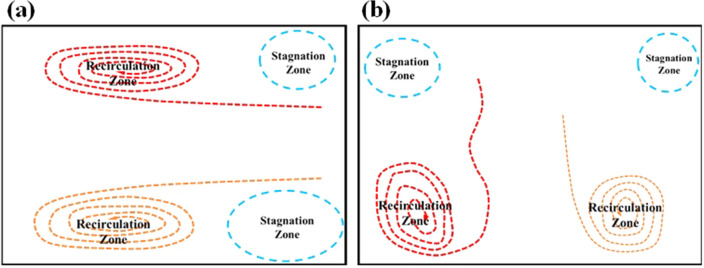
Improving air flow and ventilation in an indoor environment is central to mitigating the airborne transmission of aerosols. Examples include, COVID-19 or similar diseases that transmit by airborne aerosols or respiratory droplets. While there are standard guidelines for enhancing the ventilation of space, the effect of a ceiling fan on the ventilation has not been explored. Such an intervention could be critical, especially in a resource-limited setting. In the present work, we numerically study the effect of a rotating ceiling fan on indoor air ventilation using computational fluid dynamics (CFD) simulations. In particular, we employ RANS turbulence model and compare the computed flow fields for a stationary and rotating fan in an office room with a door and window. While a re-circulation zone spans the whole space for the stationary fan, stronger re-circulation zones and small stagnation zones appear in the flow-field inside the room for the case of a rotating fan. The re-circulation zones help bring in fresh air through the window and remove stale air through the door, thereby improving the ventilation rate by one order of magnitude. We briefly discuss the chances of infection by aerosols via flow-fields corresponding to stationary and rotating fans.
改善室内环境中的气流和通风对于减轻气溶胶的空气传播至关重要。例如,新冠病毒或其他通过空气传播的气溶胶或呼吸道飞沫传播的类似疾病。虽然有增强空间通风的标准指南,但尚未探讨吊扇对通风的影响。这种干预可能至关重要,尤其是在资源有限的环境中。在本研究中,我们使用计算流体动力学(CFD)模拟对旋转吊扇对室内空气通风的影响进行了数值研究。具体而言,我们采用雷诺平均 Navier-Stokes(RANS)湍流模型,并比较了在有门和窗的办公室房间中,固定风扇和旋转风扇的计算流场。对于固定风扇,回流区贯穿整个空间,而对于旋转风扇的情况,在房间内部的流场中出现了更强的回流区和小停滞区。回流区有助于通过窗户引入新鲜空气,并通过门排出陈旧空气,从而将通风率提高了一个数量级。我们简要讨论了通过与固定风扇和旋转风扇对应的流场产生气溶胶感染的可能性。