Remmington Christopher, Barrett Nicholas A, Agarwal Sangita, Lams Boris, Collins Patrick, Camarda Valentina, Meadows Chris, Hanks Fraser, Sanderson Barnaby, Retter Andrew, Camporota Luigi
Pharmacy Department, Guy's and St Thomas' NHS Foundation Trust, London, UK.
Institute of Pharmaceutical Science, King's College London, London, UK.
BJA Open. 2023 Mar;5:100128. doi: 10.1016/j.bjao.2023.100128. Epub 2023 Jan 31.
Corticosteroids are used to treat COVID-19 pneumonia. However, the optimal dose is unclear. This study describes the association between corticosteroid exposure with disease severity and outcome in COVID-19 pneumonia.
This is a single-centre retrospective, observational study including adult ICU patients who received systemic corticosteroids for COVID-19 pneumonia between March 2020 and March 2021. We recorded patient characteristics, disease severity, total steroid exposure, respiratory support and gas exchange data, and 90-day mortality.
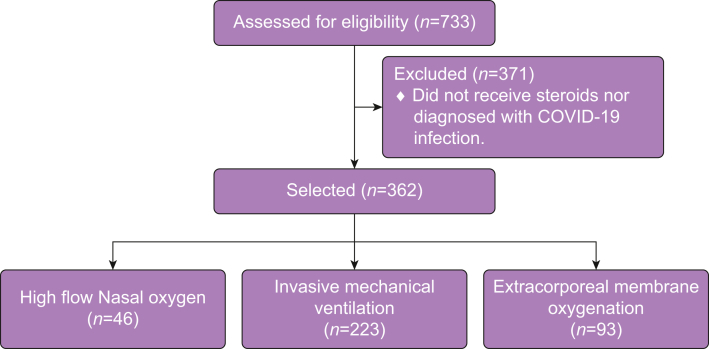
We included 362 patients. We allocated patients to groups with increasing disease severity according to the highest level of respiratory support that they received: high-flow nasal oxygen or continuous positive airway pressure (HFNO/CPAP) in 12.7%, invasive mechanical ventilation (IMV) in 61.6%, and extracorporeal membrane oxygenation (ECMO) in 25.7%. For these three groups, the median (inter-quartile range [IQR]) age was 61 (54-71) 58 (50-66) 46 (38-53) yr, respectively (<0.001); median (IQR) APACHE (Acute Physiology and Chronic Health Evaluation) II scores were 12 (9-15) 14 (12-18) 15 (12-17), respectively (=0.006); the median (IQR) lowest /FiO ratio was 15.1 (11.8-21.7) 15.1 (10.7-22.2) 9.5 (7.9-10.9) kPa, respectively (<0.001). Ninety-day mortality was 9% 27% 37% (=0.002). Median (IQR) dexamethasone-equivalent exposure was 37 (24-62) 174 (86-504) 535 (257-1213) mg (<0.001). 'Pulsed' steroids were administered to 26% of the IMV group and 48% of the ECMO group. Patients with higher disease severity who received pulse steroids had a higher 90-day mortality.
Corticosteroid exposure increased with the severity of COVID-19 pneumonia. Pulsed dose steroids were used more frequently in patients receiving greater respiratory support. Future studies should address patient selection and outcomes associated with pulsed dose steroids in patients with severe and deteriorating COVID-19 pneumonia.
皮质类固醇用于治疗新型冠状病毒肺炎(COVID-19肺炎)。然而,最佳剂量尚不清楚。本研究描述了皮质类固醇暴露与COVID-19肺炎疾病严重程度及预后之间的关联。
这是一项单中心回顾性观察性研究,纳入了2020年3月至2021年3月期间因COVID-19肺炎接受全身皮质类固醇治疗的成年重症监护病房(ICU)患者。我们记录了患者特征、疾病严重程度、皮质类固醇总暴露量、呼吸支持和气体交换数据以及90天死亡率。
我们纳入了362例患者。根据患者接受的最高级别的呼吸支持,将患者分为疾病严重程度递增的组:接受高流量鼻导管给氧或持续气道正压通气(HFNO/CPAP)的患者占12.7%,接受有创机械通气(IMV)的患者占61.6%,接受体外膜肺氧合(ECMO)的患者占25.7%。对于这三组患者,年龄中位数(四分位间距[IQR])分别为61(54 - 71)岁、58(50 - 66)岁、46(38 - 53)岁(<0.001);急性生理与慢性健康状况评价(APACHE)II评分中位数(IQR)分别为12(9 - 15)、14(12 - 18)、15(12 - 17)(=0.006);最低氧合指数(PaO₂/FiO₂)中位数(IQR)分别为15.1(11.8 - 21.7)kPa、15.1(10.7 - 22.2)kPa、9.5(7.9 - 10.9)kPa(<0.001)。90天死亡率分别为9%、27%、37%(=0.002)。地塞米松等效暴露量中位数(IQR)分别为37(24 - 62)mg(<0.001)、174(86 - 504)mg(<0.001)、535(257 - 1213)mg(<0.001)。IMV组26%的患者和ECMO组48%的患者接受了“脉冲式”皮质类固醇治疗。接受脉冲式皮质类固醇治疗的疾病严重程度较高的患者90天死亡率更高。
皮质类固醇暴露量随COVID-19肺炎严重程度增加而增加。在接受更强呼吸支持的患者中,脉冲剂量皮质类固醇使用更为频繁。未来的研究应探讨重症及病情恶化的COVID-19肺炎患者中脉冲剂量皮质类固醇的患者选择及相关预后。