Department of Laboratory Medicine, Shanghai Public Health Clinical Center, Fudan University, Shanghai, China.
Department of Biochemistry and Microbiology, School of Environmental and Biological Sciences and Center for Microbiome, Nutrition, and Health, New Jersey Institute for Food, Nutrition, and Health, Rutgers, The State University of New Jersey, New Brunswick, New Jersey, USA.
mBio. 2023 Feb 28;14(1):e0351922. doi: 10.1128/mbio.03519-22. Epub 2023 Feb 6.
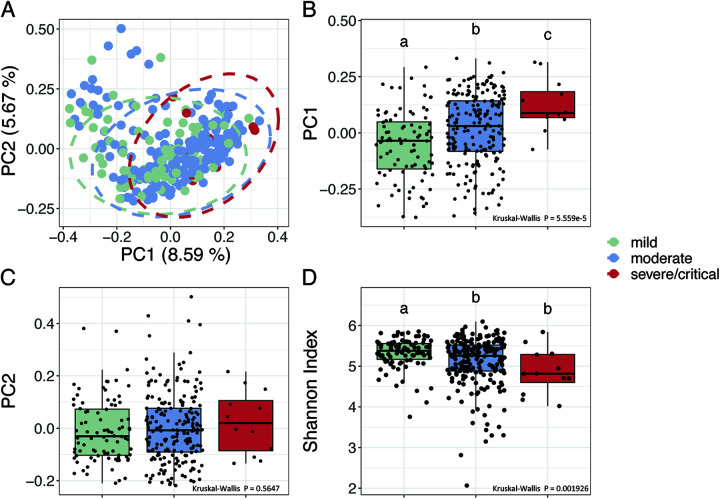
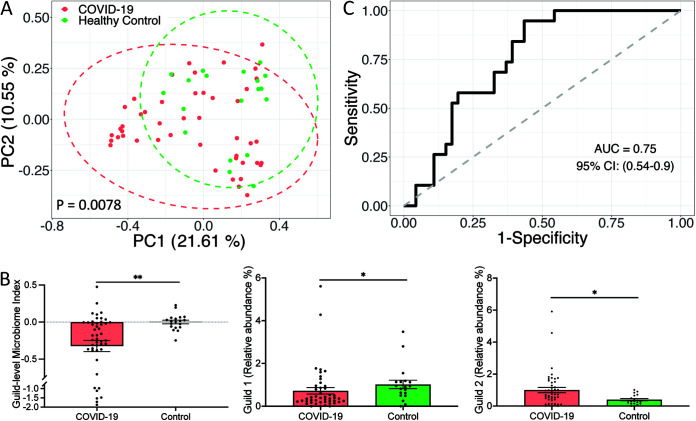
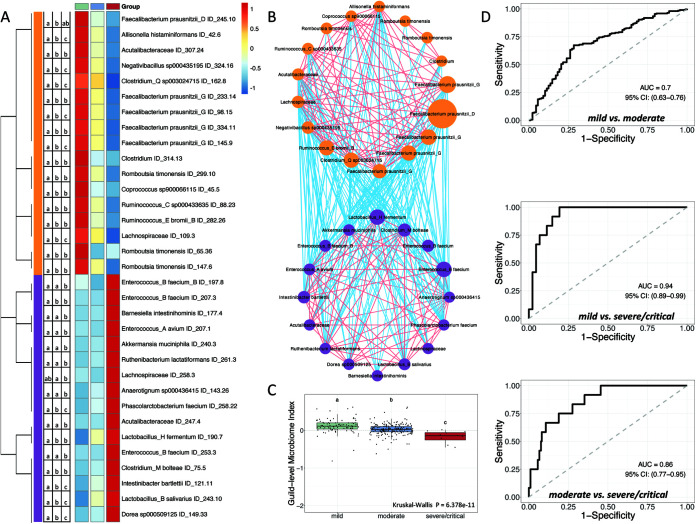
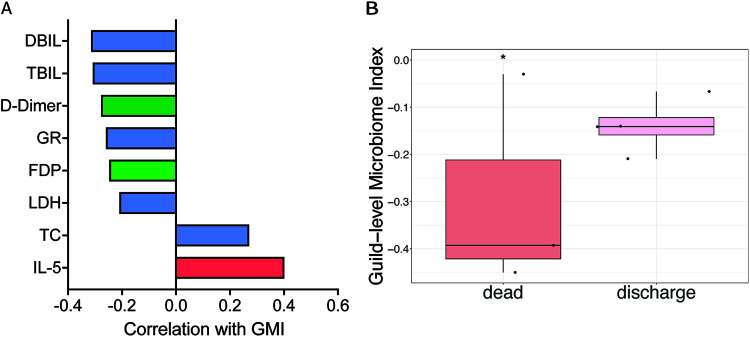
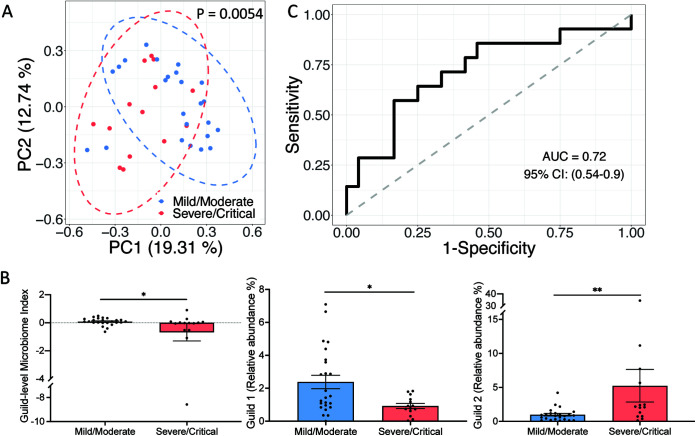
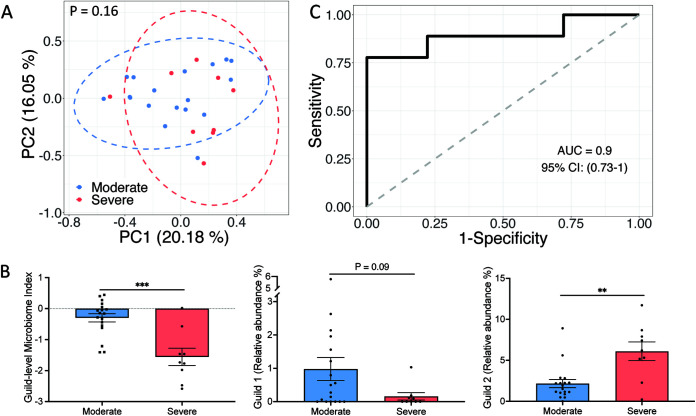
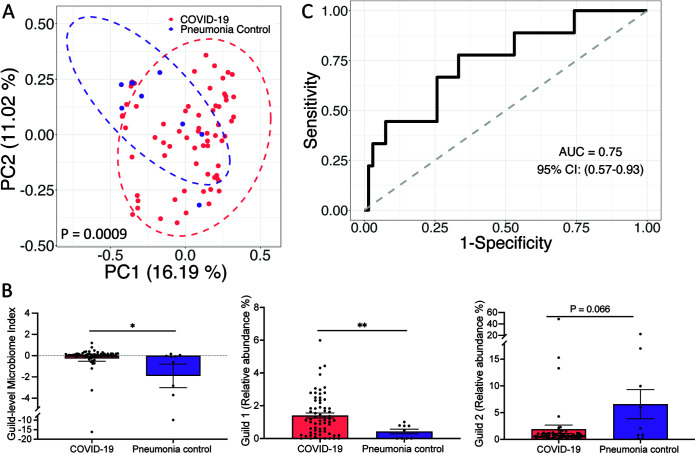
Coronavirus disease 2019 (COVID-19) severity has been associated with alterations of the gut microbiota. However, the relationship between gut microbiome alterations and COVID-19 prognosis remains elusive. Here, we performed a genome-resolved metagenomic analysis on fecal samples from 300 in-hospital COVID-19 patients, collected at the time of admission. Among the 2,568 high quality metagenome-assembled genomes (HQMAGs), redundancy analysis identified 33 HQMAGs which showed differential distribution among mild, moderate, and severe/critical severity groups. Co-abundance network analysis determined that the 33 HQMAGs were organized as two competing guilds. Guild 1 harbored more genes for short-chain fatty acid biosynthesis, and fewer genes for virulence and antibiotic resistance, compared with Guild 2. Based on average abundance difference between the two guilds, the guild-level microbiome index (GMI) classified patients from different severity groups (average AUROC [area under the receiver operating curve] = 0.83). Moreover, age-adjusted partial Spearman's correlation showed that GMIs at admission were correlated with 8 clinical parameters, which are predictors for COVID-19 prognosis, on day 7 in hospital. In addition, GMI at admission was associated with death/discharge outcome of the critical patients. We further validated that GMI was able to consistently classify patients with different COVID-19 symptom severities in different countries and differentiated COVID-19 patients from healthy subjects and pneumonia controls in four independent data sets. Thus, this genome-based guild-level signature may facilitate early identification of hospitalized COVID-19 patients with high risk of more severe outcomes at time of admission. Previous reports on the associations between COVID-19 and gut microbiome have been constrained by taxonomic-level analysis and overlook the interaction between microbes. By applying a genome-resolved, reference-free, guild-based metagenomic analysis, we demonstrated that the relationship between gut microbiota and COVID-19 is genome-specific instead of taxon-specific or even species-specific. Moreover, the COVID-19-associated genomes were not independent but formed two competing guilds, with Guild 1 potentially beneficial and Guild 2 potentially more detrimental to the host based on comparative genomic analysis. The dominance of Guild 2 over Guild 1 at time of admission was associated with hospitalized COVID-19 patients at high risk for more severe outcomes. Moreover, the guild-level microbiome signature is not only correlated with the symptom severity of COVID-19 patients, but also differentiates COVID-19 patients from pneumonia controls and healthy subjects across different studies. Here, we showed the possibility of using genome-resolved and guild-level microbiome signatures to identify hospitalized COVID-19 patients with a high risk of more severe outcomes at the time of admission.
新型冠状病毒疾病 2019(COVID-19)的严重程度与肠道微生物群的改变有关。然而,肠道微生物组的改变与 COVID-19 的预后之间的关系仍然难以捉摸。在这里,我们对 300 名住院 COVID-19 患者入院时采集的粪便样本进行了基于基因组的宏基因组分析。在 2568 个高质量的宏基因组组装基因组(HQMAG)中,冗余分析确定了 33 个 HQMAG,它们在轻度、中度和重度/危重症组之间存在差异分布。共丰度网络分析确定,33 个 HQMAG 组织成两个竞争的公会。与公会 2 相比,公会 1 具有更多的短链脂肪酸生物合成基因,而更少的毒力和抗生素耐药基因。基于两个公会之间的平均丰度差异,基于菌群的微生物组指数(GMI)将不同严重程度组的患者进行分类(平均 AUROC[接受者操作特征曲线下的面积]为 0.83)。此外,年龄调整后的部分 Spearman 相关性表明,入院时的 GMIs 与住院 7 天内 8 个临床参数相关,这些参数是 COVID-19 预后的预测因子。此外,入院时的 GMI 与危重症患者的死亡/出院结局相关。我们进一步验证了 GMI 能够在不同国家和四个独立数据集的 COVID-19 患者和肺炎对照组中一致地对不同 COVID-19 症状严重程度的患者进行分类。因此,这种基于基因组的公会级特征可能有助于在入院时早期识别具有更高严重后果风险的住院 COVID-19 患者。以前关于 COVID-19 与肠道微生物组之间关联的报告受到分类分析的限制,忽略了微生物之间的相互作用。通过应用基于基因组、无参考、基于公会的宏基因组分析,我们证明了肠道微生物组与 COVID-19 之间的关系是基于基因组的,而不是基于分类群,甚至是基于物种的。此外,COVID-19 相关基因组不是独立的,而是形成了两个竞争的公会,基于比较基因组分析,公会 1 可能对宿主有益,而公会 2 可能更有害。入院时公会 2 对公会 1 的优势与住院 COVID-19 患者发生更严重后果的风险较高有关。此外,公会级微生物组特征不仅与 COVID-19 患者的症状严重程度相关,而且还可以区分不同研究中的 COVID-19 患者、肺炎对照组和健康受试者。在这里,我们展示了使用基于基因组的和公会级微生物组特征来识别入院时具有更高严重后果风险的住院 COVID-19 患者的可能性。