Wanner Christoph, Busch Martin
Medizinische Klinik und Poliklinik I, Universitätsklinikum Würzburg, Oberdürrbacher Str. 6, 97080, Würzburg, Deutschland.
Klinik für Innere Medizin III, Universitätsklinikum Jena, Am Klinikum 1, 07747, Jena, Deutschland.
Inn Med (Heidelb). 2023 Mar;64(3):219-224. doi: 10.1007/s00108-023-01485-2. Epub 2023 Feb 6.
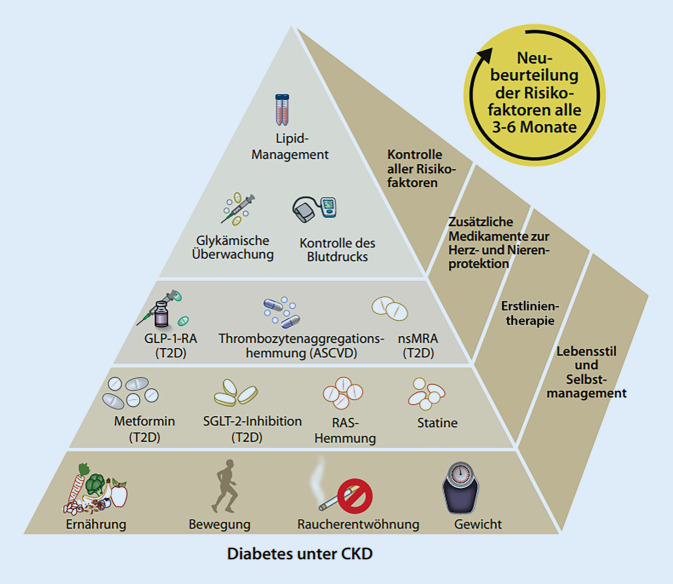
In autumn 2022, an update of the Kidney Disease: Improving Global Outcomes (KDIGO) Clinical Practice Guideline on diabetes management in chronic kidney disease (CKD) was published. This article presents in a clear manner and discusses the new aspects compared to the 2020 guideline. Innovations are seen in the area of general and all-encompassing treatment as well as in relation to blood glucose-lowering and organ-protective treatments with sodium-glucose cotransporter 2 inhibitors, non-steroidal mineralocorticoid receptor antagonists, and glucagon-like peptide‑1 receptor agonists. A new feature is also the top 10 recommendations on diabetes management in CKD for both patients and physicians. The KDIGO guideline on diabetes management in CKD represents the current evidence-based standard of care for patients with diabetes mellitus and CKD. It is now important to implement the guideline in order to provide patients with the benefits of the treatments and thus improve their lives.
2022年秋季,《改善全球肾脏病预后(KDIGO)慢性肾脏病糖尿病管理临床实践指南》进行了更新。本文清晰地呈现并讨论了与2020年指南相比的新内容。在综合全面治疗领域以及使用钠-葡萄糖协同转运蛋白2抑制剂、非甾体类盐皮质激素受体拮抗剂和胰高血糖素样肽-1受体激动剂进行降糖和器官保护治疗方面都有创新。一个新特点是针对患者和医生的慢性肾脏病糖尿病管理十大建议。KDIGO慢性肾脏病糖尿病管理指南代表了目前糖尿病和慢性肾脏病患者基于证据的护理标准。现在重要的是实施该指南,以便为患者带来治疗益处,从而改善他们的生活。