The NOMAD Laboratory at the Fritz-Haber-Institut of the Max-Planck-Gesellschaft and IRIS-Adlershof of the Humboldt-Universität zu Berlin, Faradayweg 4-6, D-14195 Berlin, Germany.
BasCat - UniCat BASF JointLab, Hardenbergstraße 36, D-10623 Berlin, Germany.
J Am Chem Soc. 2023 Feb 15;145(6):3427-3442. doi: 10.1021/jacs.2c11117. Epub 2023 Feb 6.
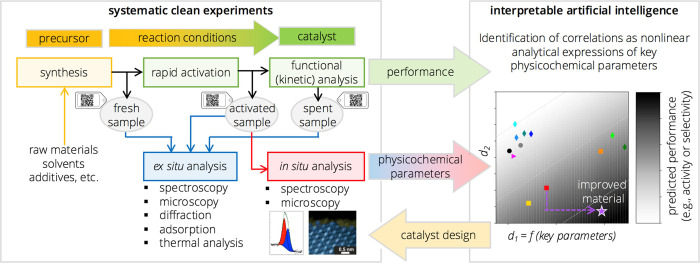
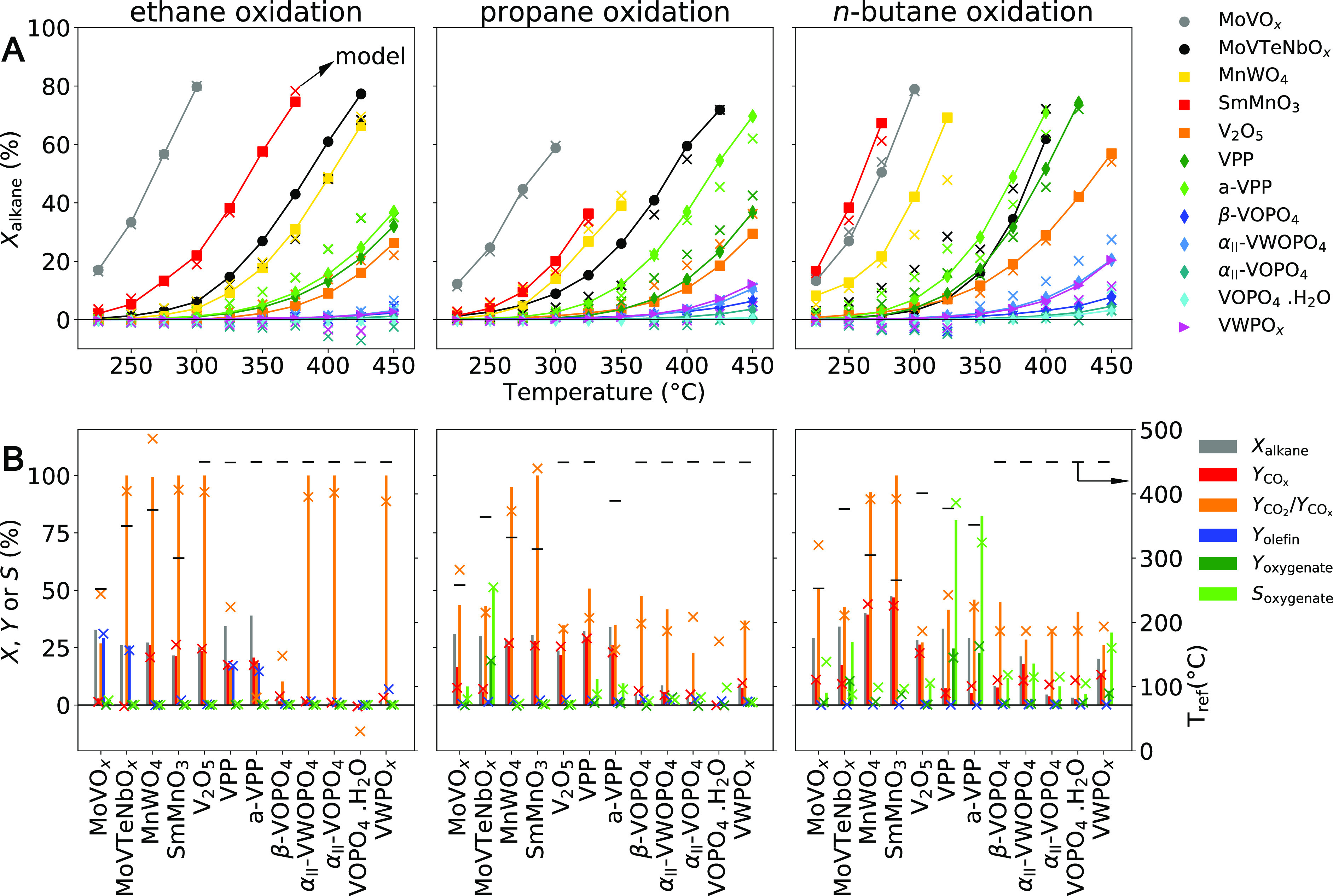
Artificial intelligence (AI) can accelerate catalyst design by identifying key physicochemical descriptive parameters correlated with the underlying processes triggering, favoring, or hindering the performance. In analogy to genes in biology, these parameters might be called "materials genes" of heterogeneous catalysis. However, widely used AI methods require big data, and only the smallest part of the available data meets the quality requirement for data-efficient AI. Here, we use rigorous experimental procedures, designed to consistently take into account the kinetics of the catalyst active states formation, to measure 55 physicochemical parameters as well as the reactivity of 12 catalysts toward ethane, propane, and -butane oxidation reactions. These materials are based on vanadium or manganese redox-active elements and present diverse phase compositions, crystallinities, and catalytic behaviors. By applying the sure-independence-screening-and-sparsifying-operator symbolic-regression approach to the consistent data set, we identify nonlinear property-function relationships depending on several key parameters and reflecting the intricate interplay of processes that govern the formation of olefins and oxygenates: local transport, site isolation, surface redox activity, adsorption, and the material dynamical restructuring under reaction conditions. These processes are captured by parameters derived from N adsorption, X-ray photoelectron spectroscopy (XPS), and near-ambient-pressure in situ XPS. The data-centric approach indicates the most relevant characterization techniques to be used for catalyst design and provides "rules" on how the catalyst properties may be tuned in order to achieve the desired performance.
人工智能 (AI) 可以通过识别与触发、促进或阻碍性能相关的关键物理化学描述性参数,加速催化剂设计。与生物学中的基因类似,这些参数可以被称为多相催化的“材料基因”。然而,广泛使用的 AI 方法需要大数据,而可用数据中只有一小部分满足数据高效 AI 的质量要求。在这里,我们使用严格的实验程序,旨在始终考虑催化剂活性状态形成的动力学,来测量 55 个物理化学参数以及 12 个催化剂对乙烷、丙烷和异丁烷氧化反应的反应性。这些材料基于钒或锰氧化还原活性元素,具有不同的相组成、结晶度和催化行为。通过将严格独立筛选和稀疏运算符符号回归方法应用于一致的数据集,我们确定了依赖于几个关键参数的非线性属性-功能关系,反映了控制烯烃和含氧物形成的复杂相互作用过程:局部传输、位隔离、表面氧化还原活性、吸附以及反应条件下的材料动力学重构。这些过程由 N 吸附、X 射线光电子能谱 (XPS) 和近常压原位 XPS 得出的参数捕捉。以数据为中心的方法指出了最相关的表征技术,用于催化剂设计,并提供了关于如何调整催化剂性能以实现所需性能的“规则”。