Department of Medicine, Johns Hopkins University, Baltimore, Maryland.
Department of Surgery, Division of Urology, University of Pennsylvania, Philadelphia, Pennsylvania.
J Am Soc Nephrol. 2023 May 1;34(5):755-771. doi: 10.1681/ASN.0000000000000063. Epub 2023 Jan 13.
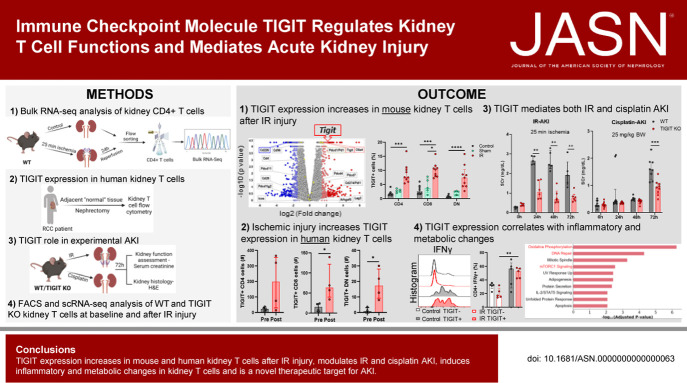
T cells mediate pathogenic and reparative processes during AKI, but the exact mechanisms regulating kidney T cell functions are unclear. This study identified upregulation of the novel immune checkpoint molecule, TIGIT, on mouse and human kidney T cells after AKI. TIGIT-expressing kidney T cells produced proinflammatory cytokines and had effector (EM) and central memory (CM) phenotypes. TIGIT-deficient mice had protection from both ischemic and nephrotoxic AKI. Single-cell RNA sequencing led to the discovery of possible downstream targets of TIGIT. TIGIT mediates AKI pathophysiology, is a promising novel target for AKI therapy, and is being increasingly studied in human cancer therapy trials.
T cells play pathogenic and reparative roles during AKI. However, mechanisms regulating T cell responses are relatively unknown. We investigated the roles of the novel immune checkpoint molecule T cell immunoreceptor with Ig and immunoreceptor tyrosine-based inhibitory motif domains (TIGIT) in kidney T cells and AKI outcomes.
TIGIT expression and functional effects were evaluated in mouse kidney T cells using RNA sequencing (RNA-Seq) and flow cytometry. TIGIT effect on AKI outcomes was studied with TIGIT knockout (TIGIT-KO) mice in ischemia reperfusion (IR) and cisplatin AKI models. Human kidney T cells from nephrectomy samples and single cell RNA sequencing (scRNA-Seq) data from the Kidney Precision Medicine Project were used to assess TIGIT's role in humans.
RNA-Seq and flow cytometry analysis of mouse kidney CD4+ T cells revealed increased expression of TIGIT after IR injury. Ischemic injury also increased TIGIT expression in human kidney T cells, and TIGIT expression was restricted to T/natural killer cell subsets in patients with AKI. TIGIT-expressing kidney T cells in wild type (WT) mice had an effector/central memory phenotype and proinflammatory profile at baseline and post-IR. Kidney regulatory T cells were predominantly TIGIT+ and significantly reduced post-IR. TIGIT-KO mice had significantly reduced kidney injury after IR and nephrotoxic injury compared with WT mice. scRNA-Seq analysis showed enrichment of genes related to oxidative phosphorylation and mTORC1 signaling in Th17 cells from TIGIT-KO mice.
TIGIT expression increases in mouse and human kidney T cells during AKI, worsens AKI outcomes, and is a novel therapeutic target for AKI.
T 细胞在 AKI 期间介导致病和修复过程,但调节肾脏 T 细胞功能的确切机制尚不清楚。本研究在 AKI 后发现新型免疫检查点分子 TIGIT 在小鼠和人肾脏 T 细胞上的上调。表达 TIGIT 的肾脏 T 细胞产生促炎细胞因子,并具有效应(EM)和中央记忆(CM)表型。TIGIT 缺陷型小鼠对缺血性和肾毒性 AKI 均有保护作用。单细胞 RNA 测序导致发现 TIGIT 的可能下游靶标。TIGIT 介导 AKI 病理生理学,是 AKI 治疗的有前途的新靶点,并且在人类癌症治疗试验中越来越受到研究。
T 细胞在 AKI 中发挥致病和修复作用。然而,调节 T 细胞反应的机制尚不清楚。我们研究了新型免疫检查点分子 T 细胞免疫受体与 Ig 和免疫受体酪氨酸基抑制基序域(TIGIT)在肾脏 T 细胞和 AKI 结果中的作用。
使用 RNA 测序(RNA-Seq)和流式细胞术评估小鼠肾脏 T 细胞中的 TIGIT 表达和功能影响。在缺血再灌注(IR)和顺铂 AKI 模型中,使用 TIGIT 敲除(TIGIT-KO)小鼠研究 TIGIT 对 AKI 结果的影响。从肾切除术样本中获取人类肾脏 T 细胞,并使用来自肾脏精准医学项目的单细胞 RNA 测序(scRNA-Seq)数据评估 TIGIT 在人类中的作用。
IR 损伤后,对小鼠肾脏 CD4+T 细胞的 RNA-Seq 和流式细胞术分析显示 TIGIT 表达增加。缺血性损伤也增加了人类肾脏 T 细胞中的 TIGIT 表达,并且在 AKI 患者中 TIGIT 表达局限于 T/自然杀伤细胞亚群。在野生型(WT)小鼠中,表达 TIGIT 的肾脏 T 细胞在基线和 IR 后具有效应/中央记忆表型和促炎特征。肾脏调节性 T 细胞主要是 TIGIT+,IR 后显著减少。与 WT 小鼠相比,TIGIT-KO 小鼠的 IR 和肾毒性损伤后肾损伤明显减少。scRNA-Seq 分析显示,TIGIT-KO 小鼠的 Th17 细胞中与氧化磷酸化和 mTORC1 信号相关的基因富集。
TIGIT 在 AKI 期间在小鼠和人肾脏 T 细胞中表达增加,加重 AKI 结局,是 AKI 的新治疗靶点。