Department of Nursing, West China Hospital, Sichuan University/West China School of Nursing, Sichuan University, Chengdu, China.
Office of Performance Management, Children's Hospital of Chongqing Medical University, Chongqing, China.
Nurs Open. 2023 Jun;10(6):3774-3786. doi: 10.1002/nop2.1635. Epub 2023 Feb 6.
This study aims to explore nursing emergency management system under public health emergencies.
A descriptive qualitative study.
Semi-structured interviews were conducted during March-November 2020 with 11 nursing emergency management administrators from 11 COVID-19 designated hospitals and infectious disease hospitals under four administrative divisions in China, who were recruited through convenience and purposive sampling. Interviews were audio-recorded and transcribed. Data were analysed with Braun and Clarke's inductive thematic analysis. The study adhered to the Consolidated Criteria for Reporting Qualitative Research.
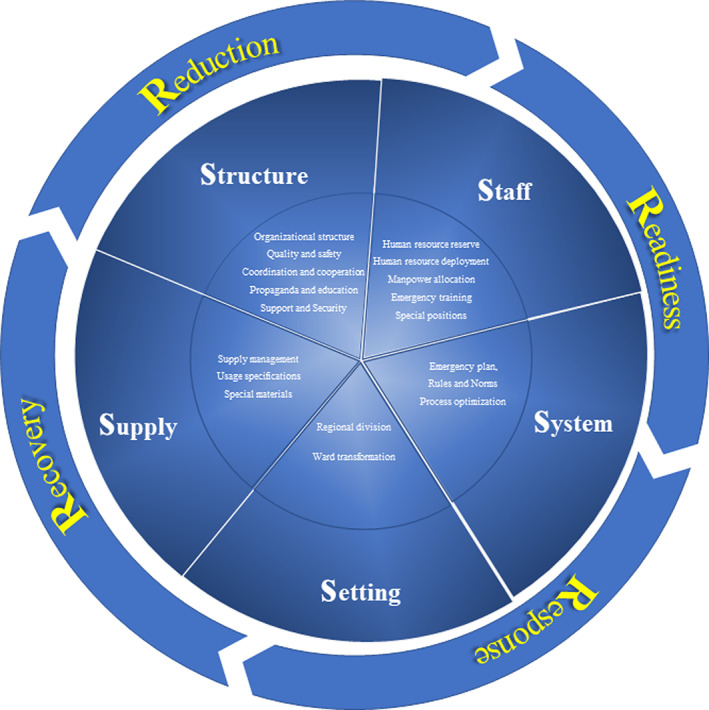
Three main themes emerged from data analysis: (1) Five core elements of nursing emergency management system: Structure, Staff, System, Setting, and Supply (5S); (2) Four phases of nursing emergency management system: Reduction, Readiness, Response and Recovery (4R); and (3) operational process of nursing emergency management system (5S*4R). The findings generated a conceptual model of a nursing emergency management system.
This study provides a theoretical basis for nursing emergency management system for public health emergencies in the future. Nurse administrators could refer to this model to either review or develop their system and develop viable interventions to prepare for future public health emergencies.
本研究旨在探讨突发公共卫生事件下的护理应急管理体系。
描述性定性研究。
2020 年 3 月至 11 月,采用便利抽样和目的抽样的方法,选取中国 4 个行政分区的 11 家新冠定点医院和传染病医院的 11 名护理应急管理管理人员进行半结构式访谈。访谈进行录音和转录。采用 Braun 和 Clarke 的归纳主题分析方法进行数据分析。本研究遵循《定性研究报告的统一标准》。
数据分析得出三个主要主题:(1)护理应急管理体系的 5 个核心要素:结构、人员、系统、设置和供应(5S);(2)护理应急管理体系的 4 个阶段:减少、准备、应对和恢复(4R);(3)护理应急管理体系的运作过程(5S*4R)。研究结果生成了突发公共卫生事件下护理应急管理体系的概念模型。
本研究为未来突发公共卫生事件下的护理应急管理体系提供了理论基础。护理管理人员可以参考该模型来审查或制定他们的体系,并制定可行的干预措施为未来的突发公共卫生事件做好准备。