Raymond William S, Ghaffari Sadaf, Aguilera Luis U, Ron Eric, Morisaki Tatsuya, Fox Zachary R, May Michael P, Stasevich Timothy J, Munsky Brian
School of Biomedical Engineering, Colorado State University, Fort Collins, Colorado, USA.
Department of Computer Science, Colorado State University, Fort Collins, Colorado, USA.
bioRxiv. 2023 Jan 26:2023.01.25.525583. doi: 10.1101/2023.01.25.525583.
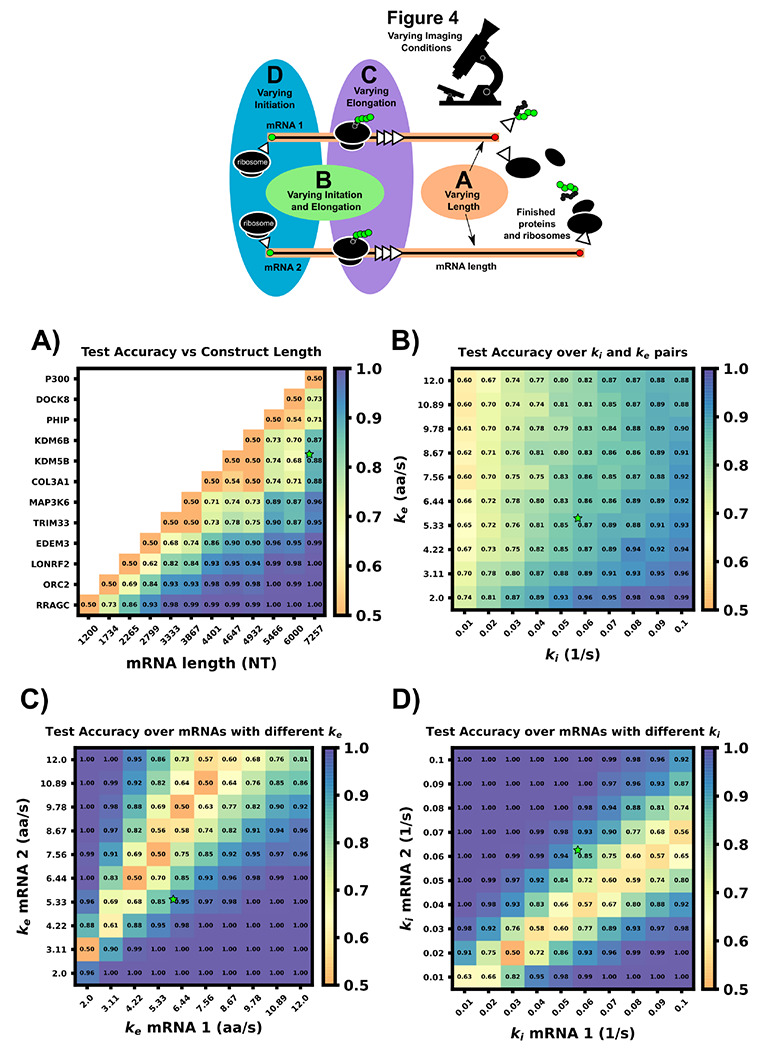
mRNA translation is the ubiquitous cellular process of reading messenger-RNA strands into functional proteins. Over the past decade, large strides in microscopy techniques have allowed observation of mRNA translation at a single-molecule resolution for self-consistent time-series measurements in live cells. Dubbed Nascent chain tracking (NCT), these methods have explored many temporal dynamics in mRNA translation uncaptured by other experimental methods such as ribosomal profiling, smFISH, pSILAC, BONCAT, or FUNCAT-PLA. However, NCT is currently restricted to the observation of one or two mRNA species at a time due to limits in the number of resolvable fluorescent tags. In this work, we propose a hybrid computational pipeline, where detailed mechanistic simulations produce realistic NCT videos, and machine learning is used to assess potential experimental designs for their ability to resolve multiple mRNA species using a single fluorescent color for all species. Through simulation, we show that with careful application, this hybrid design strategy could in principle be used to extend the number of mRNA species that could be watched simultaneously within the same cell. We present a simulated example NCT experiment with seven different mRNA species within the same simulated cell and use our ML labeling to identify these spots with 90% accuracy using only two distinct fluorescent tags. The proposed extension to the NCT color palette should allow experimentalists to access a plethora of new experimental design possibilities, especially for cell signalling applications requiring simultaneous study of multiple mRNAs.
mRNA翻译是将信使RNA链解读为功能蛋白的普遍存在的细胞过程。在过去十年中,显微镜技术取得了长足进步,能够以单分子分辨率观察活细胞中mRNA翻译的自洽时间序列测量。这些方法被称为新生链追踪(NCT),探索了许多mRNA翻译中的时间动态,而这些动态是核糖体分析、单分子荧光原位杂交(smFISH)、脉冲稳定同位素标记氨基酸在细胞培养物中的掺入(pSILAC)、生物正交非经典氨基酸标记(BONCAT)或功能分析邻近连接分析(FUNCAT-PLA)等其他实验方法所无法捕捉到的。然而,由于可分辨荧光标签数量的限制,NCT目前一次只能观察一两种mRNA种类。在这项工作中,我们提出了一种混合计算流程,其中详细的机理模拟生成逼真的NCT视频,机器学习用于评估潜在的实验设计,以确定它们使用单一荧光颜色分辨多种mRNA种类的能力。通过模拟,我们表明,经过仔细应用,这种混合设计策略原则上可用于增加同一细胞内可同时观察的mRNA种类数量。我们展示了一个在同一模拟细胞内有七种不同mRNA种类的模拟NCT实验示例,并使用我们的机器学习标记仅使用两种不同的荧光标签以90%的准确率识别这些斑点。提议对NCT调色板进行的扩展应使实验人员能够获得大量新的实验设计可能性,特别是对于需要同时研究多种mRNA的细胞信号传导应用。