Frank Dalit Talmi, Byas Alex D, Murrieta Reyes, Weger-Lucarelli James, Rückert Claudia, Gallichotte Emily, Yoshimoto Janna A, Allen Chris, Bosco-Lauth Angela M, Graham Barbara, Felix Todd A, Brault Aaron, Ebel Gregory D
Center for Vector-borne Infectious Diseases, Department of Microbiology, Immunology and Pathology, Colorado State University, Fort Collins, Colorado, USA.
Department of Biochemistry and Molecular Biology, College of Agriculture, Biotechnology & Natural Resources, University of Nevada, Reno, Nevada, USA.
bioRxiv. 2023 Jan 29:2023.01.27.525959. doi: 10.1101/2023.01.27.525959.
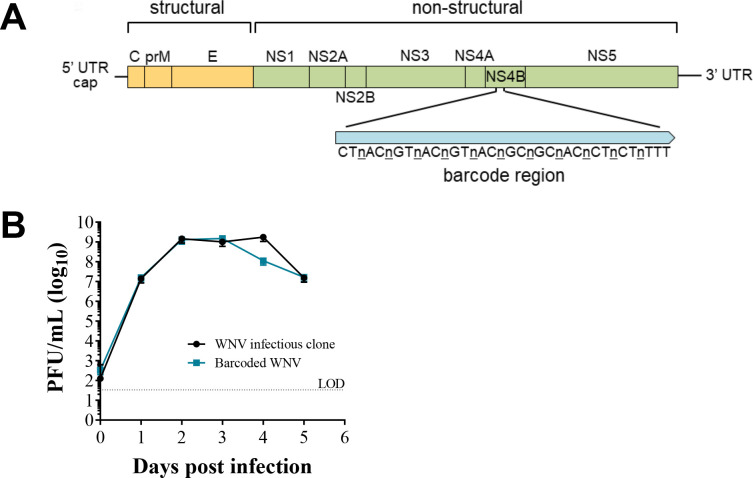
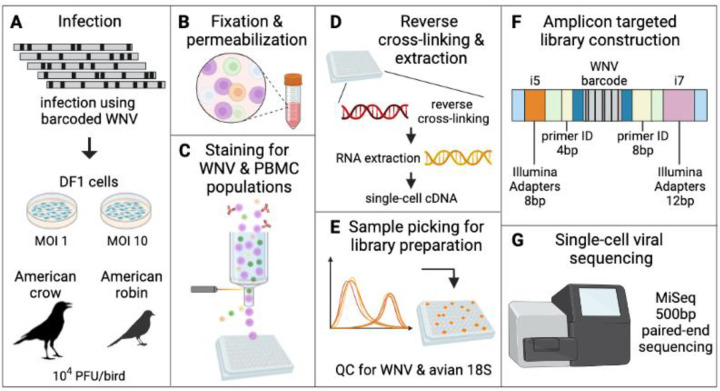
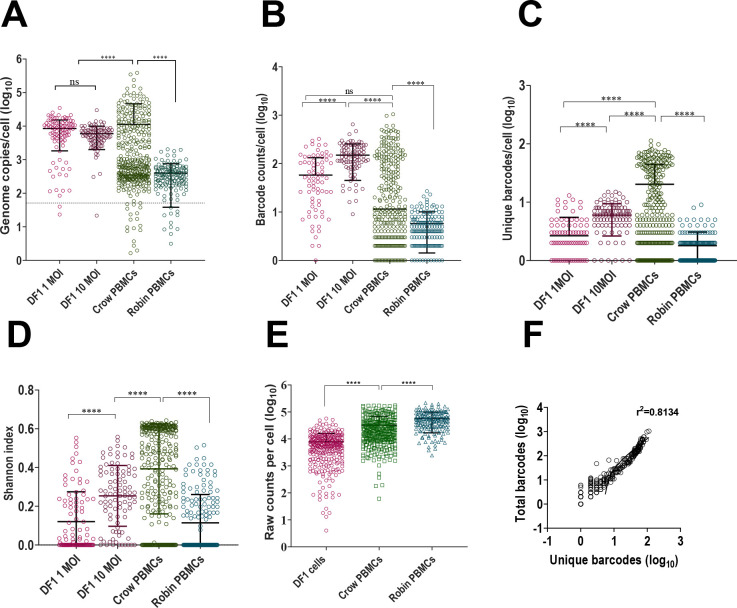
Error-prone replication of RNA viruses generates the genetic diversity required for adaptation within rapidly changing environments. Thus, arthropod-borne virus (arbovirus) populations exist in nature as mutant swarms that are maintained between arthropods and vertebrates. Previous studies have demonstrated that West Nile virus (WNV) population dynamics are host dependent: In American crows, which experience extremely high viremia, purifying selection is weak and population diversity is high compared to American robins, which have 100 to 1000-fold lower viremia. WNV passed in robins experiences fitness gains, whereas that passed in crows does not. Therefore, we tested the hypothesis that high crow viremia allows higher genetic diversity within individual avian peripheral-blood mononuclear cells (PBMCs), reasoning that this could have produced the previously observed host-specific differences in genetic diversity and fitness. Specifically, we infected cells and birds with a novel, barcoded version of WNV and sequenced viral RNA from single cells to quantify the number of WNV barcodes that each contained. Our results demonstrate that the richness of WNV populations within crows far exceeds that in robins. Similarly, rare WNV variants were maintained by crows more frequently than by robins. Our results suggest that increased viremia in crows relative to robins leads to maintenance of defective genomes and less prevalent variants, presumably through complementation. Our findings further suggest that weaker purifying selection in highly susceptible crows is attributable to this higher viremia, polyinfections and complementation. These studies further document the role of particular, ecologically relevant hosts in shaping virus population structure.
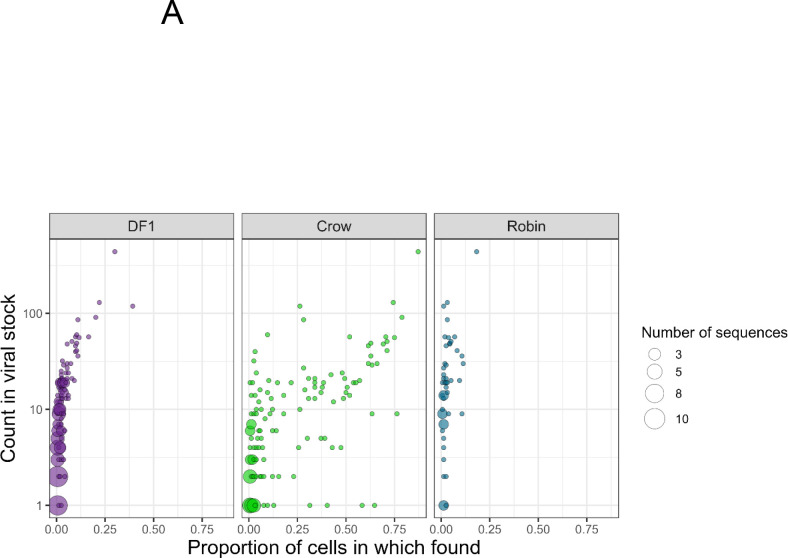
WNV mutational diversity in vertebrates is species-dependent. In crows, low frequency variants are common, and viral populations are more diverse. In robins, fewer mutations become permanent fixtures of the overall viral population. We infected crows, robins and a chicken cell line with a genetically marked (barcoded) WNV. Higher levels of virus led to multiple unique WNV genomes infecting individual cells, even when a genotype was present at low levels in the input viral stock. Our findings suggest that higher levels of circulating virus in natural hosts allow less fit viruses to survive in RNA virus populations through complementation by more fit viruses. This is significant as it allows less represented and less fit viruses to be maintained at low levels until they potentially emerge when virus environments change. Overall our data reveal new insights on the relationships between host susceptibility to high viremia and virus evolution.
RNA病毒易于出错的复制产生了在快速变化的环境中适应所需的遗传多样性。因此,节肢动物传播病毒(虫媒病毒)种群在自然界中以突变群体的形式存在,这些群体在节肢动物和脊椎动物之间维持。先前的研究表明,西尼罗河病毒(WNV)的种群动态取决于宿主:在经历极高病毒血症的美洲乌鸦中,净化选择较弱,与病毒血症低100至1000倍的美洲知更鸟相比,种群多样性较高。在知更鸟中传代的WNV适应性增强,而在乌鸦中传代的则不然。因此,我们检验了这样一个假设,即乌鸦的高病毒血症允许单个鸟类外周血单核细胞(PBMC)内有更高的遗传多样性,理由是这可能产生了先前观察到的宿主特异性遗传多样性和适应性差异。具体而言,我们用一种新型的、带有条形码的WNV感染细胞和鸟类,并对单个细胞的病毒RNA进行测序,以量化每个细胞中所含WNV条形码的数量。我们的结果表明,乌鸦体内WNV种群的丰富度远远超过知更鸟。同样,乌鸦比知更鸟更频繁地维持罕见的WNV变体。我们的结果表明,与知更鸟相比,乌鸦病毒血症的增加导致缺陷基因组和不太常见变体的维持,可能是通过互补作用。我们的发现进一步表明,高度易感的乌鸦中较弱的净化选择归因于这种更高的病毒血症、多重感染和互补作用。这些研究进一步证明了特定的、与生态相关的宿主在塑造病毒种群结构中的作用。
WNV在脊椎动物中的突变多样性取决于物种。在乌鸦中,低频变体很常见,病毒种群更加多样化。在知更鸟中,较少的突变成为整个病毒种群的永久特征。我们用一种基因标记(条形码)的WNV感染乌鸦、知更鸟和鸡细胞系。更高水平的病毒导致多个独特的WNV基因组感染单个细胞,即使在输入病毒库中某种基因型含量较低时也是如此。我们的发现表明,天然宿主中循环病毒水平的升高允许不太适应的病毒通过更适应的病毒的互补作用在RNA病毒种群中存活。这很重要,因为它允许代表性较低和适应性较差的病毒在低水平维持,直到病毒环境变化时它们可能出现。总体而言,我们的数据揭示了宿主对高病毒血症的易感性与病毒进化之间关系的新见解。