Lindman Marissa, Angel Juan P, Estevez Irving, Chang Nydia P, Chou Tsui-Wen, McCourt Micheal, Atkins Colm, Daniels Brian P
Department of Cell Biology and Neuroscience, Rutgers University, Piscataway, NJ, USA.
bioRxiv. 2023 May 22:2023.01.23.525284. doi: 10.1101/2023.01.23.525284.
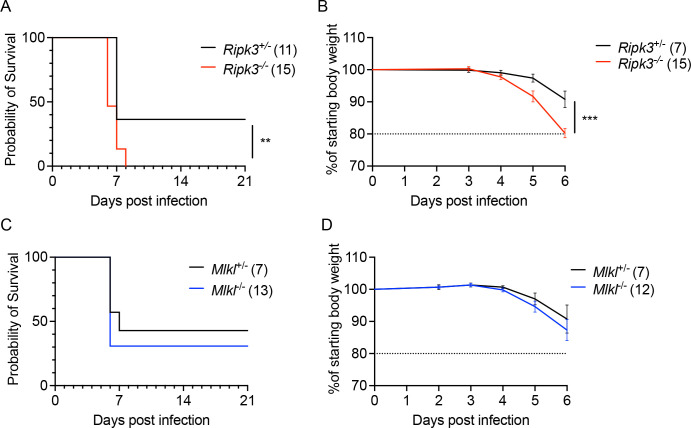
Innate immune signaling in the central nervous system (CNS) exhibits many remarkable specializations that vary across cell types and CNS regions. In the setting of neuroinvasive flavivirus infection, neurons employ the immunologic kinase receptor-interacting kinase 3 (RIPK3) to promote an antiviral transcriptional program, independently of the traditional function of this enzyme in promoting necroptotic cell death. However, while recent work has established roles for neuronal RIPK3 signaling in controlling mosquito-borne flavivirus infections, including West Nile virus and Zika virus, functions for RIPK3 signaling in the CNS during tick-borne flavivirus infection have not yet been explored. Here, we use a model of Langat virus (LGTV) encephalitis to show that RIPK3 signaling is specifically required in neurons of the cerebellum to control LGTV replication and restrict disease pathogenesis. This effect did not require the necroptotic executioner molecule mixed lineage kinase domain like protein (MLKL), a finding similar to previous observations in models of mosquito-borne flavivirus infection. However, control of LGTV infection required a unique, region-specific dependence on RIPK3 to promote expression of key antiviral interferon-stimulated genes (ISG) in the cerebellum. This RIPK3-mediated potentiation of ISG expression was associated with robust cell-intrinsic restriction of LGTV replication in cerebellar granule cell neurons. These findings further illuminate the complex roles of RIPK3 signaling in the coordination of neuroimmune responses to viral infection, as well as provide new insight into the mechanisms of region-specific innate immune signaling in the CNS.
中枢神经系统(CNS)中的先天性免疫信号表现出许多显著的特化,这些特化因细胞类型和CNS区域而异。在神经侵袭性黄病毒感染的情况下,神经元利用免疫激酶受体相互作用激酶3(RIPK3)来促进抗病毒转录程序,而不依赖于该酶在促进坏死性细胞死亡中的传统功能。然而,尽管最近的研究已经确定了神经元RIPK3信号在控制蚊媒黄病毒感染(包括西尼罗河病毒和寨卡病毒)中的作用,但尚未探索RIPK3信号在蜱传黄病毒感染期间在CNS中的功能。在这里,我们使用兰加特病毒(LGTV)脑炎模型来表明,小脑神经元中特异性需要RIPK3信号来控制LGTV复制并限制疾病发病机制。这种作用不需要坏死性执行分子混合谱系激酶结构域样蛋白(MLKL),这一发现与先前在蚊媒黄病毒感染模型中的观察结果相似。然而,对LGTV感染的控制需要对RIPK3有独特的、区域特异性的依赖性,以促进小脑中关键抗病毒干扰素刺激基因(ISG)的表达。这种RIPK3介导的ISG表达增强与小脑颗粒细胞神经元中LGTV复制的强大细胞内在限制有关。这些发现进一步阐明了RIPK3信号在协调对病毒感染的神经免疫反应中的复杂作用,同时也为CNS中区域特异性先天性免疫信号的机制提供了新的见解。