Chantziantoniou Nikolaos
CellPathology Plus, 136 Silver Linden Drive, Richmond Hill, Ontario L4B4H6, Canada.
J Pathol Inform. 2023 Jan 2;14:100182. doi: 10.1016/j.jpi.2022.100182. eCollection 2023.
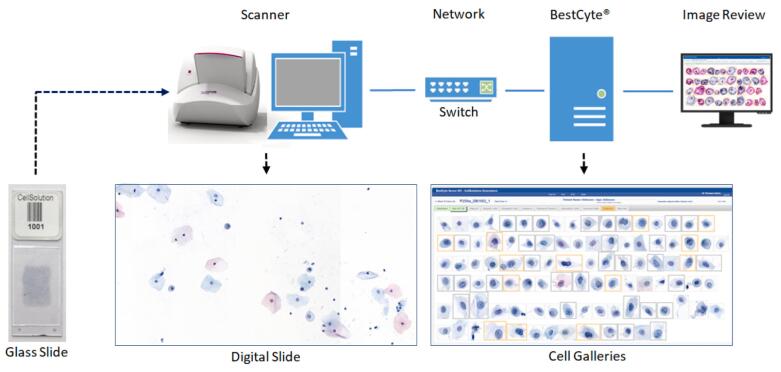
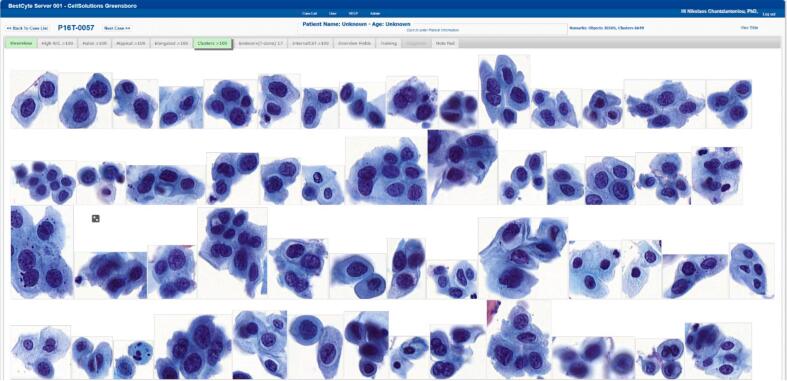
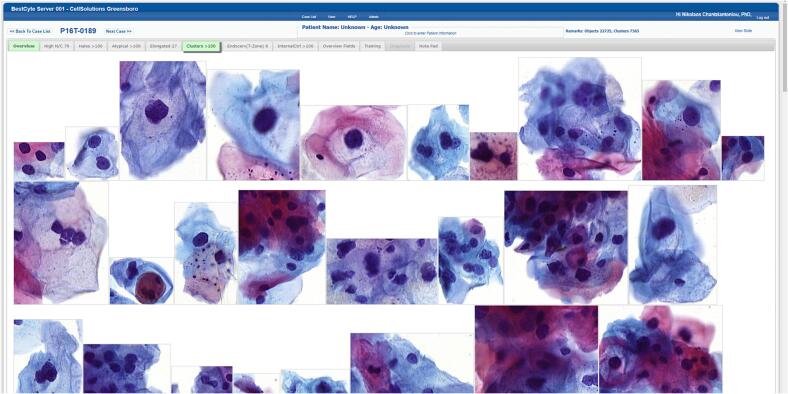
The BestCyte® Cell Sorter Imaging System (BestCyte) facilitates algorithmic discrimination of clinically relevant cells in Pap test cytopathology by classifying and projecting images of cells in galleries based on cytomorphology. Warranted is awareness of potential BestCyte advantages as measured through 3 cytologists' interobserver diagnostic concordance, specificity and sensitivity differentials, and equivalency grading relative to manual microscopy (MM).
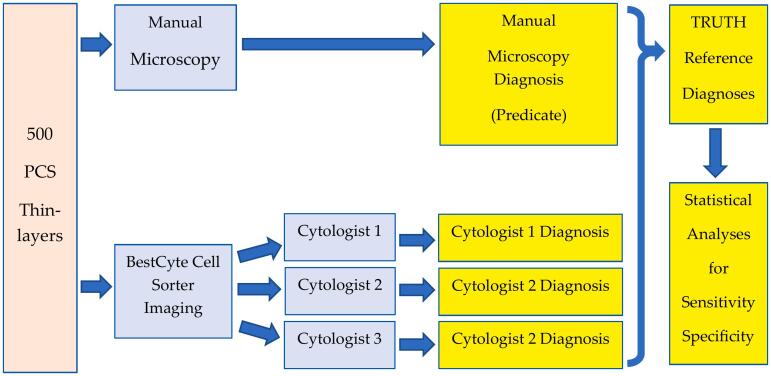
Using 500 MM-reported ThinPrep thin-layers, analyze: (1) cytologists' blinded BestCyte screening to raise Bethesda diagnoses; (2) correlate BestCyte and MM diagnoses (i.e., predicate) to establish Truth Reference Diagnoses (TRDx) from concordance between 4 possible diagnoses; (3) analyze cytologists' and MM predicate diagnoses through 4 diagnostic thresholds defined by TRDx: NILM () for specificity, and ASCUS+, LSIL+, and ASCH+ () for graded sensitivity (with abnormal cells decreasing in size with increasing dysplasia); and, (4) statistically determine cytologists' equivalency grading to MM using 95% Confidence Interval (CI) ranges.
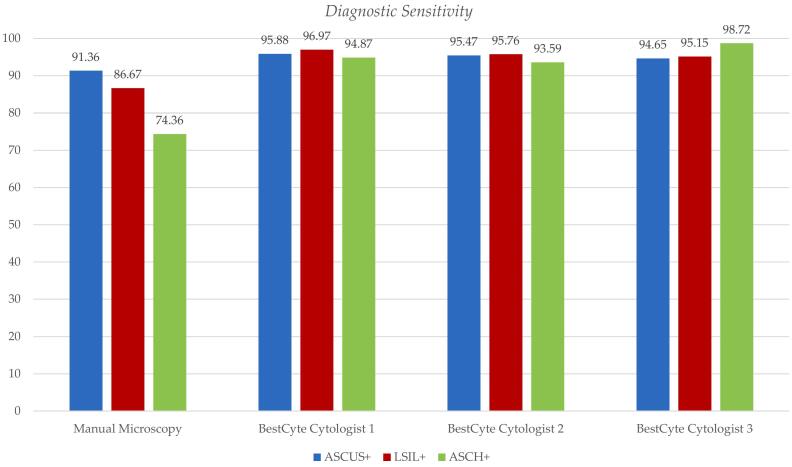
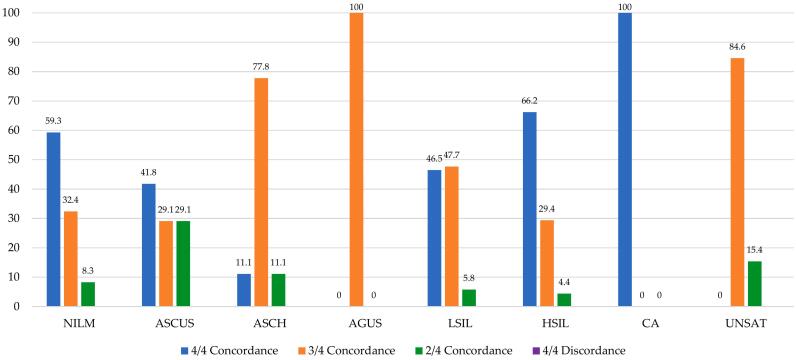
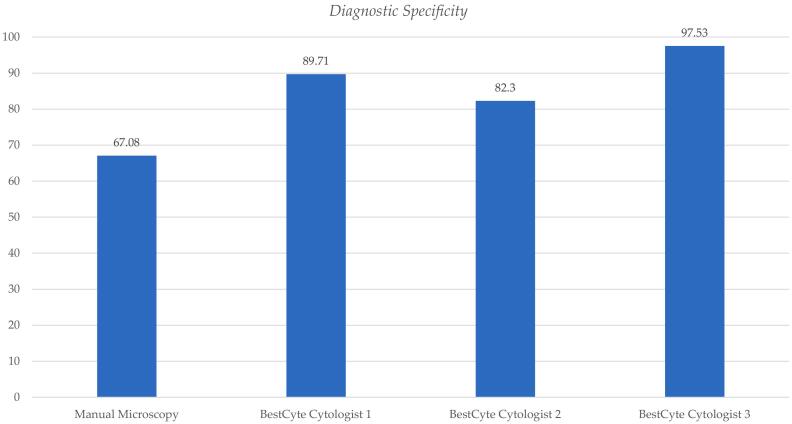
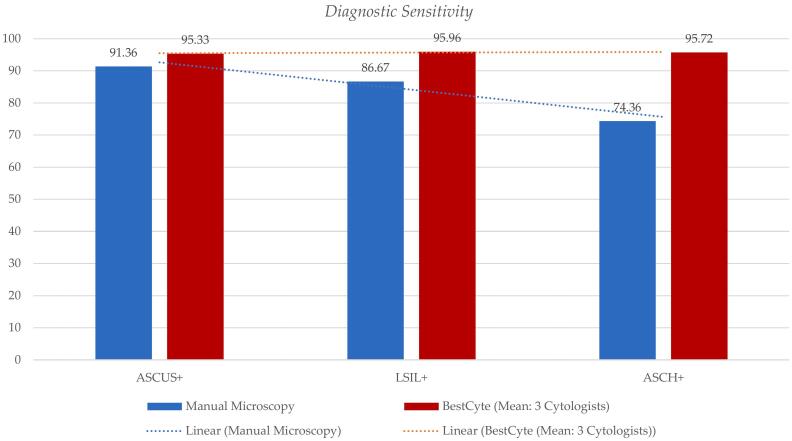
500 TRDx breakdown (n/%): NILM (241/48.2), ASCUS (79/15.8), ASCH (9/1.80), AGUS (2/0.40), LSIL (86/17.2), HSIL (68/13.6), CA (2/0.40), UNSAT (13/2.60). TRDx breakdown (n/%) per 4 of 4, 3 of 4, 2 of 4 diagnostic concordances: 264 (52.8%), 182 (36.4%), 54 (10.8%), respectively. No cases of discordant diagnoses were recorded. HSIL TRDx were established from 66.2% of 4 of 4 concordances, followed by NILM (59.3%), LSIL (46.5%), ASCUS (41.8%); antithetically, from 4.40% of 2 of 4 concordances. Specificity for MM predicate (NILM): 67.08%; for Cytologists 1, 2, and 3: 89.71%, 82.30%, 97.53%, respectively. For NILM threshold, cytologists revealed equivalency to MM. Sensitivity for ASCUS+, LSIL+, and ASCH+ thresholds: MM (91.36%, 86.67%, 74.36%); Cytologist 1 (95.88%, 96.97%, 94.87%); Cytologist 2 (95.47%, 95.76%, 93.59%), Cytologist 3 (94.65%, 95.15%, 98.72%), respectively. Cytologists revealed equivalency to MM for graded thresholds; with Cytologist 3 for ASCUS+ being: .
BestCyte detects and efficiently displays abnormal cells in strategic galleries standardizing objectivity by systematizing mosaics of cell-types for cytologists' consideration. BestCyte fosters consistent, enhanced cytologists' sensitivity values for the ASCUS+, LSIL+, and ASCH+ thresholds relative to MM. Also, BestCyte facilitates improved specificity and superior equivalency grading to MM reflecting efficient screening, and reduced labor. Confident interpretations of small dysplastic epithelial cells characteristic of HSIL led to exceptional interobserver diagnostic concordance inferring BestCyte is primed for effective cervical cancer screening practice.
BestCyte®细胞分选成像系统(BestCyte)通过根据细胞形态对图库中的细胞图像进行分类和投影,有助于在巴氏试验细胞病理学中对临床相关细胞进行算法鉴别。需要了解通过3位细胞病理学家的观察者间诊断一致性、特异性和敏感性差异以及相对于手动显微镜检查(MM)的等效性分级所衡量的BestCyte的潜在优势。
使用500份MM报告的ThinPrep薄层涂片,分析:(1)细胞病理学家对BestCyte进行盲法筛查以提高贝塞斯达诊断;(2)关联BestCyte和MM诊断(即预测),以便根据4种可能诊断之间的一致性建立真实参考诊断(TRDx);(3)通过TRDx定义的4个诊断阈值分析细胞病理学家和MM的预测诊断:NILM()用于特异性,ASCUS+、LSIL+和ASCH+()用于分级敏感性(异常细胞随着发育异常程度增加而变小);以及(4)使用95%置信区间(CI)范围通过统计学方法确定细胞病理学家相对于MM的等效性分级。
500份TRDx分类(n/%):NILM(241/48.2),ASCUS(79/15.8),ASCH(9/1.80),AGUS(2/0.40),LSIL(86/17.2),HSIL(68/13.6),CA(2/0.40),UNSAT(13/2.60)。每4种诊断一致性中的TRDx分类(n/%):4种诊断全一致的为264(52.8%),3种诊断一致的为182(36.4%),2种诊断一致的为54(10.8%)。未记录到诊断不一致的病例。HSIL的TRDx由4种诊断全一致的病例中的66.2%确定,其次是NILM(59.3%)、LSIL(46.5%)、ASCUS(41.8%);相反,由2种诊断一致的病例中的4.40%确定。MM预测(NILM)的特异性:67.08%;细胞病理学家1、2和3的特异性分别为89.71%、82.30%、97.53%。对于NILM阈值,细胞病理学家显示与MM等效。ASCUS+、LSIL+和ASCH+阈值的敏感性:MM(91.36%、86.67%、74.36%);细胞病理学家1(95.88%)、96(96.97%)、94.87%);细胞病理学家2(95.47%、95.76%、93.59%),细胞病理学家3(94.65%、95.15%、98.72%)。细胞病理学家显示在分级阈值方面与MM等效;对于ASCUS+,细胞病理学家三为:。
BestCyte通过将细胞类型的镶嵌图系统化以供细胞病理学家考虑,在策略性图库中检测并有效显示异常细胞,从而实现客观性标准化。相对于MM,BestCyte提高了细胞病理学家对ASCUS+、LSIL+和ASCH+阈值的敏感性值,且具有一致性。此外,BestCyte有助于提高特异性,并在等效性分级方面优于MM,体现了高效筛查和减少劳动量。对HSIL特有的小发育异常上皮细胞的可靠解读导致了观察者间出色的诊断一致性,这表明BestCyte适合用于有效的宫颈癌筛查实践。