• 文献检索
  • 文档翻译
  • 深度研究
  • 学术资讯
  • Suppr Zotero 插件Zotero 插件
  • 邀请有礼
  • 套餐&价格
  • 历史记录
应用&插件
Suppr Zotero 插件Zotero 插件浏览器插件Mac 客户端Windows 客户端微信小程序
定价
高级版会员购买积分包购买API积分包
服务
文献检索文档翻译深度研究API 文档MCP 服务
关于我们
关于 Suppr公司介绍联系我们用户协议隐私条款
关注我们

Suppr 超能文献

核心技术专利:CN118964589B侵权必究
粤ICP备2023148730 号-1Suppr @ 2026

文献检索

告别复杂PubMed语法,用中文像聊天一样搜索,搜遍4000万医学文献。AI智能推荐,让科研检索更轻松。

立即免费搜索

文件翻译

保留排版,准确专业,支持PDF/Word/PPT等文件格式,支持 12+语言互译。

免费翻译文档

深度研究

AI帮你快速写综述,25分钟生成高质量综述,智能提取关键信息,辅助科研写作。

立即免费体验

一项关于产后宫内节育器放置的接受情况、放置过程及随访的前瞻性多中心研究。

A Prospective Multi-centric Study of Acceptance, Insertion and Follow-Up of Postpartum Insertions of IUCD.

作者信息

Gudi Shobha N, Sachdeva Jyoti, Manchanda Renu, Mani Mrinalini, Sinha Shailja Rani Ranjan, Sinha Sushma, Shivkumar Poonam, Wani Reena J, Garg Nishi, Wanjari Sanjivani, Sharma Bharati, Yadav Pramila, Gangane Neha

机构信息

Dr Malathi Manipal Hospital, Bengaluru, India.

Directorate of Family Welfare, New Delhi, India.

出版信息

J Obstet Gynaecol India. 2023 Jun;73(3):254-261. doi: 10.1007/s13224-022-01738-4. Epub 2023 Feb 2.

DOI:10.1007/s13224-022-01738-4
PMID:36747973
原文链接:https://pmc.ncbi.nlm.nih.gov/articles/PMC9893971/
Abstract

PURPOSE OF THE STUDY

The unmet need for contraception in the postpartum period is a major challenge in our country. Unintended pregnancies are highest in the first year after birth, and postpartum IUCD insertion is an effective way to counter this problem. This study was planned to build up data for acceptance and follow-up of postpartum IUCD insertions.

METHODS

The present study has included data of PPIUCD insertions and follow-up from seven institutions over a period of 6 months. The case recruitment lasted for 3 months, including only those who had PPIUCD insertions in this period, and they were followed up for a period of 6 months. The follow-up of patients was at 6 weeks and 6 months. All issues were addressed including side effects, expulsions, myths surrounding the device, etc., along with routine postnatal care.

RESULTS AND CONCLUSION

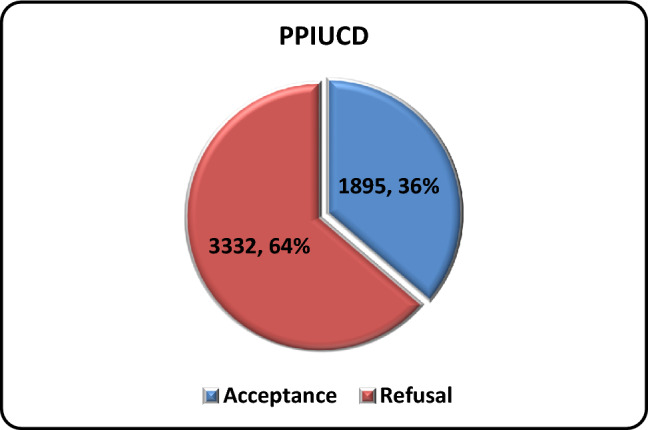
There were 5227 deliveries and 1895 insertions. The acceptance rate was 36%, and a follow-up at 6 weeks and 6 months showed up an expulsion rate of approximately 4% and a removal rate of 5%. Overall, at the end of 6 months we have a continuation rate of 90%. This shows that a dedicated approach to postpartum contraception will definitely bring down incidence of unintended pregnancies.

摘要

研究目的

产后避孕需求未得到满足是我国面临的一项重大挑战。意外怀孕在产后第一年最为高发,而产后宫内节育器(IUCD)置入是应对这一问题的有效方法。本研究旨在收集产后IUCD置入的接受情况及随访数据。

方法

本研究纳入了7家机构6个月内产后即时置入IUCD(PPIUCD)的数据及随访情况。病例招募持续了3个月,仅纳入在此期间接受PPIUCD置入的患者,并对其进行了6个月的随访。在6周和6个月时对患者进行随访。除常规产后护理外,还处理了所有问题,包括副作用、节育器脱落、围绕该器械的误解等。

结果与结论

共有5227例分娩和1895例置入。接受率为36%,6周和6个月的随访显示脱落率约为4%,取出率为5%。总体而言,在6个月末,持续使用率为90%。这表明采用专门的产后避孕方法肯定会降低意外怀孕的发生率。
https://cdn.ncbi.nlm.nih.gov/pmc/blobs/d5fd/10267096/c25b8e90579c/13224_2022_1738_Fig1_HTML.jpg

相似文献

1
A Prospective Multi-centric Study of Acceptance, Insertion and Follow-Up of Postpartum Insertions of IUCD.一项关于产后宫内节育器放置的接受情况、放置过程及随访的前瞻性多中心研究。
J Obstet Gynaecol India. 2023 Jun;73(3):254-261. doi: 10.1007/s13224-022-01738-4. Epub 2023 Feb 2.
2
The Acceptance of Postpartum Intrauterine Contraceptive Devices Among Women Who Receive Focused Family Planning Counseling in the Antenatal Period Compared to Those Who Receive Routine Counseling: A Randomized Controlled Trial.与接受常规咨询的女性相比,接受产前计划生育重点咨询的女性对产后宫内节育器的接受情况:一项随机对照试验。
Cureus. 2023 Jun 12;15(6):e40344. doi: 10.7759/cureus.40344. eCollection 2023 Jun.
3
Safety and Efficacy of Intra-caesarean IUCD: A Prospective Study at a Tertiary Care Centre.剖宫产术中放置宫内节育器的安全性和有效性:在一家三级医疗中心进行的前瞻性研究。
J Obstet Gynaecol India. 2019 Aug;69(4):325-329. doi: 10.1007/s13224-019-01242-2. Epub 2019 Jun 7.
4
Postpartum Insertion Of Intrauterine Contraceptive Device: A Safe And Effective Contraception.产后宫内节育器放置术:一种安全有效的避孕方法。
J Ayub Med Coll Abbottabad. 2022 Jul-Sep;34(Suppl 1)(3):S671-S677. doi: 10.55519/JAMC-03-S1-10029.
5
Acceptability for the use of postpartum intrauterine contraceptive devices: Assiut experience.产后宫内节育器使用的可接受性:阿斯尤特的经验
Med Princ Pract. 2003 Jul-Sep;12(3):170-5. doi: 10.1159/000070754.
6
Changing Scenario in Indian Contraceptive Methods: A Glimpse Through a Tertiary Hospital Statistics.印度避孕方法的变化情况:透过一家三级医院的统计数据一瞥
J Obstet Gynaecol India. 2019 Oct;69(5):462-466. doi: 10.1007/s13224-019-01218-2. Epub 2019 Mar 20.
7
Evaluation of Safety, Efficacy, and Expulsion of Post-Placental and Intra-Cesarean Insertion of Intrauterine Contraceptive Devices (PPIUCD).胎盘娩出后及剖宫产术中放置宫内节育器(PPIUCD)的安全性、有效性及脱落情况评估
J Obstet Gynaecol India. 2014 Oct;64(5):337-43. doi: 10.1007/s13224-014-0550-3. Epub 2014 May 18.
8
Experience on Safety, Expulsion, and Complication of Intracesarean Post-Partum Intrauterine Copper Device.剖宫产术后宫腔内置入含铜宫内节育器的安全性、脱落及并发症的经验
Cureus. 2020 Sep 25;12(9):e10647. doi: 10.7759/cureus.10647.
9
Postpartum IUDS: keys for success.产后宫内节育器:成功的关键
Contraception. 1992 Apr;45(4):351-61. doi: 10.1016/0010-7824(92)90057-z.
10
Acceptance, safety and efficacy of postpartum intrauterine contraceptive device.产后宫内节育器的可接受性、安全性和有效性。
J Family Med Prim Care. 2023 May;12(5):868-873. doi: 10.4103/jfmpc.jfmpc_1392_22. Epub 2023 May 31.

本文引用的文献

1
Increasing postpartum IUCD coverage through a QI initiative: a step towards reducing the unmet need of postpartum contraception.通过质量改进举措提高产后宫内节育器的覆盖率:迈向减少产后避孕未满足需求的一步。
BMJ Open Qual. 2021 Jul;10(Suppl 1). doi: 10.1136/bmjoq-2021-001346.
2
Awareness about postpartum insertion of intrauterine device among antenatal cases.产前病例对产后宫内节育器放置的知晓情况。
Med J Armed Forces India. 2015 Jul;71(3):221-4. doi: 10.1016/j.mjafi.2015.04.002. Epub 2015 Jun 9.
3
Evaluation of Safety, Efficacy, and Expulsion of Post-Placental and Intra-Cesarean Insertion of Intrauterine Contraceptive Devices (PPIUCD).
胎盘娩出后及剖宫产术中放置宫内节育器(PPIUCD)的安全性、有效性及脱落情况评估
J Obstet Gynaecol India. 2014 Oct;64(5):337-43. doi: 10.1007/s13224-014-0550-3. Epub 2014 May 18.
4
The revival of postpartum intrauterine contraceptive devices.
Arch Gynecol Obstet. 2014 Jul;290(1):7-8. doi: 10.1007/s00404-014-3160-5. Epub 2014 Feb 7.
5
Long-term safety, efficacy, and patient acceptability of the intrauterine Copper T-380A contraceptive device.宫内节育器 TCu380A 的长期安全性、有效性和患者可接受性。
Int J Womens Health. 2010 Aug 9;2:211-20. doi: 10.2147/ijwh.s6914.
6
Abortion and maternal mortality in the developing world.发展中世界的堕胎与孕产妇死亡率
J Obstet Gynaecol Can. 2006 Nov;28(11):974-979. doi: 10.1016/S1701-2163(16)32307-6.
7
Family planning: the unfinished agenda.计划生育:未竟议程。
Lancet. 2006 Nov 18;368(9549):1810-27. doi: 10.1016/S0140-6736(06)69480-4.
8
Prevalence and determinants of contraceptive practice in a defined Nigerian population.尼日利亚特定人群中避孕措施的普及率及其决定因素。
J Obstet Gynaecol. 2002 Sep;22(5):540-3. doi: 10.1080/0144361021000003126.
9
The KAP-gap in Nepal: reasons for non-use of contraception among couples with an unmet need for family planning.尼泊尔的知识、态度和实践差距:计划生育需求未得到满足的夫妇不使用避孕措施的原因。
Asia Pac Popul J. 1991 Mar;6(1):25-38.
10
Sexuality during pregnancy and the year postpartum.孕期及产后一年内的性征。
J Fam Pract. 1998 Oct;47(4):305-8.