Hooshangnejad Hamed, Chen Quan, Feng Xue, Zhang Rui, Ding Kai
Department of Biomedical Engineering, Johns Hopkins School of Medicine, Baltimore, MD, USA.
Department of Radiation Oncology and Molecular Radiation Sciences, Johns Hopkins School of Medicine, Baltimore, MD, USA.
ArXiv. 2023 Jan 27:arXiv:2301.11085v2.
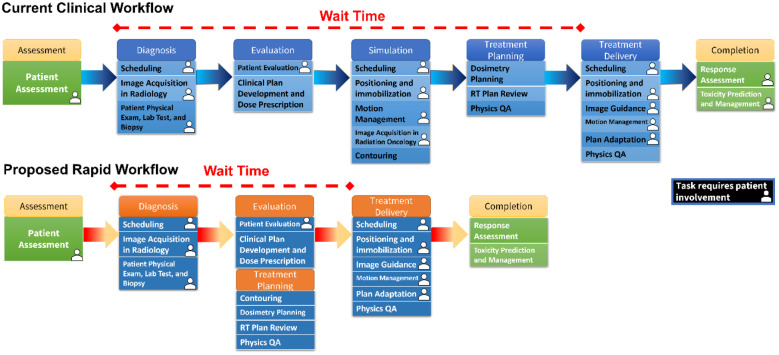
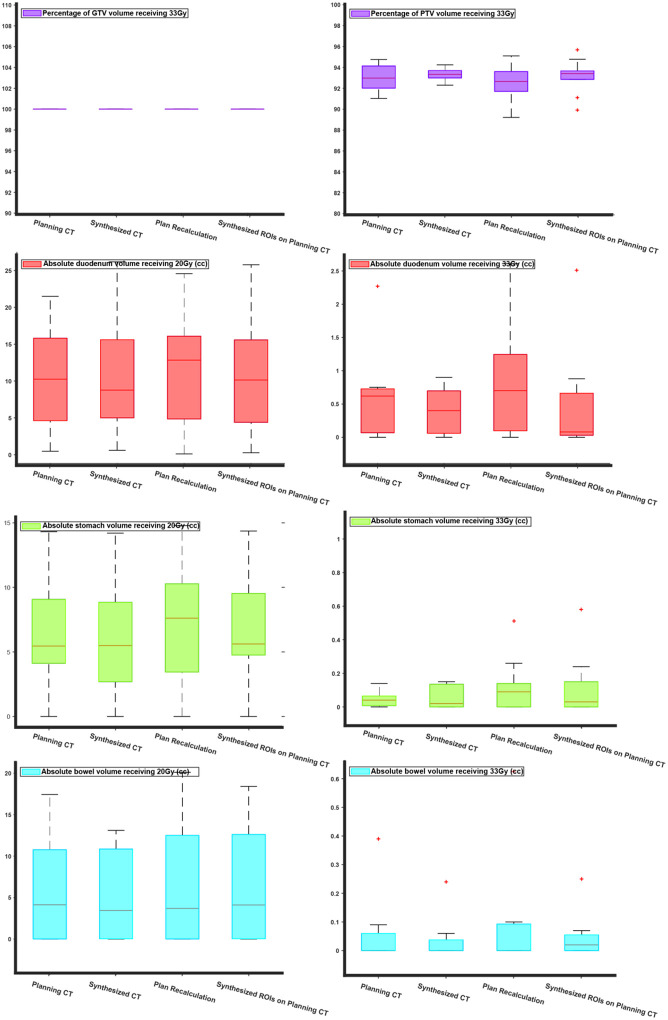
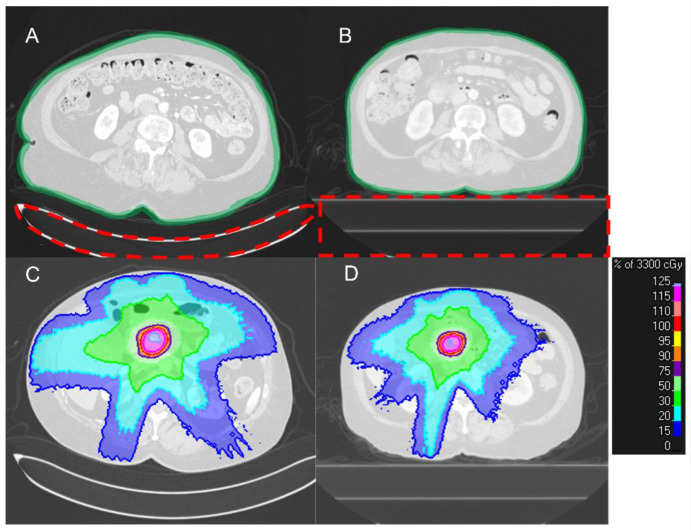
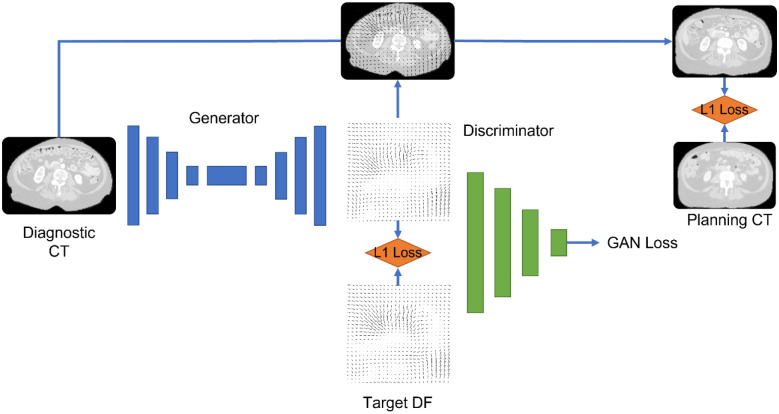
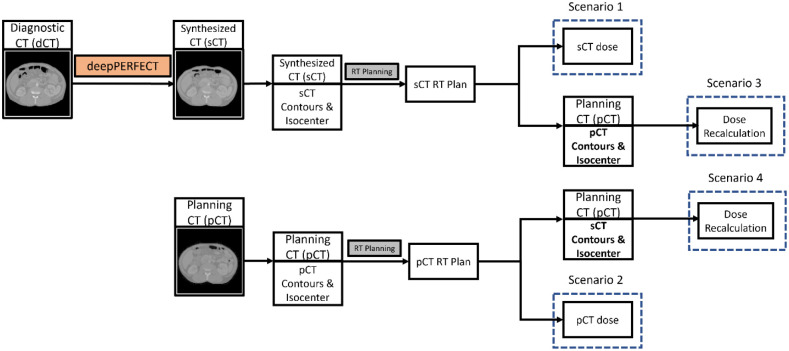
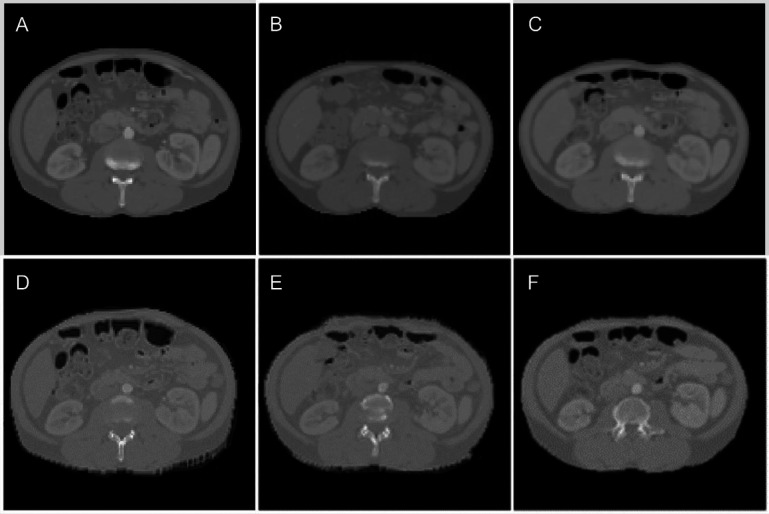
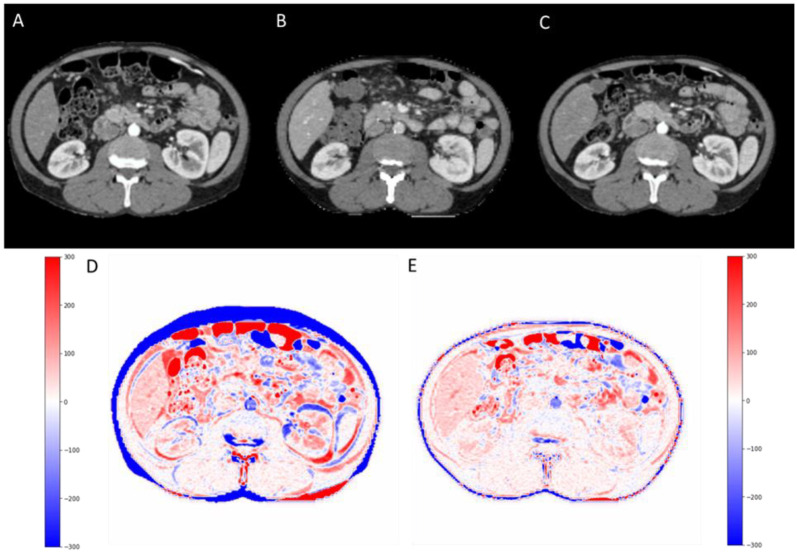
Pancreatic cancer with more than 60,000 new cases each year has less than 10 percent 5-year overall survival. Radiation therapy (RT) is an effective treatment for Locally advanced pancreatic cancer (LAPC). The current clinical RT workflow is lengthy and involves separate image acquisition for diagnostic CT (dCT) and planning CT (pCT). Studies have shown a reduction in mortality rate from expeditious radiotherapy treatment. dCT and pCT are acquired separately because of the differences in the image acquisition setup and patient body. We are presenting deepPERFECT: deep learning-based model to adapt the shape of the patient body on dCT to the treatment delivery setup. Our method expedites the treatment course by allowing the design of the initial RT planning before the pCT acquisition. Thus, the physicians can evaluate the potential RT prognosis ahead of time, verify the plan on the treatment day-one CT and apply any online adaptation if needed. We used the data from 25 pancreatic cancer patients. The model was trained on 15 cases and tested on the remaining ten cases. We evaluated the performance of four different deep-learning architectures for this task. The synthesized CT (sCT) and regions of interest (ROIs) were compared with ground truth (pCT) using Dice similarity coefficient (DSC) and Hausdorff distance (HD). We found that the three-dimensional Generative Adversarial Network (GAN) model trained on large patches has the best performance. The average DSC and HD for body contours were 0.93, and 4.6 mm. We found no statistically significant difference between the synthesized CT plans and the ground truth. We showed that employing deepPERFECT shortens the current lengthy clinical workflow by at least one week and improves the effectiveness of treatment and the quality of life of pancreatic cancer patients.
每年新增病例超过6万例的胰腺癌患者,其5年总生存率不到10%。放射治疗(RT)是局部晚期胰腺癌(LAPC)的有效治疗方法。当前的临床放疗流程冗长,涉及诊断性CT(dCT)和计划CT(pCT)的单独图像采集。研究表明,快速放疗可降低死亡率。由于图像采集设置和患者身体的差异,dCT和pCT是分别采集的。我们提出了deepPERFECT:一种基于深度学习的模型,用于使dCT上的患者身体形状适应治疗交付设置。我们的方法通过在采集pCT之前设计初始放疗计划来加快治疗进程。因此,医生可以提前评估潜在的放疗预后,在治疗第一天的CT上验证计划,并在需要时进行任何在线调整。我们使用了25例胰腺癌患者的数据。该模型在15例病例上进行训练,并在其余10例病例上进行测试。我们评估了四种不同深度学习架构在这项任务中的性能。使用骰子相似系数(DSC)和豪斯多夫距离(HD)将合成CT(sCT)和感兴趣区域(ROI)与真实情况(pCT)进行比较。我们发现,在大补丁上训练的三维生成对抗网络(GAN)模型性能最佳。身体轮廓的平均DSC和HD分别为0.93和4.6毫米。我们发现合成CT计划与真实情况之间没有统计学上的显著差异。我们表明,采用deepPERFECT可将当前冗长的临床工作流程至少缩短一周,并提高治疗效果和胰腺癌患者的生活质量。