Pharmacy Department, Geneva University Hospitals, Geneva, Switzerland.
Institute of Pharmaceutical Sciences of Western Switzerland, School of Pharmaceutical Sciences, University of Geneva, Geneva, Switzerland.
J Oncol Pharm Pract. 2023 Dec;29(8):1868-1877. doi: 10.1177/10781552231152145. Epub 2023 Feb 7.
We used an educational healthcare simulation tool called room of errors (ROE) to raise pharmacy operators' awareness of potential errors in a chemotherapy production process and assessed its impact on their knowledge and satisfaction.
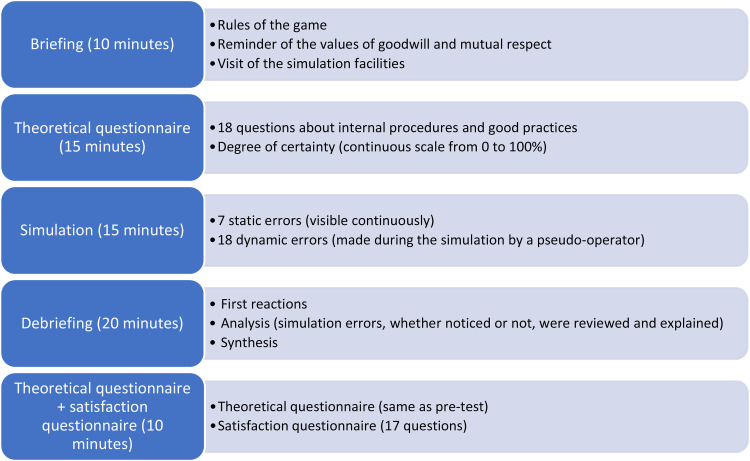
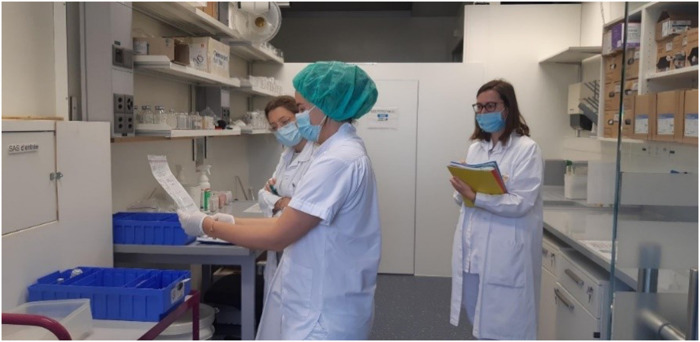
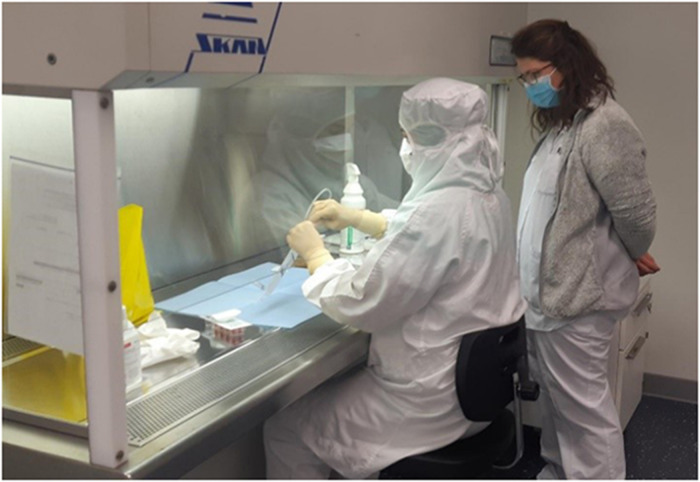
Twenty-five errors (compiled from internal procedures, literature and our hospital's reported incidents) were categorised as static ( = 7, visible by the participant anytime) and dynamic ( = 18, made by a pseudooperator in front of the participant). Our simulated cytotoxic production unit (CPU) hosted the 1 h-simulation. Two pharmacists (supervisor/pseudo-operator) welcomed the trainee for a 10-min briefing. During the 20-min simulation, participants watched the pseudo-operator's gestures in a simulated chemotherapy production process. Participants called out each error observed (recorded by the supervisor). A 20-min debriefing followed. ROE's impact on knowledge was measured through participants' answers to a before-and after 18-item questionnaire about CPU's procedures and certainty about answers on a scale (0%-100%). Participants evaluated the training using a satisfaction questionnaire (Likert scale, 1-6).
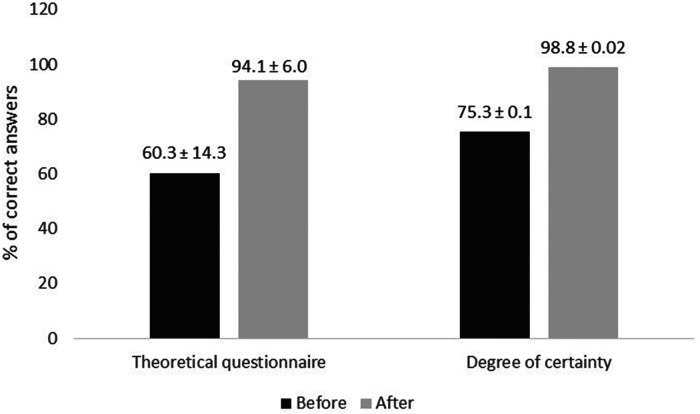
The 14 participants detected 70.4% ± 11.4% of errors. Least-detected errors were "using non-disinfected vials" (42.9%) and "touching syringe plunger" (0%). Critical errors (expired leftovers or glucose instead of sodium chloride) were detected at 57.1%. Knowledge improved from 60.3% to 94.1% (p < 0.001) and certainty from 75.3% to 98.8% (p < 0.001). Participants appreciated this non-judgmental, informative, and original training (satisfaction 95.7%). Some pointed out difficulties settling into the game quickly and visualising static and dynamic errors simultaneously.
This ROE simulation improved operators' knowledge and certainty. Longer-term testing should be done to measure knowledge retention over time.
我们使用了一种名为“错误房间”(ROE)的教育医疗模拟工具,旨在提高药剂师在化疗生产过程中潜在错误的意识,并评估其对他们的知识和满意度的影响。
从内部程序、文献和我们医院报告的事件中,共收集了 25 个错误,分为静态( = 7,参与者随时可见)和动态( = 18,由伪操作员在参与者面前完成)。我们的模拟细胞毒性生产单元(CPU)举办了 1 小时的模拟。两名药剂师(主管/伪操作员)欢迎学员参加 10 分钟的简介。在 20 分钟的模拟过程中,参与者观察伪操作员在模拟化疗生产过程中的手势。参与者观察到的每个错误都会大声说出来(由主管记录)。随后进行了 20 分钟的讨论。ROE 对知识的影响通过参与者对 CPU 程序的前测和后测 18 项问卷的回答以及对答案的确定性(0%-100%)来衡量。参与者使用满意度问卷(李克特量表,1-6)对培训进行了评估。
14 名参与者发现了 70.4%±11.4%的错误。检测率最低的错误是“使用未消毒的小瓶”(42.9%)和“触碰注射器活塞”(0%)。发现了 57.1%的关键错误(过期的剩余物或葡萄糖代替氯化钠)。知识从 60.3%提高到 94.1%(p < 0.001),确定性从 75.3%提高到 98.8%(p < 0.001)。参与者非常欣赏这种非评判性、信息丰富且具有创意的培训(满意度为 95.7%)。一些参与者指出,他们很难快速适应游戏,并且很难同时看到静态和动态错误。
ROE 模拟提高了操作人员的知识和确定性。应该进行更长期的测试,以测量随着时间的推移知识的保留情况。