Department of Gynecology, Litongde Hospital of Zhejiang Province, Hangzhou, Zhejiang, China.
Medicine (Baltimore). 2023 Feb 3;102(5):e31217. doi: 10.1097/MD.0000000000031217.
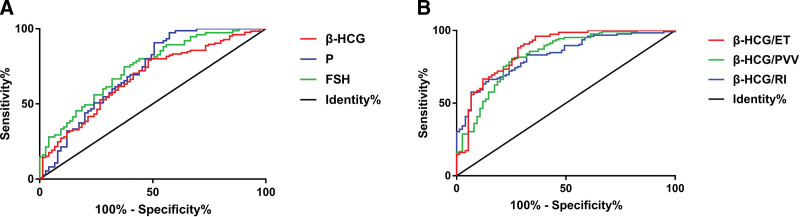
To probe the diagnostic value of transvaginal color Doppler ultrasonography plus serum β-human chorionic gonadotropin (β-HCG) dynamic monitoring in intrauterine residue after medical abortion.In total, 200 pregnant women undergoing medical abortion in our institution from January 2017 to December 2019 were picked, and assigned to either group A (n = 75, with residue) or group B (n = 125, without residue). We detected serum β-HCG, progesterone (P), follicle stimulating estrogen (FSH) levels and ultrasonic indicators endometrial thickness (ET), peak systolic velocity (PSV), resistance index (RI) values, dissected correlation of indicators using logistic linear regression analysis, and prospected the diagnostic value of relevant indicators in intrauterine residue after medical abortion utilizingreceiver operating characteristic curve.At 7 days after abortion (T3), total vaginal bleeding and visual analogue scalescore in group A were saliently higher in contrast to group B ( P < .05). At 72 hours after abortion (T2) and T3, serum β-HCG, P and FSH levels declined strikingly in both groups, but group B held plainly higher decrease rate than group A ( P HC.05). At T3, ET and PSV levels in both groups considerably waned, whereas RI levels notedly waxed, and group B owned markedly higher decrease/increase than group A ( P wa.05). At T3, serum β-HCG in group A possessed positive association with serum P, FSH, intrauterine ET, PSV levels separately ( P HC.05), whereas negative link with RI levels ( P , .05). The specificity and sensitivity of β-HCG, P, FSH, β-HCG/ET, β-HCG/PSV and β-HCG/RI in the diagnosis of intrauterine residue after medical abortion were high ( P < .05).Serum β-HCG dynamic monitoring plus transvaginal color Doppler ultrasonography is of great value in diagnosing intrauterine residue after medical abortion. Serum β-HCG, P, FSH levels can be combined with the results of intrauterine ET, PSV, RI values, so as to boost the diagnostic accuracy of the intrauterine residue after medical abortion.
探讨经阴道彩色多普勒超声联合血清β-人绒毛膜促性腺激素(β-HCG)动态监测在药物流产后宫内残留中的诊断价值。选取 2017 年 1 月至 2019 年 12 月在我院行药物流产的孕妇 200 例,分为 A 组(n=75,有残留)和 B 组(n=125,无残留)。检测血清β-HCG、孕酮(P)、卵泡刺激素(FSH)水平及超声指标子宫内膜厚度(ET)、收缩期峰值流速(PSV)、阻力指数(RI)值,采用 logistic 线性回归分析指标相关性,利用受试者工作特征曲线(ROC)探讨相关指标在药物流产后宫内残留中的诊断价值。流产后 7 天(T3),A 组总阴道出血量和视觉模拟评分明显高于 B 组(P<.05)。流产后 72 小时(T2)和 T3,两组血清β-HCG、P 和 FSH 水平均明显下降,但 B 组下降率明显高于 A 组(P<.05)。T3 时,两组 ET 和 PSV 水平均明显下降,而 RI 水平明显升高,B 组下降/升高幅度明显大于 A 组(P<.05)。T3 时,A 组血清β-HCG与血清 P、FSH、宫内 ET、PSV 水平分别呈正相关(P<.05),与 RI 水平呈负相关(P<.05)。β-HCG、P、FSH、β-HCG/ET、β-HCG/PSV、β-HCG/RI 诊断药物流产后宫内残留的特异性和敏感性均较高(P<.05)。血清β-HCG 动态监测联合经阴道彩色多普勒超声对药物流产后宫内残留具有重要诊断价值。血清β-HCG、P、FSH 水平可与宫内 ET、PSV、RI 值相结合,提高药物流产后宫内残留的诊断准确性。