Centre régional de pharmacovigilance de Bourgogne, University Hospital, 21079 Dijon, France.
Pharmacovigilance, Department of Pharmacology, Pasteur Hospital, 06001 Nice, France.
Therapie. 2023 Sep-Oct;78(5):523-529. doi: 10.1016/j.therap.2023.01.004. Epub 2023 Jan 20.
In the context of COVID-19 pandemic, a national pharmacovigilance survey was set up in March 2020. The purpose of this survey was to ensure continuous monitoring of adverse drug reactions (ADRs) in patients with COVID-19, not only related to the drugs used in this indication but also related to all drugs administered to these patients or suspected of having promoted the infection.
This descriptive study was based on data extracted from the French Pharmacovigilance Database from 1 January 2020 to 30 September 2021. Misuse was also analysed through the MESANGE project. The ADRs were classified according to three groups: "drugs used to treat COVID-19", "other drugs administered to COVID-19 positive patients" and "drugs suspected of having promoted COVID-19". The data were also presented according to 2 periods (period one was from January to June 2020 and period two from July 2020 onwards).
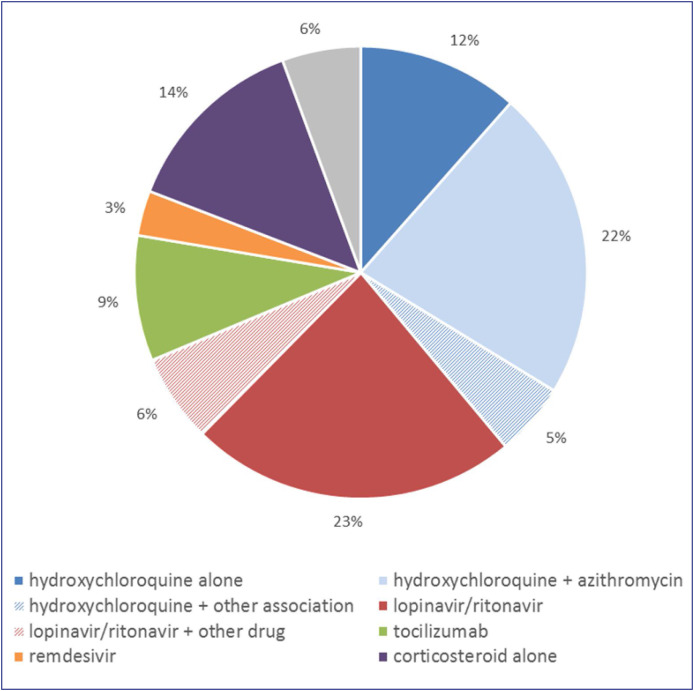
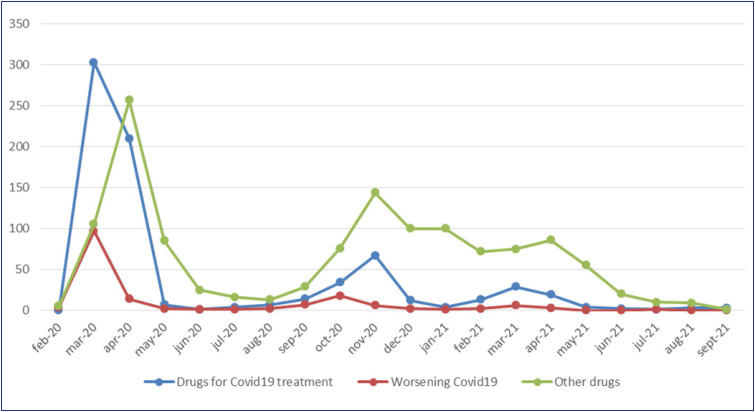
Among 2189 included cases, 67.1% were serious. Cases were mainly related to "other drugs administrated to COVID-19 positive patients" (58.5%) followed by "drugs used to treat COVID-19" (33.7%) and "drugs suspected of having promoted COVID-19" (7.8%). Drugs used to treat COVID-19 and their main safety profile were different depending on the period: mostly hydroxychloroquine (51%) with heart injury and lopinavir/ritonavir (42%) with liver injury for the first period, and dexamethasone (46%) with hyperglycemia and tocilizumab (28%) with liver injury for the second period. The drugs suspected of worsening COVID-19 differed in both periods especially for non-steroidal anti-inflammatory drugs mainly reported in period 1 (41.5% versus 8.2% in period 2). Other immunosuppressive drugs were in the majority in the second period (85.7%), with mainly methotrexate (15.3%), anti-CD20 (15.3%) and anti-TNF alpha (10.5%). No confirmed safety signal was identified among other drugs administered to patients with COVID-19. The profile of ADRs and suspected drugs was similar between the 2 periods. The study of misuse in outpatient settings identified in both periods mainly hydroxychloroquine, azithromycin, ivermectin and zinc±vitamin C.
This survey, based on real-time pharmacological and medical assessment of ADRs and weekly meetings in a specific national committee, made it possible to identify relevant safety signals which contribute to patient care with no delay. The main safety signal highlighted was serious cardiac damage under hydroxychloroquine, alone or combined with azithromycin and also with lopinavir/ritonavir. This signal has contributed to the evolution of the recommendations for these 2 drugs. The methodology of this survey has been taken over and is still going on for the pharmacovigilance monitoring of vaccines against COVID-19, for monoclonal antibodies used against COVID-19 and also for Paxlovid® (nirmatrelvir/ritonavir) which benefit from dedicated surveys.
在 COVID-19 大流行背景下,2020 年 3 月开展了一项全国范围的药物警戒调查。该调查的目的是确保持续监测 COVID-19 患者的药物不良反应(ADR),不仅与该适应证下使用的药物相关,还与所有给予这些患者的药物或疑似促进感染的药物相关。
本描述性研究基于 2020 年 1 月 1 日至 2021 年 9 月 30 日期间从法国药物警戒数据库中提取的数据。误用情况也通过 MESANGE 项目进行了分析。ADR 根据三组进行分类:“用于治疗 COVID-19 的药物”、“给予 COVID-19 阳性患者的其他药物”和“疑似促进 COVID-19 的药物”。还根据两个时期(第一时期为 2020 年 1 月至 6 月,第二时期为 2020 年 7 月以后)呈现数据。
在纳入的 2189 例病例中,67.1%为严重病例。病例主要与“给予 COVID-19 阳性患者的其他药物”(58.5%)相关,其次是“用于治疗 COVID-19 的药物”(33.7%)和“疑似促进 COVID-19 的药物”(7.8%)。用于治疗 COVID-19 的药物及其主要安全性特征因时期而异:第一时期主要为羟氯喹(51%)致心脏损伤和洛匹那韦/利托那韦(42%)致肝损伤,第二时期主要为地塞米松(46%)致高血糖和托珠单抗(28%)致肝损伤。在两个时期中,疑似加重 COVID-19 的药物也有所不同,尤其是非甾体抗炎药主要在第一时期报告(41.5%与第二时期的 8.2%)。在第二时期,大多数为其他免疫抑制剂(85.7%),主要为甲氨蝶呤(15.3%)、抗-CD20(15.3%)和抗 TNF-α(10.5%)。给予 COVID-19 患者的其他药物未发现确认的安全信号。两个时期的 ADR 和疑似药物特征相似。门诊环境中误用的研究在两个时期均发现主要为羟氯喹、阿奇霉素、伊维菌素和锌+维生素 C。
本调查基于对 ADR 的实时药理学和医学评估以及在一个特定的国家委员会中进行的每周会议,确定了相关的安全信号,这有助于患者的护理而不会有任何延误。突出的主要安全信号是羟氯喹单独或与阿奇霉素联合使用,以及与洛匹那韦/利托那韦联合使用时的严重心脏损伤。这一信号促进了这两种药物的建议演变。该调查的方法已被采用并仍在继续,用于 COVID-19 疫苗的药物警戒监测、用于治疗 COVID-19 的单克隆抗体,以及用于奈玛特韦/利托那韦(nirmatrelvir/ritonavir)的专门调查,后者受益于此。