Uppsala Monitoring Centre, Uppsala, Sweden.
Drug Saf. 2020 Dec;43(12):1309-1314. doi: 10.1007/s40264-020-01000-8. Epub 2020 Sep 25.
In late 2019, a new coronavirus-severe acute respiratory syndrome coronavirus 2 (SARS-CoV-2)-was discovered in Wuhan, China, and the World Health Organization later declared coronavirus disease 2019 (COVID-19) a pandemic. Numerous drugs have been repurposed and investigated for therapeutic effectiveness in the disease, including those from "Solidarity," an international clinical trial (azithromycin, chloroquine, hydroxychloroquine, the fixed combination lopinavir/ritonavir, and remdesivir).
Our objective was to evaluate adverse drug reaction (ADR) reporting for drugs when used in the treatment of COVID-19 compared with use for other indications, specifically focussing on sex differences.
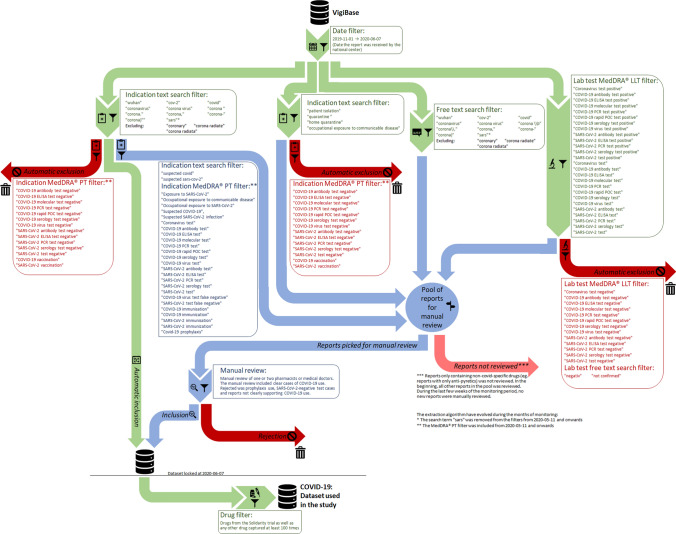
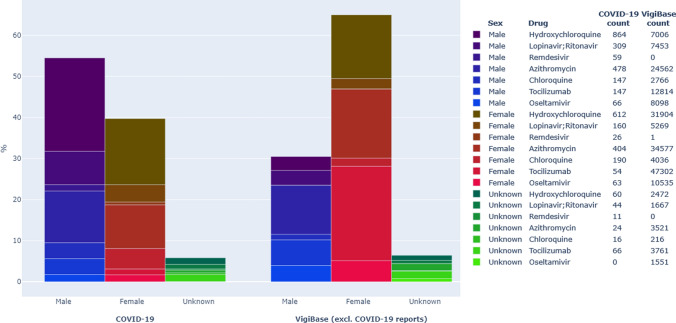
We extracted reports on COVID-19-specific treatments from the global ADR database, VigiBase, using an algorithm developed to identify reports that listed COVID-19 as the indication. The Solidarity trial drugs were included, as were any drugs reported ≥ 100 times. We performed a descriptive comparison of reports for the same drugs used in non-COVID-19 indications. The data lock point date was 7 June 2020.
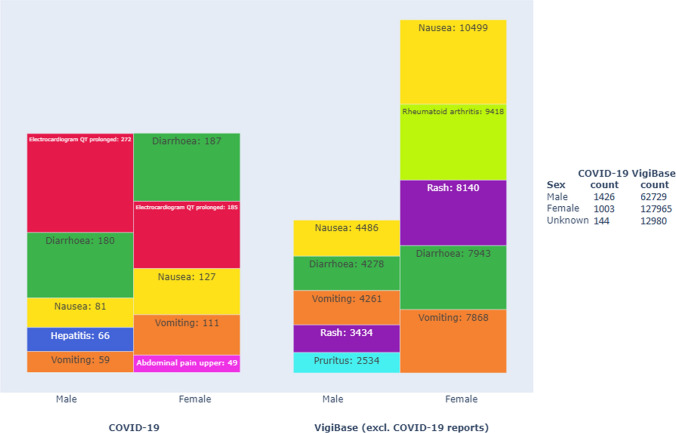
In total, 2573 reports were identified for drugs used in the treatment of COVID-19. In order of frequency, the most reported ADRs were electrocardiogram QT-prolonged, diarrhoea, nausea, hepatitis, and vomiting in males and diarrhoea, electrocardiogram QT-prolonged, nausea, vomiting, and upper abdominal pain in females. Other hepatic and kidney-related events were included in the top ten ADRs in males, whereas no hepatic or renal terms were reported for females. COVID-19-related reporting patterns differed from non-pandemic reporting for these drugs.
Review of a global database of suspected ADR reports revealed sex differences in the reporting patterns for drugs used in the treatment of COVID-19. Patterns of ADR sex differences need further elucidation.
2019 年末,一种新型冠状病毒——严重急性呼吸综合征冠状病毒 2(SARS-CoV-2)在中国武汉被发现,世界卫生组织随后宣布 2019 年冠状病毒病(COVID-19)为大流行。为治疗 COVID-19,人们对包括“团结”(一项国际临床试验)在内的许多药物进行了重新应用和治疗效果研究,这些药物包括阿奇霉素、氯喹、羟氯喹、洛匹那韦/利托那韦固定剂量复方制剂和瑞德西韦。
本研究旨在评估 COVID-19 治疗药物与其他适应证药物相比的药物不良反应(ADR)报告情况,特别关注性别差异。
我们使用一种针对 COVID-19 适应证的报告制定的算法,从全球 ADR 数据库(VigiBase)中提取 COVID-19 特异性治疗药物的报告。纳入了“团结”试验药物和任何报告≥100 次的药物。我们对用于非 COVID-19 适应证的相同药物报告进行了描述性比较。数据锁定日期为 2020 年 6 月 7 日。
共确定了 2573 例用于 COVID-19 治疗的药物报告。按频率顺序,男性报告的最常见 ADR 为心电图 QT 延长、腹泻、恶心、肝炎和呕吐,女性报告的最常见 ADR 为腹泻、心电图 QT 延长、恶心、呕吐和上腹痛。其他与肝、肾相关的事件也位列男性 ADR 前 10 位,而女性未报告任何肝或肾相关术语。这些药物的 COVID-19 相关报告模式与大流行前的报告模式不同。
审查全球疑似 ADR 报告数据库显示,COVID-19 治疗药物的报告模式存在性别差异。需要进一步阐明 ADR 性别差异的模式。