Kākāpō Recovery Programme, Department of Conservation, Invercargill, New Zealand.
Department of Computer Science, Aalto University, Espoo, Finland.
PeerJ. 2023 Feb 3;11:e14675. doi: 10.7717/peerj.14675. eCollection 2023.
Animal conservation often requires intensive management actions to improve reproductive output, yet any adverse effects of these may not be immediately apparent, particularly in threatened species with small populations and long lifespans. Hand-rearing is an example of a conservation management strategy which, while boosting populations, can cause long-term demographic and behavioural problems. It is used in the recovery of the critically endangered kākāpō (), a flightless parrot endemic to New Zealand, to improve the slow population growth that is due to infrequent breeding, low fertility and low hatching success.
We applied Bayesian mixed models to examine whether hand-rearing and other factors were associated with clutch fertility in kākāpō. We used projection predictive variable selection to compare the relative contributions to fertility from the parents' rearing environment, their age and previous copulation experience, the parental kinship, and the number of mates and copulations for each clutch. We also explored how the incidence of repeated copulations and multiple mates varied with kākāpō density.
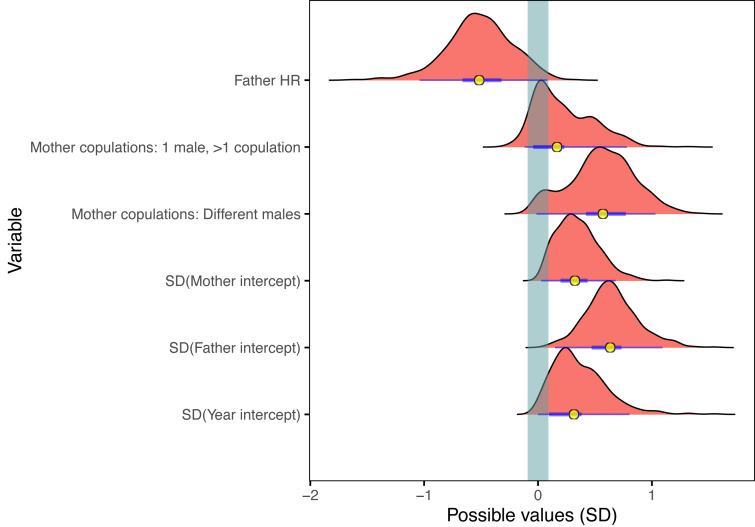
The rearing status of the clutch father and the number of mates and copulations of the clutch mother were the dominant factors in predicting fertility. Clutches were less likely to be fertile if the father was hand-reared compared to wild-reared, but there was no similar effect for mothers. Clutches produced by females copulating with different males were more likely to be fertile than those from repeated copulations with one male, which in turn had a higher probability of fertility than those from a single copulation. The likelihood of multiple copulations and mates increased with female:male adult sex ratio, perhaps as a result of mate guarding by females. Parental kinship, copulation experience and age all had negligible associations with clutch fertility.
These results provide a rare assessment of factors affecting fertility in a wild threatened bird species, with implications for conservation management. The increased fertility due to multiple mates and copulations, combined with the evidence for mate guarding and previous results of kākāpō sperm morphology, suggests that an evolutionary mechanism exists to optimise fertility through sperm competition in kākāpō. The high frequency of clutches produced from single copulations in the contemporary population may therefore represent an unnatural state, perhaps due to too few females. This suggests that opportunity for sperm competition should be maximised by increasing population densities, optimising sex ratios, and using artificial insemination. The lower fertility of hand-reared males may result from behavioural defects due to lack of exposure to conspecifics at critical development stages, as seen in other taxa. This potential negative impact of hand-rearing must be balanced against the short-term benefits it provides.
动物保护常常需要密集的管理措施来提高繁殖产量,但这些措施的任何不利影响可能不会立即显现,尤其是在种群数量小且寿命长的濒危物种中。人工育雏是一种保护管理策略,它可以增加种群数量,但会导致长期的人口和行为问题。在濒危物种鸮鹦鹉()的恢复中就使用了这种策略,它通过提高繁殖频率较低、生育率低和孵化成功率低导致的缓慢种群增长。
我们应用贝叶斯混合模型来研究人工育雏和其他因素是否与鸮鹦鹉的卵受精能力有关。我们使用投影预测变量选择来比较父母育雏环境、年龄和以前交配经验、父母亲缘关系、每个巢的配偶数量和交配次数对繁殖力的相对贡献。我们还探索了鸮鹦鹉密度如何影响重复交配和多个配偶的发生率。
巢的父亲的育雏状态和巢的母亲的配偶数量和交配次数是预测繁殖力的主要因素。与野生育雏相比,育雏的父亲的雏鸟产卵率较低,但母亲的雏鸟没有类似的影响。与一只雄性进行多次交配的雌性所产的卵比与一只雄性进行重复交配的卵更有可能受精,而与一只雄性进行单次交配的卵则更有可能受精。多次交配和多个配偶的可能性随着雌性:雄性成年性别比例的增加而增加,这可能是由于雌性的配偶保卫行为导致的。父母亲缘关系、交配经验和年龄与卵受精能力都没有明显的关联。
这些结果为评估影响野生濒危鸟类繁殖力的因素提供了一个难得的机会,对保护管理具有重要意义。由于多个配偶和交配导致的繁殖力增加,再加上配偶保卫行为和以前鸮鹦鹉精子形态学的结果,表明在鸮鹦鹉中存在通过精子竞争来优化繁殖力的进化机制。在当代种群中,单次交配产生的卵的高频率可能代表一种非自然状态,可能是由于雌性数量太少。这表明通过增加种群密度、优化性别比例和使用人工授精来最大限度地提高精子竞争机会。由于在关键发育阶段缺乏与同种动物的接触,人工育雏雄性的繁殖力可能较低,这可能是由于行为缺陷所致,在其他分类群中也有类似的情况。这种人工育雏的潜在负面影响必须与它提供的短期利益相平衡。