Kwan Alan C, Wei Janet, Ouyang David, Ebinger Joseph E, Merz C Noel Bairey, Berman Daniel, Cheng Susan
Department of Cardiology, Smidt Heart Institute, Los Angeles, CA, United States.
Barbara Streisand Women's Heart Institute, Los Angeles, CA, United States.
Front Cardiovasc Med. 2023 Jan 24;10:1085914. doi: 10.3389/fcvm.2023.1085914. eCollection 2023.
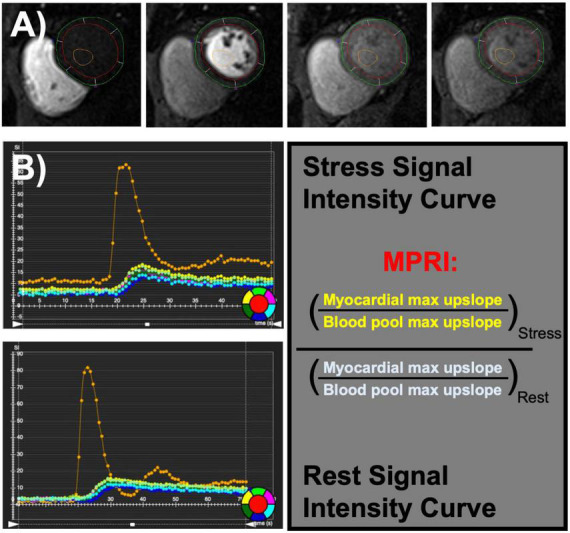
Coronary microvascular dysfunction (CMD) has differences in prevalence and presentation between women and men; however, we have limited understanding about underlying contributors to sex differences in CMD. Myocardial perfusion reserve index (MPRI), as semi-quantitative measure of myocardial perfusion derived from cardiac magnetic resonance (CMR) imaging has been validated as a measure of CMD. We sought to understand the sex differences in the relations between the MPRI and traditional measures of cardiovascular disease by CMR.
A retrospective analysis of a single-center cohort of patients receiving clinical stress CMR from 2015 to 2022 was performed. Patients with calculated MPRI and no visible perfusion defects consistent with obstructive epicardial coronary disease were included. We compared associations between MPRI versus traditional cardiovascular risk factors and markers of cardiac structure/function in sex-stratified populations using univariable and multivariable regression models.
A total of 229 patients [193 female, 36 male, median age 57 (47-67) years] were included in the analysis. In the female population, no traditional cardiovascular risk factors were associated with MPRI, whereas in the male population, diabetes (β: -0.80, = 0.03) and hyperlipidemia (β: -0.76, = 0.006) were both associated with reduced MPRI in multivariable models. Multivariable models revealed significant associations between reduced MPRI and increased ascending aortic diameter (β: -0.42, = 0.005) and T1 times (β: -0.0056, = 0.03) in the male population, and increased T1 times (β: -0.0037, = 0.006) and LVMI (β: -0.022, = 0.0003) in the female population.
The findings suggest different underlying pathophysiology of CMD in men versus women, with lower MPRI in male patients fitting a more "traditional" atherosclerotic profile.
冠状动脉微血管功能障碍(CMD)在女性和男性中的患病率及表现存在差异;然而,我们对CMD性别差异的潜在影响因素了解有限。心肌灌注储备指数(MPRI)作为一种从心脏磁共振(CMR)成像得出的心肌灌注半定量指标,已被证实可用于衡量CMD。我们试图通过CMR了解MPRI与传统心血管疾病指标之间关系的性别差异。
对2015年至2022年接受临床应激CMR的单中心队列患者进行回顾性分析。纳入计算了MPRI且无与梗阻性心外膜冠状动脉疾病一致的可见灌注缺损的患者。我们使用单变量和多变量回归模型,比较了性别分层人群中MPRI与传统心血管危险因素及心脏结构/功能标志物之间的关联。
共有229例患者[193例女性,36例男性,中位年龄57(47 - 67)岁]纳入分析。在女性人群中,没有传统心血管危险因素与MPRI相关,而在男性人群中,多变量模型显示糖尿病(β:-0.80,P = 0.03)和高脂血症(β:-0.76,P = 0.006)均与MPRI降低相关。多变量模型显示,男性人群中MPRI降低与升主动脉直径增加(β:-0.42,P = 0.005)和T1时间增加(β:-0.0056,P = 0.03)显著相关,女性人群中MPRI降低与T1时间增加(β:-0.0037,P = 0.006)和左室质量指数增加(β:-0.022,P = 0.0003)显著相关。
研究结果表明,男性和女性CMD的潜在病理生理学不同,男性患者较低的MPRI符合更“传统”的动脉粥样硬化特征。