Department of Radiation Oncology, Massachusetts General Hospital, Harvard Medical School, Boston, MA, USA.
Department of Medicine, Massachusetts General Hospital, Harvard Medical School, Boston, MA, USA.
JNCI Cancer Spectr. 2023 Mar 1;7(2). doi: 10.1093/jncics/pkad008.
Gender disparities in academic medicine are a long-acknowledged concern, particularly at medical conferences. We investigated gender representation and prevalence of "manels" (all-men panels) among invited speakers at the 2018-2021 American Society of Clinical Oncology Annual Meetings.
Using American Society of Clinical Oncology online programs, 2018-2021 faculty information was obtained, including perceived or self-reported gender, medical specialty, session type, and topic. Primary outcomes were percentage of manels and proportion of women panelists over time; women representation among specialties and topics were evaluated. Cochran-Armitage and Fisher's exact tests were used to analyze trends in proportion of manels and women representation over time and to compare each session type, topic, or specialty with other categories combined, respectively.
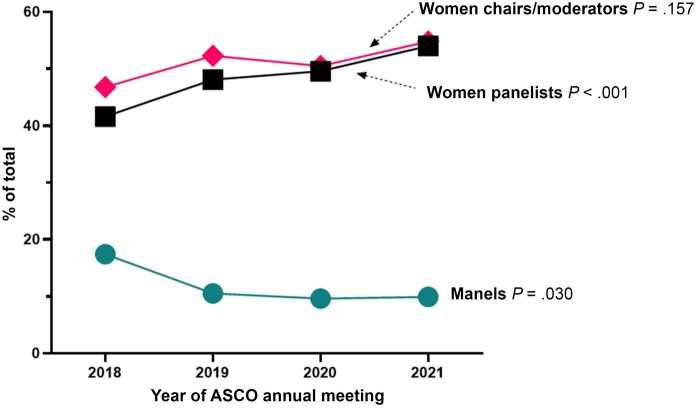
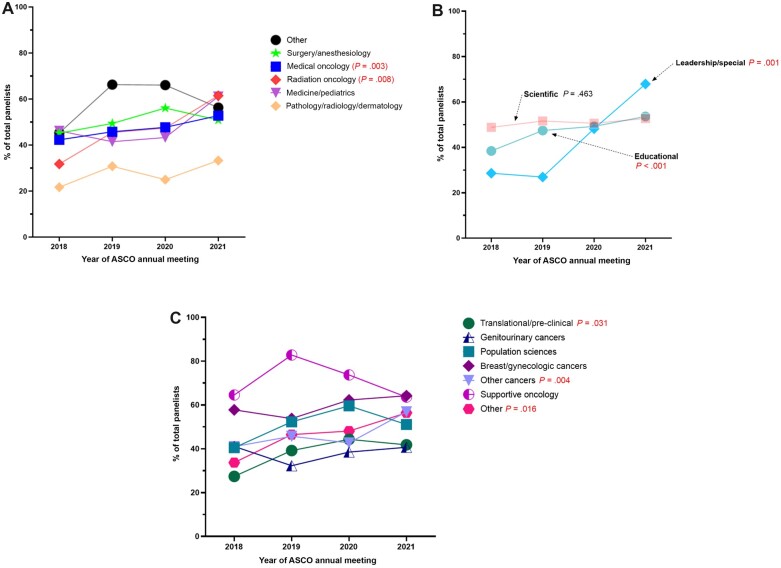
During 2018-2021, there were 670 sessions, 81 of which (12.1%) were manels. Among 2475 panelists, 1181 (47.7%) were women. Over time, the percentage of manels significantly decreased from 17.4% in 2018 to 9.9% in 2021 (P = .030). The highest proportion of manels was observed for leadership or special sessions (17.1%, P = .419). Women panelists were underrepresented for the topics of genitourinary cancers (38.6%, P = .029) and translational or preclinical sciences (36.7%, P < .001). There was a positive trend toward improved women representation among translational or preclinical sciences (27.4% in 2018 vs 41.8% in 2021, P = .031) but not among genitourinary cancers (41.1% in 2018 vs 40.7% in 2021, P = .969).
The number of women panelists increased during the study period, with a corresponding decrease in the proportion of manels, specifically in education and leadership or special sessions. Ongoing underrepresentation of women in genitourinary cancers and translational or preclinical topics underscores the importance of annual meeting organizers continuing to strive for diverse gender representation.
医学学术界的性别差异是一个长期存在的问题,尤其是在医学会议上。我们调查了 2018 年至 2021 年美国临床肿瘤学会年会邀请演讲者中的性别代表性和“全男小组”(全男性小组)的流行情况。
使用美国临床肿瘤学会在线项目,获取 2018 年至 2021 年的教员信息,包括感知或自我报告的性别、医学专业、会议类型和主题。主要结果是全男小组的百分比和女性小组成员的比例随时间的变化;评估各专业和主题的女性代表性。采用 Cochran-Armitage 和 Fisher 精确检验分析全男小组比例和女性代表性随时间的变化趋势,并分别比较每个会议类型、主题或专业与其他类别组合的情况。
在 2018 年至 2021 年期间,共举办了 670 个会议,其中 81 个(12.1%)为全男小组。在 2475 名小组成员中,有 1181 名(47.7%)为女性。随着时间的推移,全男小组的比例从 2018 年的 17.4%显著下降到 2021 年的 9.9%(P=0.030)。领导力或特别会议的全男小组比例最高(17.1%,P=0.419)。在泌尿生殖系统癌症(38.6%,P=0.029)和转化或临床前科学(36.7%,P<0.001)主题方面,女性小组成员代表性不足。在转化或临床前科学领域,女性代表人数呈上升趋势(2018 年为 27.4%,2021 年为 41.8%,P=0.031),但在泌尿生殖系统癌症方面则没有(2018 年为 41.1%,2021 年为 40.7%,P=0.969)。
在研究期间,女性小组成员的数量增加,全男小组的比例相应减少,特别是在教育和领导力或特别会议方面。在泌尿生殖系统癌症和转化或临床前领域女性代表性不足,突显了年会组织者继续努力实现性别多样性的重要性。