Department of Medicine, School of Clinical Medicine, LKS Faculty of Medicine, The University of Hong Kong, Hong Kong SAR, China.
Department of Medicine, Queen Mary Hospital, Pokfulam Road, Professorial Block, Hong Kong, China.
BMC Cancer. 2023 Feb 10;23(1):141. doi: 10.1186/s12885-023-10612-z.
The epidemiology and treatment of acute promyelocytic leukaemia (APL) are changing. We have incorporated oral arsenic trioxide (oral-ATO) into induction/maintenance.
Newly-diagnosed APL from 1991 to 2021 divided into three 10-year periods were studied to define its epidemiology and how oral-ATO impacted on its outcome. Primary endpoints included APL incidence, early deaths (ED, first 30 days), and overall survival (OS). Secondary endpoints included post-30-day OS, relapse-free survival (RFS), and incidence of second cancers.
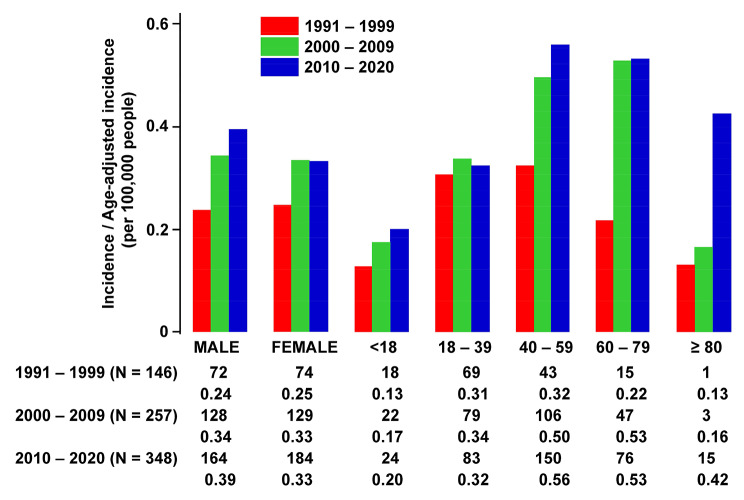
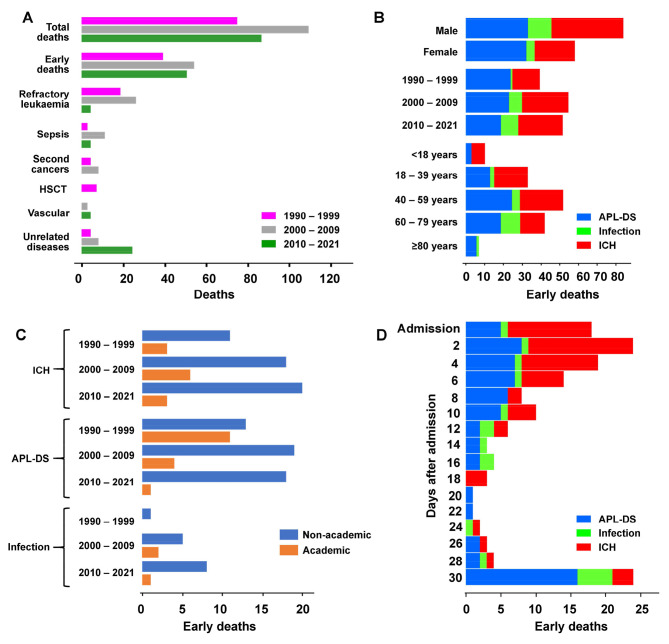
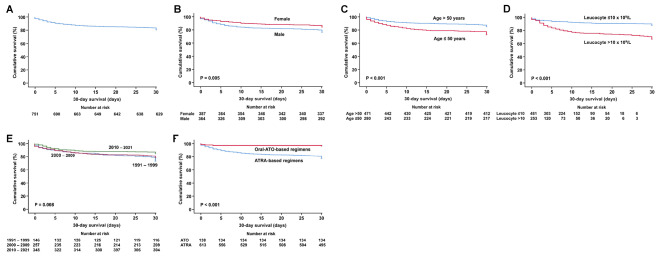
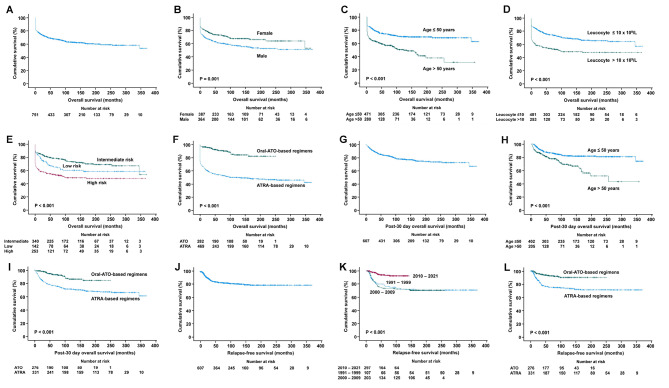
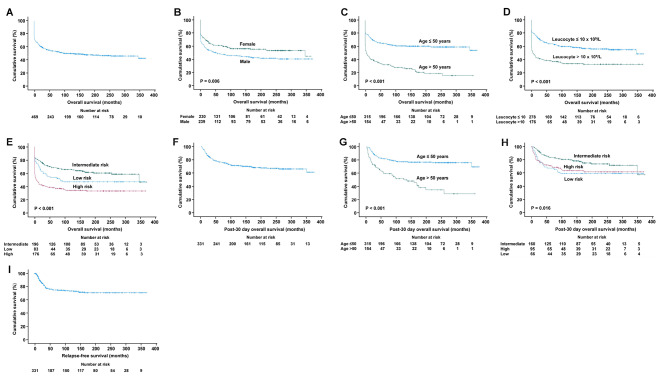
APL occurred in 374 males and 387 females at a median age of 44 (1-97) years. Annual incidences increased progressively, averaging 0.32 per 100,000 people. All-trans retinoic acid (ATRA)-based and oral-ATO-based regimens were used in 469 and 282 patients. There were 144 EDs, occurring almost exclusively in ATRA-based inductions (N = 139), being more with males, age > 50 years, leucocyte > 10 × 10/L, diagnosis during 1991-2009 and fewer with oral-ATO-based regimens. After a median of 75 (interquartile range: 14-161) months, 5-year and 10-year OS were 68.1% and 63.3%, inferior with males, age > 50 years, leucocyte > 10 × 10/L, high-risk Sanz score and superior with oral-ATO-based regimens. Factoring out EDs, 5-year and 10-year post-30-day OS were 84.0% and 78.1%, inferior with males and superior with oral-ATO-based regimens. In 607 CR1 patients, the 5-year RFS was 83.8%, superior with diagnosis in 2010-2021 and oral-ATO-based regimens. Second cancers developed in 21 patients, unrelated to oral-ATO-based regimens.
There was an increasing incidence of APL, and all survivals were superior with the use of oral-ATO-based regimens. This study formed part of the Acute Promyelocytic Leukaemia Asian Consortium Project (ClinicalTrials.gov identifier: NCT04251754).
急性早幼粒细胞白血病(APL)的流行病学和治疗正在发生变化。我们已经将口服三氧化二砷(oral-ATO)纳入诱导/维持治疗。
研究了 1991 年至 2021 年期间的三组新诊断的 APL,以确定其流行病学情况以及口服-ATO 对其结果的影响。主要终点包括 APL 发病率、早期死亡(ED,前 30 天)和总生存率(OS)。次要终点包括 30 天后 OS、无复发生存率(RFS)和第二癌症发病率。
374 名男性和 387 名女性患者中位年龄为 44(1-97)岁。APL 的年发病率呈逐渐递增趋势,平均每 10 万人中有 0.32 人发病。469 名患者接受了全反式维甲酸(ATRA)为基础的方案,282 名患者接受了口服-ATO 为基础的方案。共有 144 例 ED,几乎仅发生在 ATRA 为基础的诱导治疗中(N=139),男性、年龄>50 岁、白细胞>10×10/L、诊断时间在 1991-2009 年以及接受口服-ATO 为基础的方案的患者中 ED 发生率更高。中位随访 75(四分位距:14-161)个月后,5 年和 10 年 OS 分别为 68.1%和 63.3%,男性、年龄>50 岁、白细胞>10×10/L、高风险 Sanz 评分患者预后较差,而接受口服-ATO 为基础的方案的患者预后较好。排除 ED 后,30 天后的 5 年和 10 年 OS 分别为 84.0%和 78.1%,男性患者预后较差,而接受口服-ATO 为基础的方案的患者预后较好。在 607 例 CR1 患者中,5 年 RFS 为 83.8%,诊断时间在 2010-2021 年和接受口服-ATO 为基础的方案的患者 RFS 较高。21 例患者发生第二癌症,与口服-ATO 为基础的方案无关。
APL 的发病率呈上升趋势,所有生存率均随着口服-ATO 为基础的方案的应用而提高。本研究是急性早幼粒细胞白血病亚洲协作组项目(ClinicalTrials.gov 标识符:NCT04251754)的一部分。