Ghosh Ruchira, Thomas Donald S, Arcot Jayashree
Food and Health, School of Chemical Engineering, UNSW Sydney, Sydney, NSW 2052, Australia.
NMR Facility, UNSW Sydney, Sydney, NSW 2052, Australia.
Foods. 2023 Jan 28;12(3):575. doi: 10.3390/foods12030575.
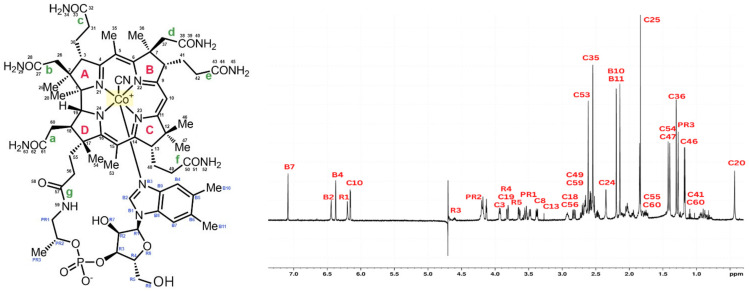
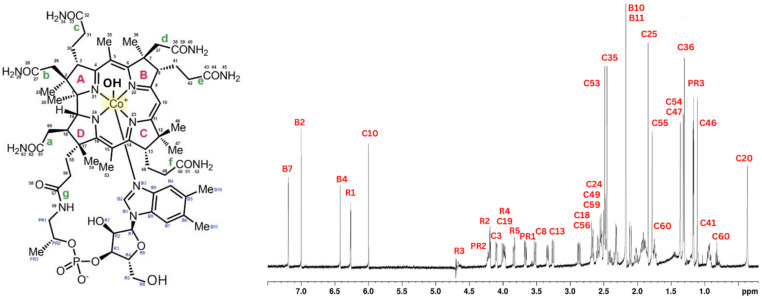
Ligand-receptor molecular recognition is the basis of biological processes. The Saturation Transfer Difference-NMR (STD-NMR) technique has been recently used to gain qualitative and quantitative information about physiological interactions at an atomic resolution. The molecular recognition patterns between the cyanocobalamin (CNBL)/aqua cobalamin (OHBL) and different plant and animal proteins were investigated via STD-NMR supplemented by molecular docking. This study demonstrates that myoglobin has the highest binding affinity and that gluten has the lowest affinity. Casein also shows a higher binding affinity for cyanocobalamin when compared with that of plant-based proteins. STD-NMR results showed the moderate binding capability of casein with both CNBL and OHBL. Computer simulation confirmed the recognition mode in theory and was compared with the experiments. This work is beneficial for understanding the binding affinity and biological action of cyanocobalamin and will attract researchers to use NMR technology to link the chemical and physiological properties of nutrients.
配体-受体分子识别是生物过程的基础。饱和转移差分核磁共振(STD-NMR)技术最近已被用于在原子分辨率下获取有关生理相互作用的定性和定量信息。通过分子对接辅助的STD-NMR研究了氰钴胺(CNBL)/水合钴胺(OHBL)与不同动植物蛋白之间的分子识别模式。本研究表明,肌红蛋白具有最高的结合亲和力,而谷蛋白具有最低的亲和力。与植物性蛋白质相比,酪蛋白对氰钴胺也表现出更高的结合亲和力。STD-NMR结果表明酪蛋白与CNBL和OHBL均具有中等结合能力。计算机模拟从理论上证实了识别模式,并与实验进行了比较。这项工作有助于理解氰钴胺的结合亲和力和生物学作用,并将吸引研究人员使用核磁共振技术来联系营养素的化学和生理特性。