Baratti Greta, Boffelli Sara, Potrich Davide, Sovrano Valeria Anna
CIMeC, Center for Mind/Brain Sciences, University of Trento, 38068 Rovereto, Italy.
Department of Psychology and Cognitive Science, University of Trento, 38068 Rovereto, Italy.
Animals (Basel). 2023 Jan 27;13(3):440. doi: 10.3390/ani13030440.
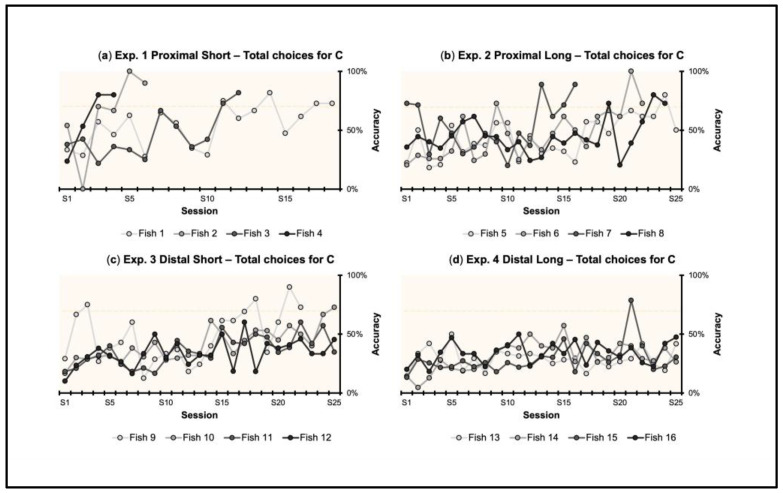
Fish conjoin environmental geometry with conspicuous landmarks to reorient towards foraging sites and social stimuli. Zebrafish () can merge a rectangular opaque arena with a 2D landmark (a blue-colored wall) but cannot merge a rectangular transparent arena with a 3D landmark (a blue cylinder) without training to "feel" the environment thanks to other-than-sight pathways. Thus, their success is linked to tasks differences (spontaneous vs. rewarded). This study explored the reorientation behavior of zebrafish within a rectangular transparent arena, with a blue cylinder outside, proximal to/distal from a target corner position, on the short/long side of the arena. Adult males were extensively trained to distinguish the correct corner from the rotational one, sharing an equivalent metric-sense relationship (short surface left, long surface right), to access food and companions. Results showed that zebrafish's reorientation behavior was driven by both the non-visual geometry and the visual landmark, partially depending on the landmark's proximity and surface length. Better accuracy was attained when the landmark was proximal to the target corner. When long-term experience was allowed, zebrafish handled non-visual and visual sensory stimulations over time for reorienting. We advance the possibility that multisensory processes affect fish's reorientation behavior and spatial learning, providing a link through which to investigate animals' exploratory strategies to face situations of visual deprivation or impairments.
鱼类将环境几何形状与显著地标相结合,以重新定位到觅食地点和社交刺激源。斑马鱼()可以将一个矩形不透明竞技场与一个二维地标(一堵蓝色的墙)相结合,但如果没有经过训练以通过非视觉途径“感知”环境,它们就无法将一个矩形透明竞技场与一个三维地标(一个蓝色圆柱体)相结合。因此,它们的成功与任务差异(自发的与有奖励的)有关。本研究探讨了斑马鱼在一个矩形透明竞技场中的重新定位行为,竞技场外部有一个蓝色圆柱体,靠近/远离目标角落位置,位于竞技场的短边/长边。成年雄性斑马鱼经过广泛训练,以区分正确的角落和旋转的角落,它们具有相同的度量感关系(短边在左,长边在右),以便获取食物和同伴。结果表明,斑马鱼的重新定位行为受到非视觉几何形状和视觉地标的驱动,部分取决于地标的接近程度和表面长度。当地标靠近目标角落时,准确率更高。当给予长期经验时,斑马鱼会随着时间的推移处理非视觉和视觉感官刺激以进行重新定位。我们提出了多感官过程影响鱼类重新定位行为和空间学习的可能性,提供了一个联系,通过它可以研究动物面对视觉剥夺或损伤情况时的探索策略。