Occupational and Environmental Epidemiology Branch, Cancer Risk Factors and Lifestyle Epidemiology Unit, Institute for Cancer Research, Prevention and Clinical Network (ISPRO), 50139 Florence, Italy.
Local Health Unit AUSL Modena, SPSAL-Department of Public Health, 41121 Modena, Italy.
Int J Environ Res Public Health. 2023 Jan 21;20(3):1983. doi: 10.3390/ijerph20031983.
Formaldehyde, a colorless and highly irritating substance, causes cancer of the nasopharynx and leukemia. Furthermore, it is one of the environmental mutagens to which humans are most abundantly exposed. Acetaldehyde was recently classified as carcinogen class 1B and mutagen class 2 in Annex VI EC regulation. Occupational exposure to the two aldehydes occurs in a wide variety of occupations and industries. The aim of this study is to deepen exposure to the two aldehydes in the non-traditional productive sectors of bakeries and pastry producers.
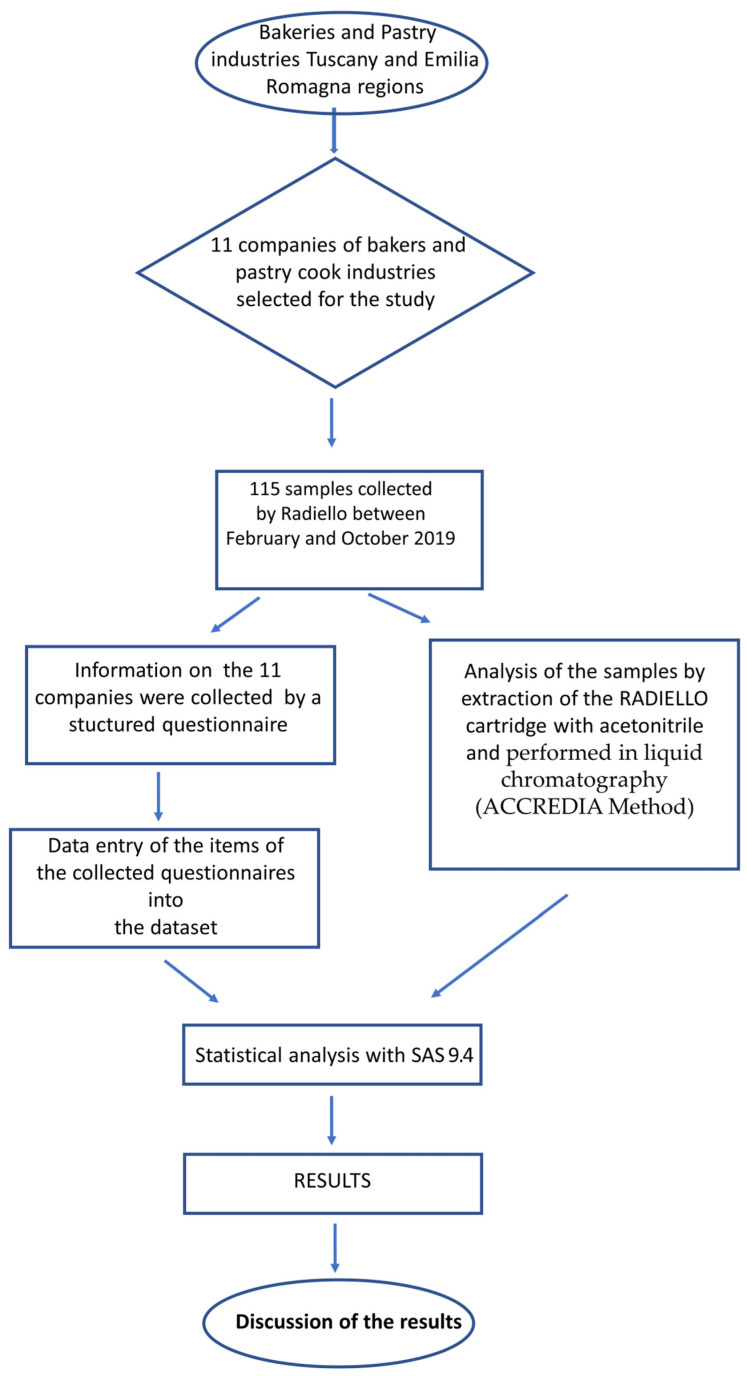
The evaluation of exposure to formaldehyde and acetaldehyde was conducted in Italy in 2019, in specific tasks and positions of 11 bakeries and pastry producers (115 measures, of which 57.4% were in fixed positions and the rest were personal air sampling). The measurements were performed using Radiello© radial diffusion samplers. A logarithmic transformation of the data was performed, and the correlation between the two substances was calculated. Moreover, linear models considering the log-formaldehyde as the outcome and adjusting for log-acetaldehyde values were used.
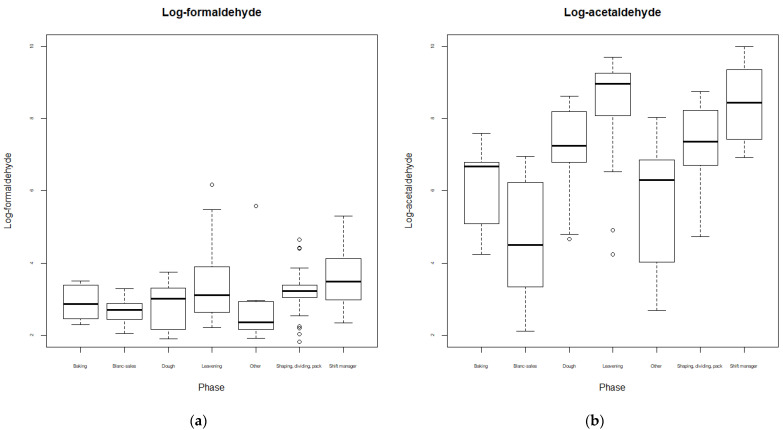
The study identified high levels of acetaldehyde and formaldehyde exposure in the monitored workplaces. Higher mean values were observed in the leavening phase (8.39 µg/m and 3.39 µg/m for log-transformed data acetaldehyde and formaldehyde, respectively). The adjusted univariate analyses show statistically significant factors for formaldehyde as the presence of yeast, the presence of type 1 flour, the use of barley, the use of fats, the type of production, the use of spelt, and the presence of type 0 flour.
The measurements confirmed the release of formaldehyde and acetaldehyde in bakeries and pastry industries, especially in some phases of the work process, such as leavening.
甲醛是一种无色且具有高度刺激性的物质,会导致鼻咽癌和白血病。此外,它是人类接触最多的环境诱变剂之一。乙醛最近被归类为 EC 法规附件 VI 中 1B 类致癌物质和 2 类致突变物质。职业暴露于这两种醛类物质存在于各种职业和行业中。本研究旨在深入了解面包店和糕点生产商等非传统生产领域中这两种醛类物质的暴露情况。
2019 年在意大利对 11 家面包店和糕点生产商的特定任务和岗位(115 项测量值,其中 57.4%为固定岗位,其余为个人空气采样)进行了甲醛和乙醛暴露评估。使用 Radiello©径向扩散采样器进行测量。对数据进行对数转换,并计算两种物质之间的相关性。此外,还使用考虑以对数形式的甲醛作为结果并调整以对数形式的乙醛值的线性模型。
该研究在监测的工作场所中发现了高浓度的乙醛和甲醛暴露。在发酵阶段观察到更高的平均值(对数转换后的数据,乙醛和甲醛的平均值分别为 8.39µg/m 和 3.39µg/m)。调整后的单变量分析显示,对于甲醛来说,酵母的存在、1 型面粉的存在、大麦的使用、脂肪的使用、生产类型、斯佩尔特小麦的使用以及 0 型面粉的存在是统计学上显著的因素。
测量结果证实了面包店和糕点行业中甲醛和乙醛的释放,特别是在发酵等一些工作过程阶段。