NeuroEpigenetics Lab, Instituto de Investigación Sanitaria de Santiago (IDIS), Complejo Hospitalario Universitario de Santiago, 15706 Santiago de Compostela, Spain.
Translational Neuroscience Group, Galicia Sur Health Research Institute (IIS Galicia Sur), Área Sanitaria de Vigo-Hospital Álvaro Cunqueiro, SERGAS-UVIGO, CIBERSAM-ISCIII, 36213 Vigo, Spain.
Int J Mol Sci. 2023 Jan 18;24(3):1891. doi: 10.3390/ijms24031891.
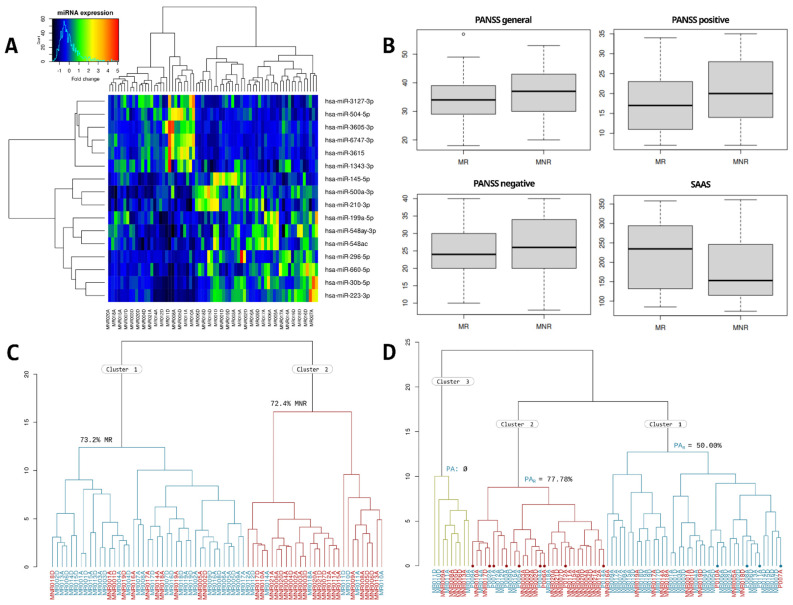
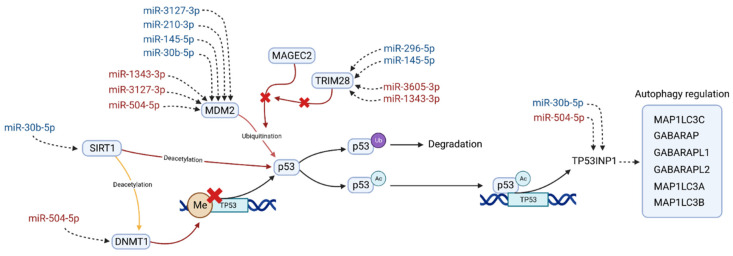
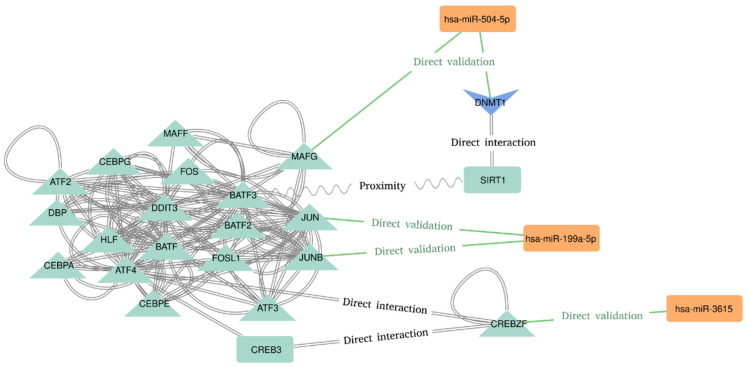
Schizophrenia (SZ) is a serious mental disorder that is typically treated with antipsychotic medication. Treatment-resistant schizophrenia (TRS) is the condition where symptoms remain after pharmacological intervention, resulting in long-lasting functional and social impairments. As the identification and treatment of a TRS patient requires previous failed treatments, early mechanisms of detection are needed in order to quicken the access to effective therapy, as well as improve treatment adherence. In this study, we aim to find a microRNA (miRNA) signature for TRS, as well as to shed some light on the molecular pathways potentially involved in this severe condition. To do this, we compared the blood miRNAs of schizophrenia patients that respond to medication and TRS patients, thus obtaining a 16-miRNA TRS profile. Then, we assessed the ability of this signature to separate responders and TRS patients using hierarchical clustering, observing that most of them are grouped correctly (~70% accuracy). We also conducted a network, pathway analysis, and bibliography search to spot molecular pathways potentially altered in TRS. We found that the response to stress seems to be a key factor in TRS and that proteins p53, SIRT1, MDM2, and TRIM28 could be the potential mediators of such responses. Finally, we suggest a molecular pathway potentially regulated by the miRNAs of the TRS profile.
精神分裂症(SZ)是一种严重的精神障碍,通常采用抗精神病药物治疗。治疗抵抗性精神分裂症(TRS)是指在药物干预后症状仍然存在,导致长期的功能和社交障碍。由于识别和治疗 TRS 患者需要先前失败的治疗,因此需要早期的检测机制,以便尽快获得有效的治疗,并提高治疗的依从性。在这项研究中,我们旨在寻找 TRS 的 microRNA(miRNA)特征,并阐明可能涉及这种严重疾病的分子途径。为此,我们比较了对药物有反应的精神分裂症患者和 TRS 患者的血液 miRNA,从而获得了 16 个 miRNA 的 TRS 特征。然后,我们使用层次聚类评估了该特征区分应答者和 TRS 患者的能力,观察到它们中的大多数被正确分组(约 70%的准确率)。我们还进行了网络、途径分析和文献搜索,以发现 TRS 中可能改变的分子途径。我们发现,对压力的反应似乎是 TRS 的一个关键因素,p53、SIRT1、MDM2 和 TRIM28 等蛋白可能是这些反应的潜在介质。最后,我们提出了一个可能受 TRS 特征 miRNA 调节的分子途径。