AntiCancer Inc., 7917 Ostrow Str., San Diego, CA 92111-3604, USA.
Department of Surgery, University of California, San Diego, CA 92037-7220, USA.
Int J Mol Sci. 2023 Jan 18;24(3):1935. doi: 10.3390/ijms24031935.
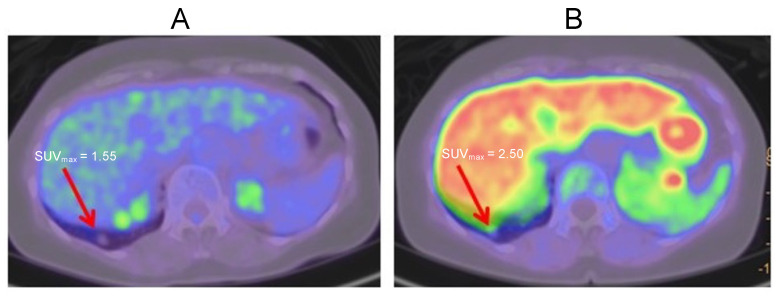
Positron emission tomography (PET) is widely used to detect cancers. The usual isotope for PET imaging of cancer is [F]deoxyglucose. The premise of using [F]deoxyglucose is that cancers are addicted to glucose (The Warburg effect). However, cancers are more severely addicted to methionine (The Hoffman effect). [C]methionine PET (MET-PET) has been effectively used for the detection of glioblastoma and other cancers in the brain, and in comparison, MET-PET has been shown to be more sensitive and accurate than [F]deoxyglucose PET (FDG-PET). However, MET-PET has been limited to cancers in the brain. The present report describes the first applications of MET-PET to cancers of multiple organs, including rectal, bladder, lung, and kidney. The results in each case show that MET-PET is superior to FDG-PET due to the methionine addiction of cancer and suggest that the broad application of MET-PET should be undertaken for cancer detection.
正电子发射断层扫描(PET)广泛用于癌症检测。癌症 PET 成像常用的同位素是[F]脱氧葡萄糖。使用[F]脱氧葡萄糖的前提是癌症对葡萄糖(沃伯格效应)有依赖性。然而,癌症对蛋氨酸(霍夫曼效应)的依赖性更严重。[C]蛋氨酸 PET(MET-PET)已有效地用于脑胶质瘤和其他脑部癌症的检测,相比之下,MET-PET 被证明比[F]脱氧葡萄糖 PET(FDG-PET)更敏感和准确。然而,MET-PET 仅限于脑部癌症。本报告描述了 MET-PET 首次应用于包括直肠、膀胱、肺和肾在内的多种器官癌症的情况。在每种情况下的结果均表明,由于癌症对蛋氨酸的依赖性,MET-PET 优于 FDG-PET,并提示应广泛开展 MET-PET 用于癌症检测。