Centre for Rare Disease-Disorders of Iron Metabolism, Fondazione IRCCS, San Gerardo dei Tintori, European Reference Network-EuroBloodNet, 20900 Monza, Italy.
Centro Ricerca Tettamanti, 20900 Monza, Italy.
Int J Mol Sci. 2023 Jan 29;24(3):2560. doi: 10.3390/ijms24032560.
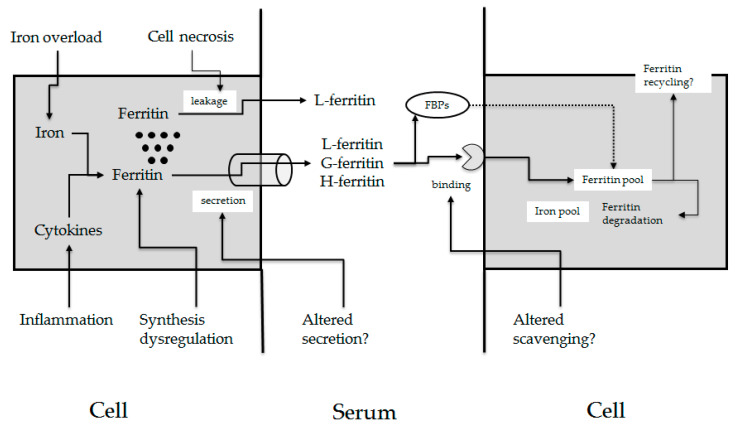
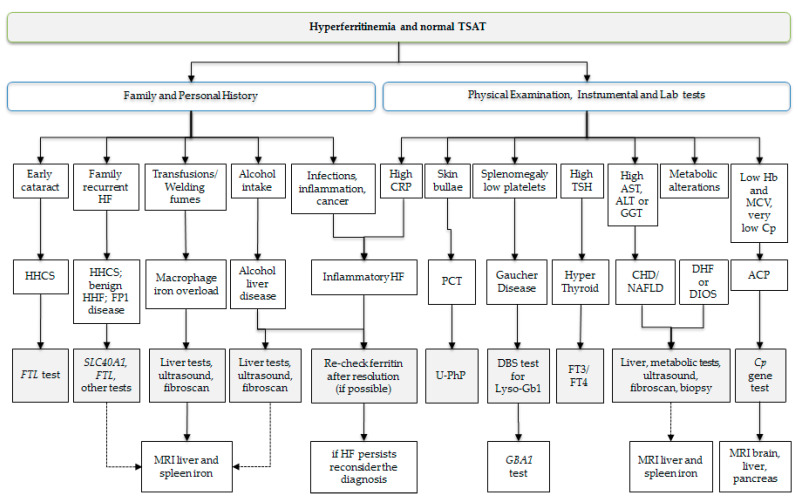
Ferritin is a ubiquitous protein that is present in most tissues as a cytosolic protein. The major and common role of ferritin is to bind Fe, oxidize it and sequester it in a safe form in the cell, and to release iron according to cellular needs. Ferritin is also present at a considerably low proportion in normal mammalian sera and is relatively iron poor compared to tissues. Serum ferritin might provide a useful and convenient method of assessing the status of iron storage, and its measurement has become a routine laboratory test. However, many additional factors, including inflammation, infection, metabolic abnormalities, and malignancy-all of which may elevate serum ferritin-complicate interpretation of this value. Despite this long history of clinical use, fundamental aspects of the biology of serum ferritin are still unclear. According to the high number of factors involved in regulation of ferritin synthesis, secretion, and uptake, and in its central role in iron metabolism, hyperferritinemia is a relatively common finding in clinical practice and is found in a large spectrum of conditions, both genetic and acquired, associated or not with iron overload. The diagnostic strategy to reveal the cause of hyperferritinemia includes family and personal medical history, biochemical and genetic tests, and evaluation of liver iron by direct or indirect methods. This review is focused on the forms of inherited hyperferritinemia with or without iron overload presenting with normal transferrin saturation, as well as a step-by-step approach to distinguish these forms to the acquired forms, common and rare, of isolated hyperferritinemia.
铁蛋白是一种广泛存在的蛋白质,作为细胞溶质蛋白存在于大多数组织中。铁蛋白的主要和常见作用是结合 Fe,将其氧化并将其以安全的形式隔离在细胞内,并根据细胞的需要释放铁。铁蛋白在正常哺乳动物血清中也以相当低的比例存在,并且与组织相比相对缺铁。血清铁蛋白可能提供一种评估铁储存状态的有用且方便的方法,其测量已成为常规实验室测试。然而,许多其他因素,包括炎症、感染、代谢异常和恶性肿瘤 - 所有这些都可能使血清铁蛋白升高 - 使该值的解释变得复杂。尽管有这种长期的临床应用历史,但血清铁蛋白生物学的基本方面仍然不清楚。根据调节铁蛋白合成、分泌和摄取的众多因素,以及其在铁代谢中的核心作用,高血清铁蛋白血症在临床实践中是一种相对常见的发现,并且在遗传和获得性疾病中均有发现,与铁过载相关或不相关。揭示高血清铁蛋白血症原因的诊断策略包括家族和个人病史、生化和基因测试以及直接或间接方法评估肝脏铁。本综述重点介绍了具有或不具有铁过载的遗传性高血清铁蛋白血症的形式,以及逐步区分这些形式与获得性形式的常见和罕见的单纯性高血清铁蛋白血症的方法。