Chen Guanhua, Tan Chunlu, Liu Xubao, Wang Xing, Tan Qingquan, Chen Yonghua
Department of Pancreatic Surgery, West China Hospital of Sichuan University, Chengdu 610041, China.
J Clin Med. 2023 Jan 18;12(3):756. doi: 10.3390/jcm12030756.
There is a high prevalence of diabetes mellitus (DM) in patients with pancreatic ductal adenocarcinoma (PDAC). An inflammatory response is considered as a potential mechanism involved in the process. The systemic immune-inflammation (SII) index is an integrated and novel inflammatory indicator developed in recent years. The purpose of this study was to determine the relationship between the SII and DM secondary to PDAC.
Patients with a confirmed diagnosis of PDAC were analyzed in this cross-sectional study. Anthropometric measures, glucose-related data (including fasting glucose, 2 h OGTT, glycated hemoglobin, fasting insulin, and fasting c-peptide), tumor characteristics (tumor volumes, location and stages), and the periphery blood inflammatory index (white blood cell count, neutrophil-to-lymphocyte ratio, platelet-to-lymphocyte ratio, and SII) were recorded. The inflammation index was analyzed for its association with glucose-related parameters. Multivariable logistic regression analysis was used to analyze the association between SII levels and DM secondary to PDAC.
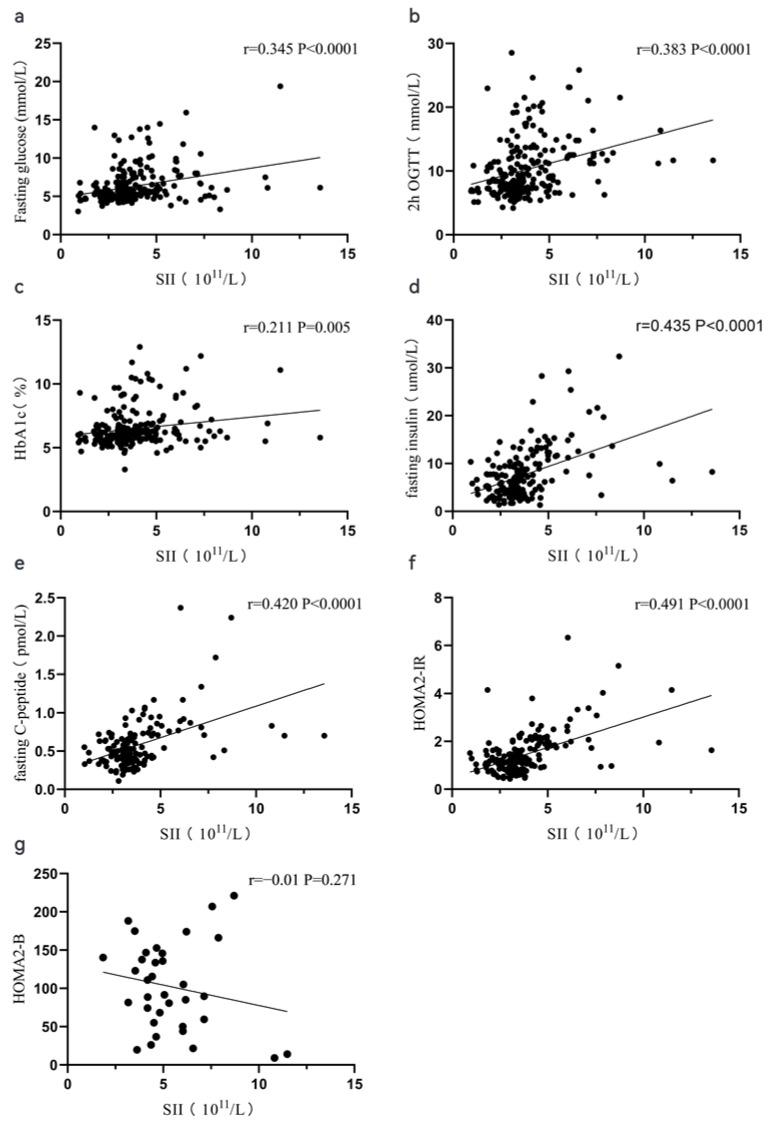
Blood cell results showed that the white blood cell count, neutrophils, lymphocytes, monocytes, platelets, the neutrophil-to-lymphocyte ratio, and platelet-to-lymphocyte ratio were higher in patients with diabetes. It was worth noting that SII significantly increased in patients with diabetes secondary to PDAC (4.41 vs. 3.19, < 0.0001). Multivariable logistic regression analysis showed that SII (OR: 2.024, 95%CI: 1.297, 3.157, = 0.002) and age (OR: 1.043, 95%CI: 1.01, 1.077, = 0.011) were the risk factors for DM secondary to PDAC after adjusting for covariates. According to Spearmen correlation analysis, SII was positively correlated with fasting glucose (r = 0.345, < 0.0001), 2 h OGTT (r = 0.383, < 0.0001), HbA1c (r = 0.211, = 0.005), fasting insulin (r = 0.435, < 0.0001), fasting C-peptide (r = 0.420, < 0.0001), and HOMA2-IR (r = 0.491, < 0.0001).
In conclusion, SII is significantly increased among patients with DM secondary to PDAC and is associated with the DM in patients with PDAC (OR: 2.382, 95% CI: 1.157, 4.903, = 0.019). Additionally, SII is significantly correlated with insulin resistance. We are the first to investigate the relationship between SII and diabetes secondary to PDAC and further confirm the role of an inflammatory response in this process. More studies need to be designed to clarify how inflammatory responses participate.
胰腺导管腺癌(PDAC)患者中糖尿病(DM)的患病率很高。炎症反应被认为是该过程中涉及的一种潜在机制。全身免疫炎症(SII)指数是近年来开发的一种综合且新颖的炎症指标。本研究的目的是确定SII与PDAC继发的DM之间的关系。
在这项横断面研究中分析确诊为PDAC的患者。记录人体测量指标、血糖相关数据(包括空腹血糖、口服葡萄糖耐量试验2小时血糖、糖化血红蛋白、空腹胰岛素和空腹C肽)、肿瘤特征(肿瘤体积、位置和分期)以及外周血炎症指标(白细胞计数、中性粒细胞与淋巴细胞比值、血小板与淋巴细胞比值和SII)。分析炎症指标与血糖相关参数的关联。采用多变量逻辑回归分析来分析SII水平与PDAC继发的DM之间的关联。
血细胞结果显示,糖尿病患者的白细胞计数、中性粒细胞、淋巴细胞、单核细胞、血小板、中性粒细胞与淋巴细胞比值和血小板与淋巴细胞比值较高。值得注意的是,PDAC继发糖尿病患者的SII显著升高(4.41对3.19,<0.0001)。多变量逻辑回归分析显示,在调整协变量后,SII(比值比:2.024,95%置信区间:1.297,3.157,P = 0.002)和年龄(比值比:1.043,95%置信区间:1.01,1.077,P = 0.011)是PDAC继发DM的危险因素。根据Spearmen相关性分析,SII与空腹血糖(r = 0.345,<0.0001)、口服葡萄糖耐量试验2小时血糖(r = 0.383,<0.0001)、糖化血红蛋白(r = 0.211,P = 0.005)、空腹胰岛素(r = 0.435,<0.0001)、空腹C肽(r = 0.420,<0.0001)和稳态模型评估的胰岛素抵抗指数(r = 0.491,<0.0001)呈正相关。
总之,PDAC继发DM患者中SII显著升高,且与PDAC患者的DM相关(比值比:2.382,95%置信区间:1.157,4.903,P = 0.019)。此外,SII与胰岛素抵抗显著相关。我们首次研究了SII与PDAC继发糖尿病之间的关系,并进一步证实了炎症反应在此过程中的作用。需要设计更多研究来阐明炎症反应是如何参与其中的。