Department of Obstetrics, Fujian Maternity and Child Health Hospital, Affiliated Hospital of Fujian Medical University, Fuzhou, China.
Fujian Key Laboratory for Prenatal Diagnosis and Birth Defect, Fujian Maternity and Child Health Hospital, Affiliated Hospital of Fujian Medical University, Fuzhou, China.
Front Endocrinol (Lausanne). 2021 Nov 3;12:723650. doi: 10.3389/fendo.2021.723650. eCollection 2021.
To establish a model to predict gestational diabetes mellitus (GDM) based on the clinical characteristics, early pregnancy (10-12 weeks gestation) peripheral blood routine, and biochemical indicators, and to explore its predictive efficiencies.
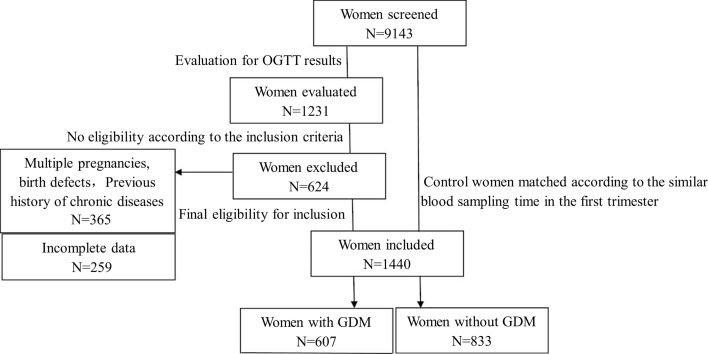
Data from 607 pregnant women with GDM were compared to the data from 833 pregnant women without GDM admitted to the Obstetrics Department of Fujian Maternity and Child Health Hospital (affiliated to Fujian Medical University) from May 2018 to December 2018 were retrospectively included. The ages of the pregnant women, paternal ages, number of pregnancies, number of deliveries, pre-pregnancy heights/weights, and the calculated body mass indexes (BMI) were recorded. In all participants, 10-12 weeks of pregnancy, afamin concentration, routine blood work, prenatal aneuploidy screening, and biochemical testing were performed. At weeks 24-28 of gestation, patients underwent oral glucose tolerance test (OGTT) for GDM screening.
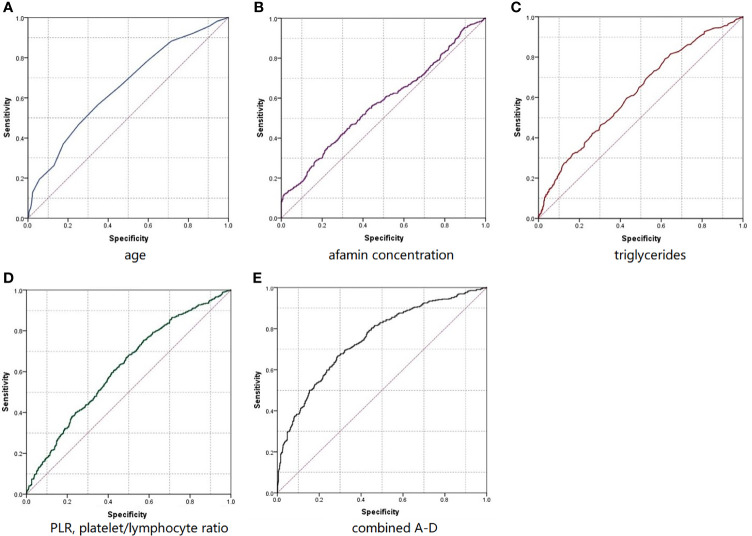
Multivariate logistic regression analysis showed that maternal age, early pregnancy afamin level, triglycerides, and platelet/lymphocyte ratio (PLR) were independent risk factors for gestational diabetes. The formula for predicting GDM probability was as follows: = 1/1 + ( - 6.054 + 0.774 × + 0.002 × + 0.155 × - 0.012 × )]. From the established ROC curve, the area under the curve (AUC) was 0.748, indicating that the model has a good degree of discrimination. When the predictive probability cut-off value was set on 0.358, sensitivity, specificity, positive predictive value, and negative predictive value were 69.2%, 68.3%, 42.5%, and 86.2%, respectively, and the accuracy rate was 70.2%. The Hosmer-Lemeshow test results showed that the goodness of the model fit has a good calibration ability (χ2 = 12.269, df=8, P=0.140).
Maternal age, early pregnancy afamin level, triglycerides, and PLR are independent risk factors for gestational diabetes. When combined, the above indicators are helpful for prediction, early diagnosis, and intervention of gestational diabetes.
建立一种基于临床特征、早孕(10-12 孕周)外周血常规和生化指标预测妊娠期糖尿病(GDM)的模型,并探讨其预测效能。
回顾性纳入 2018 年 5 月至 12 月福建医科大学附属福建妇幼保健院妇产科收治的 607 例 GDM 孕妇和 833 例非 GDM 孕妇的临床资料。记录孕妇年龄、父亲年龄、孕次、产次、孕前身高/体重及计算的体重指数(BMI)。所有参与者在妊娠 10-12 周时进行 afamin 浓度、血常规、产前非整倍体筛查和生化检查。在妊娠 24-28 周时,患者进行口服葡萄糖耐量试验(OGTT)筛查 GDM。
多因素 logistic 回归分析显示,母亲年龄、早孕 afamin 水平、三酰甘油和血小板/淋巴细胞比值(PLR)是妊娠期糖尿病的独立危险因素。预测 GDM 概率的公式如下:
=1/1+(-6.054+0.774×+0.002×+0.155×-0.012×)]。从建立的 ROC 曲线来看,曲线下面积(AUC)为 0.748,表明该模型具有良好的区分度。当预测概率截断值设定为 0.358 时,灵敏度、特异度、阳性预测值和阴性预测值分别为 69.2%、68.3%、42.5%和 86.2%,准确率为 70.2%。Hosmer-Lemeshow 检验结果表明,模型拟合优度良好(χ2=12.269,df=8,P=0.140)。
母亲年龄、早孕 afamin 水平、三酰甘油和 PLR 是妊娠期糖尿病的独立危险因素。联合上述指标有助于预测、早期诊断和干预妊娠期糖尿病。