Peeters Hannelore, Lenaerts Silvia, Verbruggen Sammy W
Sustainable Energy, Air & Water Technology (DuEL), Department of Bioscience Engineering, University of Antwerp, Groenenborgerlaan 171, 2020 Antwerp, Belgium.
NANOlab Center of Excellence, University of Antwerp, Groenenborgerlaan 171, 2020 Antwerp, Belgium.
Materials (Basel). 2023 Jan 28;16(3):1119. doi: 10.3390/ma16031119.
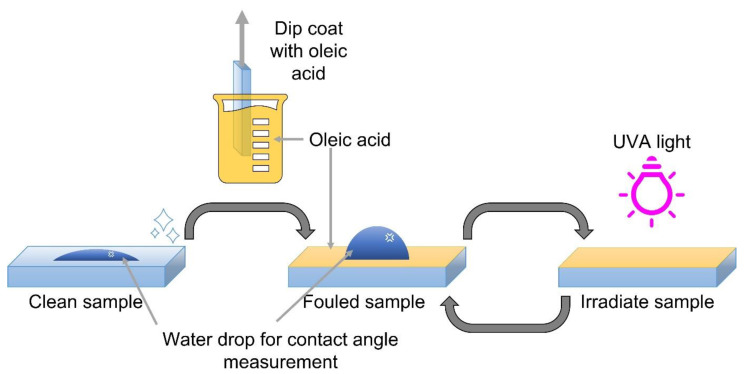
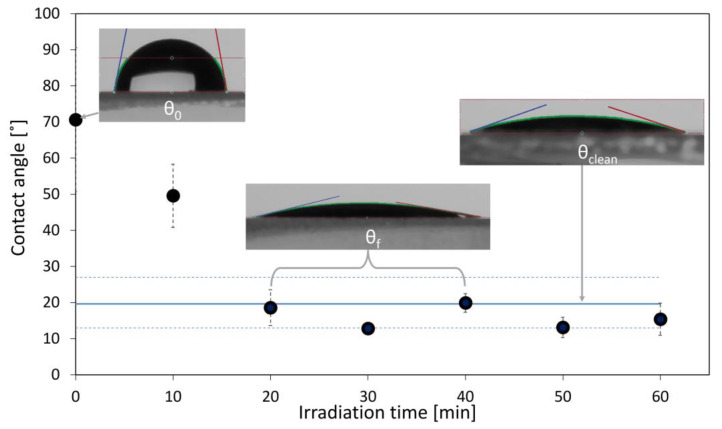
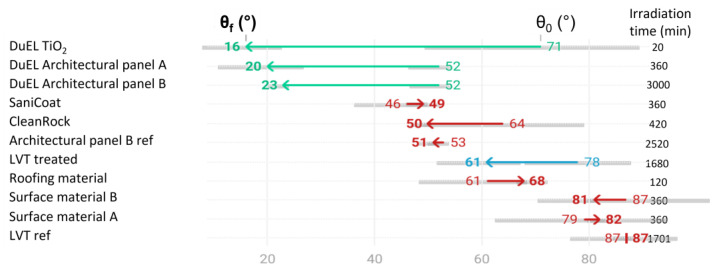
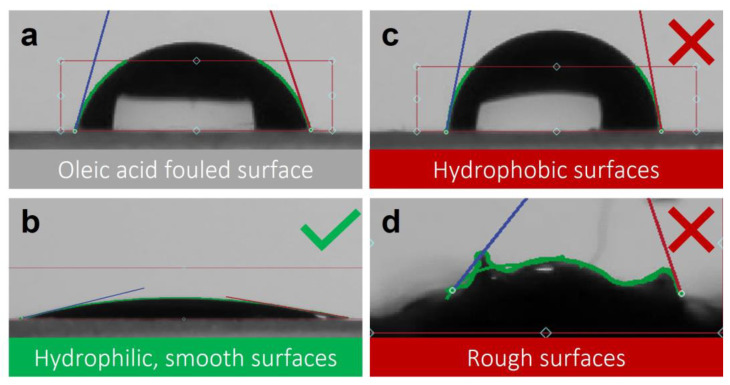
Various industrial surface materials are tested for their photocatalytic self-cleaning activity by performing the ISO 27448:2009 method. The samples are pre-activated by UV irradiation, fouled with oleic acid and irradiated by UV light. The degradation of oleic acid over time is monitored by taking water contact angle measurements using a contact angle goniometer. The foulant, oleic acid, is an organic acid that makes the surface more hydrophobic. The water contact angle will thus decrease over time as the photocatalytic material degrades the oleic acid. In this study, we argue that the use of this method is strongly limited to specific types of surface materials, i.e., only those that are hydrophilic and smooth in nature. For more hydrophobic materials, the difference in the water contact angles of a clean surface and a fouled surface is not measurable. Therefore, the photocatalytic self-cleaning activity cannot be established experimentally. Another type of material that cannot be tested by this standard are rough surfaces. For rough surfaces, the water contact angle cannot be measured accurately using a contact angle goniometer as prescribed by the standard. Because of these limitations, many potentially interesting industrial substrates cannot be evaluated. Smooth samples that were treated with an in-house developed hydrophilic titania thin film (PCT/EP2018/079983) showed a great photocatalytic self-cleaning performance according to the ISO standard. Apart from discussing the pros and cons of the current ISO standard, we also stress how to carefully interpret the results and suggest alternative testing solutions.
通过执行ISO 27448:2009方法,对各种工业表面材料的光催化自清洁活性进行测试。样品通过紫外线照射进行预活化,用油酸污染并通过紫外线照射。使用接触角测角仪测量水接触角,监测油酸随时间的降解情况。污染物油酸是一种使表面更疏水的有机酸。因此,随着光催化材料降解油酸,水接触角会随时间减小。在本研究中,我们认为该方法的使用强烈局限于特定类型的表面材料,即仅那些本质上亲水且光滑的材料。对于更疏水的材料,清洁表面和污染表面的水接触角差异无法测量。因此,无法通过实验确定光催化自清洁活性。该标准无法测试的另一类材料是粗糙表面。对于粗糙表面,按照标准规定使用接触角测角仪无法准确测量水接触角。由于这些限制,许多潜在有趣的工业基材无法评估。根据ISO标准,用自行研发的亲水性二氧化钛薄膜(PCT/EP2018/079983)处理的光滑样品表现出了出色的光催化自清洁性能。除了讨论当前ISO标准的优缺点外,我们还强调如何仔细解读结果并提出替代测试解决方案。