Brimrose Corporation of America, Baltimore, MD 21152, USA.
Department of Physics, Hampton University, Hampton, VA 23668, USA.
Sensors (Basel). 2023 Jan 26;23(3):1366. doi: 10.3390/s23031366.
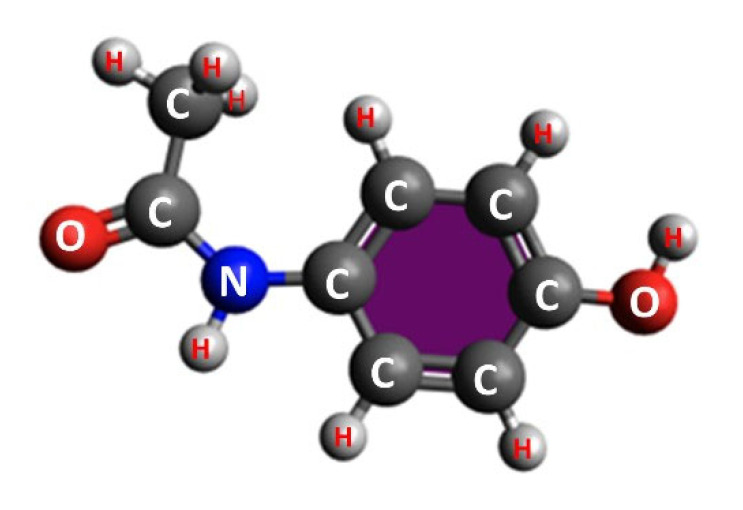
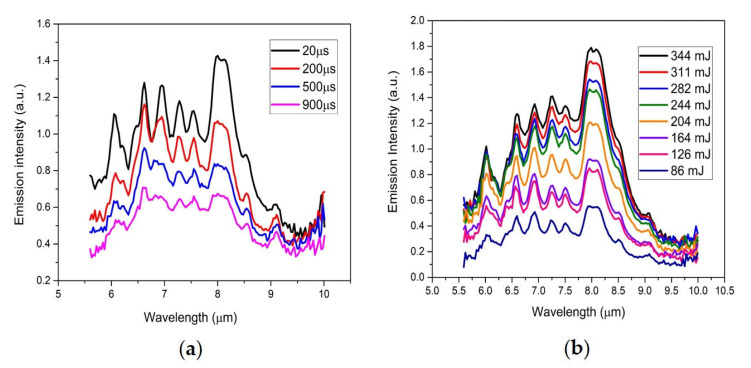
Long-wave infrared (LWIR) emissions of laser-induced plasma on solid potassium chloride and acetaminophen tablet surfaces were studied using both a one-dimensional (1-D) linear array detection system and, for the first time, a two-dimensional (2-D) focal plane array (FPA) detection system. Both atomic and molecular infrared emitters in the vicinity of the plasma were identified by analyzing the detected spectral signatures in the infrared region. Time- and space-resolved long-wave infrared emissions were also studied to assess the temporal and spatial behaviors of atomic and molecular emitters in the plasma. These pioneer temporal and spatial investigations of infrared emissions from laser-induced plasma would be valuable to the modeling of plasma evolutions and the advances of the novel LWIR laser-induced breakdown spectroscopy (LIBS). When integrated both temporally (≥200 µs) and spatially using a 2-D FPA detector, the observed intensities and signal-to-noise-ratio (SNR) of single-shot LWIR LIBS signature emissions from intact molecules were considerably enhanced (e.g., with enhancement factors up to 16 and 3.76, respectively, for a 6.62 µm band of acetaminophen molecules) and, in general, comparable to those from the atomic emitters. Pairing LWIR LIBS with conventional ultraviolet-visible-near infrared (UV/Vis/NIR) LIBS, a simultaneous UV/Vis/NIR + LWIR LIBS detection system promises unprecedented capability of in situ, real-time, and stand-off investigation of both atomic and molecular target compositions to detect and characterize a range of chemistries.
长波红外(LWIR)激光诱导等离子体在固体氯化钾和对乙酰氨基酚药片表面的发射,分别使用一维(1-D)线性阵列检测系统和首次使用的二维(2-D)焦平面阵列(FPA)检测系统进行了研究。通过分析近等离子体的红外区域中检测到的光谱特征,鉴定了等离子体中原子和分子红外发射器。还研究了时间和空间分辨的长波红外发射,以评估等离子体中原子和分子发射器的时间和空间行为。这些对激光诱导等离子体红外发射的先驱性时间和空间研究,对于等离子体演化的建模和新型长波红外激光诱导击穿光谱(LIBS)的发展将是有价值的。当使用二维 FPA 探测器在时间上(≥200 µs)和空间上进行集成时,从完整分子的单次 LWIR LIBS 特征发射中观察到的强度和信噪比(SNR)得到了显著增强(例如,对于对乙酰氨基酚分子的 6.62 µm 波段,增强因子分别高达 16 和 3.76),并且通常与原子发射器的强度相当。将 LWIR LIBS 与传统的紫外-可见-近红外(UV/Vis/NIR)LIBS 相结合,同时进行 UV/Vis/NIR + LWIR LIBS 检测系统有望具有前所未有的能力,能够原位、实时和远距离调查原子和分子目标成分,以检测和表征一系列化学物质。