Division of Rheumatology, Inflammation and Immunity, Department of Medicine, Brigham and Women's Hospital, Harvard Medical School, Boston, MA, USA.
Division of Rheumatology, Inflammation and Immunity, Department of Medicine, Brigham and Women's Hospital, Harvard Medical School, Boston, MA, USA; Division of Rheumatology, Cumming School of Medicine, University of Calgary, Calgary, Alberta, Canada.
Prostaglandins Leukot Essent Fatty Acids. 2023 Mar;190:102542. doi: 10.1016/j.plefa.2023.102542. Epub 2023 Jan 26.
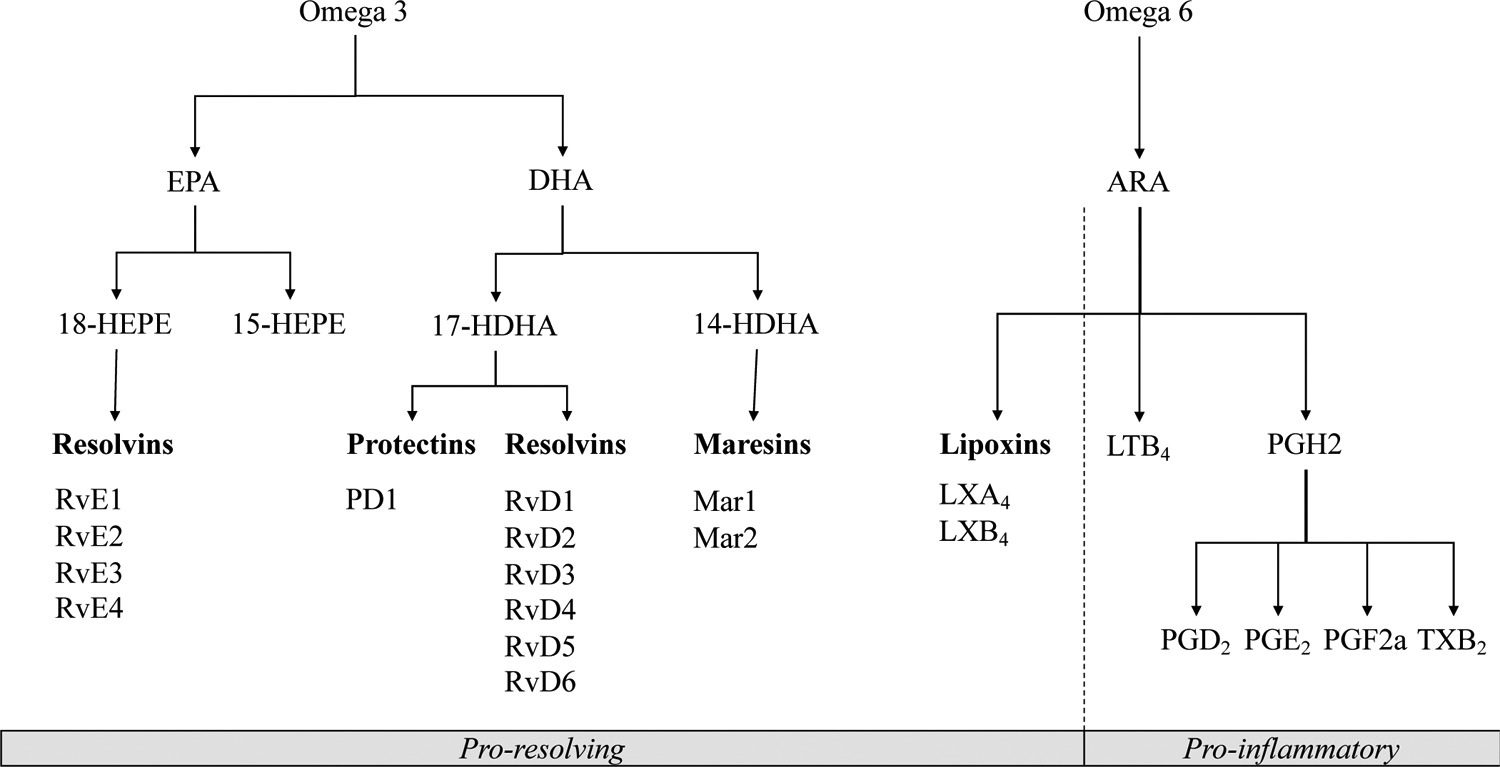
Little is known about the effects of over-the-counter fish oil (FO) supplements on circulating omega-3 polyunsaturated fatty acid (n-3 PUFA)-derived specialized pro-resolving mediators (SPMs), nor about whether having a chronic inflammatory disease such as rheumatoid arthritis (RA) influences SPM levels. We investigated associations between over-the-counter n-3 PUFA FO supplementation and circulating SPMs among patients with vs. without RA.
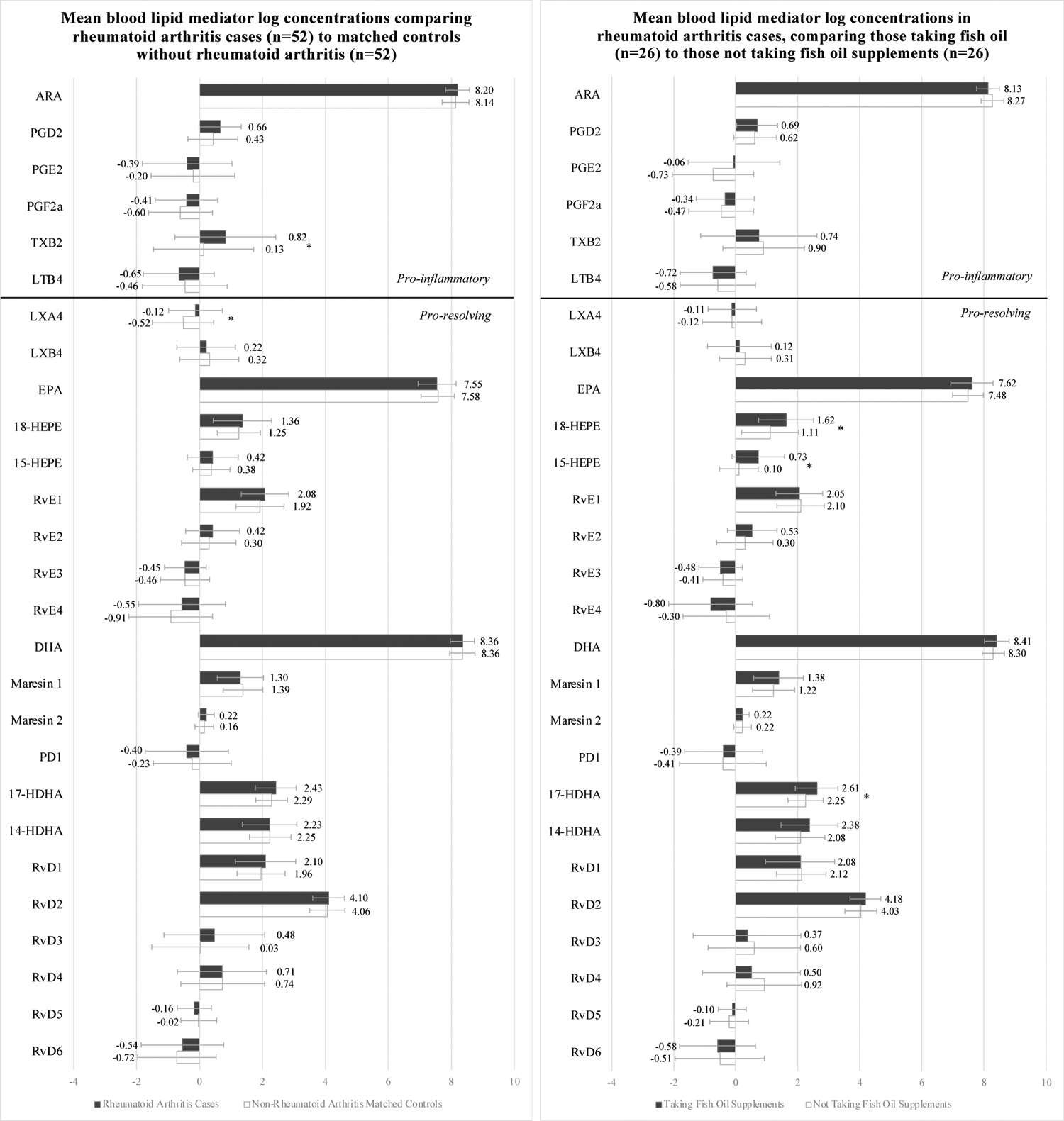
We studied 104 participants: 26 with RA taking FO matched by age and sex to 26 with RA not taking FO, 26 without RA taking FO, and 26 without RA not taking FO. Targeted-liquid chromatography-tandem mass spectroscopy was performed on patient plasma to identify and quantify 27 lipid mediators (including eicosanoids and SPMs). We performed t-tests and then multivariable linear regression analyses to assess whether having RA or taking FO supplements was associated with circulating lipid mediator concentrations, adjusting for age, race, sex, smoking, body mass index, and current medication use (statins, prednisone and immunomodulators among RA cases only). We tested for interactions between FO supplementation and RA status. We also conducted Spearman's correlations between EPA, DHA, and ARA and their downstream metabolites.
Among patients who were taking FO compared to those who were not, in multivariable- adjusted analyses, SPM substrates EPA and DHA were both elevated as were several of their pro-resolving bioactive products, including 15- and 18-HEPE from EPA, and 14- and 17-HDHA from DHA, which are substrates for specific SPMs. While E-series and D-series resolvins were present and identified, we did not find statistical elevations of other SPMs. Results were similar among patients with RA and patients without RA, taking vs. not taking FO supplementation (no formal statistical interaction observed). There was a strong positive correlation between EPA and DHA and their immediate downstream SPM precursors (18-HEPE and15-HEPE from EPA; 17-HDHA and 14-HDHA from DHA) among all patients.
Patients taking FO supplements, regardless of RA status, not only had higher blood levels of EPA and DHA, but also of their enzymatic products 18-HEPE (E-series resolvin precursors), 15-HEPE and 17-HDHA (D-series resolvin and protectin precursors). Patients with RA, an inflammatory autoimmune disease, may be able to augment some SPM precursor reserves, similarly to matched controls without RA, by taking oral FO supplements.
关于非处方鱼油(FO)补充剂对循环ω-3 多不饱和脂肪酸(n-3 PUFA)衍生的特殊促解决介质(SPM)的影响,以及是否患有类风湿关节炎(RA)等慢性炎症性疾病会影响 SPM 水平,知之甚少。我们研究了 RA 患者与非 RA 患者之间,非处方 n-3 PUFA FO 补充与循环 SPM 之间的关联。
我们研究了 104 名参与者:26 名服用 FO 的 RA 患者与 26 名年龄和性别匹配的 RA 未服用 FO 的患者、26 名未服用 FO 的非 RA 患者和 26 名未服用 FO 的非 RA 患者进行了比较。对患者血浆进行靶向液相色谱-串联质谱分析,以鉴定和定量 27 种脂质介质(包括类二十烷酸和 SPM)。我们进行了 t 检验,然后进行多变量线性回归分析,以评估是否存在 RA 或服用 FO 补充剂与循环脂质介质浓度相关,同时调整了年龄、种族、性别、吸烟、体重指数和当前药物使用情况(仅在 RA 病例中使用他汀类药物、泼尼松和免疫调节剂)。我们检测了 FO 补充剂和 RA 状态之间的相互作用。我们还对 EPA、DHA 和 ARA 及其下游代谢物进行了 Spearman 相关性分析。
与未服用 FO 的患者相比,服用 FO 的患者 SPM 底物 EPA 和 DHA 均升高,其几种促解决的生物活性产物也升高,包括 EPA 的 15-和 18-HEPE,以及 DHA 的 14-和 17-HDHA,这些都是特定 SPM 的底物。虽然存在并鉴定了 E 系列和 D 系列 resolvins,但我们没有发现其他 SPM 的统计学升高。在有 RA 和无 RA 的患者中,服用和不服用 FO 补充剂的结果相似(未观察到正式的统计学相互作用)。所有患者中,EPA 和 DHA 及其直接下游 SPM 前体(EPA 的 18-HEPE 和 15-HEPE;DHA 的 17-HDHA 和 14-HDHA)之间存在强烈的正相关关系。
无论 RA 状态如何,服用 FO 补充剂的患者不仅血液中 EPA 和 DHA 水平升高,而且其酶产物 18-HEPE(E 系列 resolvin 前体)、15-HEPE 和 17-HDHA(D 系列 resolvin 和保护素前体)水平也升高。RA 是一种炎症性自身免疫性疾病,患者可能能够通过口服 FO 补充剂来增加一些 SPM 前体储备,与无 RA 的匹配对照组相似。