Program in Biophysics, Stanford University, Stanford, California, USA; Department of Bioengineering, Stanford University, Stanford, California, USA.
Department of Biophysics and Biophysical Chemistry, Johns Hopkins University School of Medicine, Baltimore, Maryland, USA.
J Biol Chem. 2023 May;299(5):103003. doi: 10.1016/j.jbc.2023.103003. Epub 2023 Feb 11.
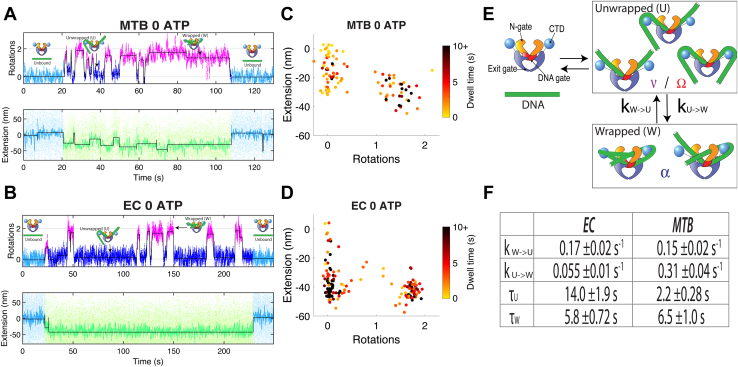
DNA gyrase is an essential nucleoprotein motor present in all bacteria and is a major target for antibiotic treatment of Mycobacterium tuberculosis (MTB) infection. Gyrase hydrolyzes ATP to add negative supercoils to DNA using a strand passage mechanism that has been investigated using biophysical and biochemical approaches. To analyze the dynamics of substeps leading to strand passage, single-molecule rotor bead tracking (RBT) has been used previously to follow real-time supercoiling and conformational transitions in Escherichia coli (EC) gyrase. However, RBT has not yet been applied to gyrase from other pathogenically relevant bacteria, and it is not known whether substeps are conserved across evolutionarily distant species. Here, we compare gyrase supercoiling dynamics between two evolutionarily distant bacterial species, MTB and EC. We used RBT to measure supercoiling rates, processivities, and the geometries and transition kinetics of conformational states of purified gyrase proteins in complex with DNA. Our results show that E. coli and MTB gyrases are both processive, with the MTB enzyme displaying velocities ∼5.5× slower than the EC enzyme. Compared with EC gyrase, MTB gyrase also more readily populates an intermediate state with DNA chirally wrapped around the enzyme, in both the presence and absence of ATP. Our substep measurements reveal common features in conformational states of EC and MTB gyrases interacting with DNA but also suggest differences in populations and transition rates that may reflect distinct cellular needs between these two species.
DNA 拓扑异构酶是一种存在于所有细菌中的必需核蛋白马达,是治疗结核分枝杆菌 (MTB) 感染的抗生素治疗的主要靶点。拓扑异构酶通过链穿越机制利用 ATP 水解来向 DNA 添加负超螺旋,该机制已通过生物物理和生化方法进行了研究。为了分析导致链穿越的亚步骤的动力学,先前已经使用单分子转子珠跟踪 (RBT) 来跟踪大肠杆菌 (EC) 拓扑异构酶中的实时超螺旋和构象转变。然而,RBT 尚未应用于来自其他相关病原体的细菌的拓扑异构酶,并且不知道亚步骤是否在进化上相距较远的物种中保守。在这里,我们比较了两种进化上相距较远的细菌,即 MTB 和 EC 中的拓扑异构酶的超螺旋动力学。我们使用 RBT 来测量超螺旋速率、进程性以及与 DNA 结合的纯化拓扑异构酶蛋白的构象状态的几何形状和转变动力学。我们的结果表明,EC 和 MTB 拓扑异构酶都是进程性的,MTB 酶的速度比 EC 酶慢约 5.5 倍。与 EC 拓扑异构酶相比,MTB 拓扑异构酶在存在和不存在 ATP 的情况下,也更容易使 DNA 以手性方式缠绕在酶上,从而进入中间状态。我们的亚步骤测量结果表明,与 DNA 相互作用的 EC 和 MTB 拓扑异构酶的构象状态具有共同特征,但也表明种群和转变速率存在差异,这可能反映了这两个物种之间不同的细胞需求。