Division of Surveillance and Policy Evaluation, Institute for Cancer Control, National Cancer Center.
J Epidemiol. 2023 Jul 5;33(7):372-380. doi: 10.2188/jea.JE20220302. Epub 2023 Mar 31.
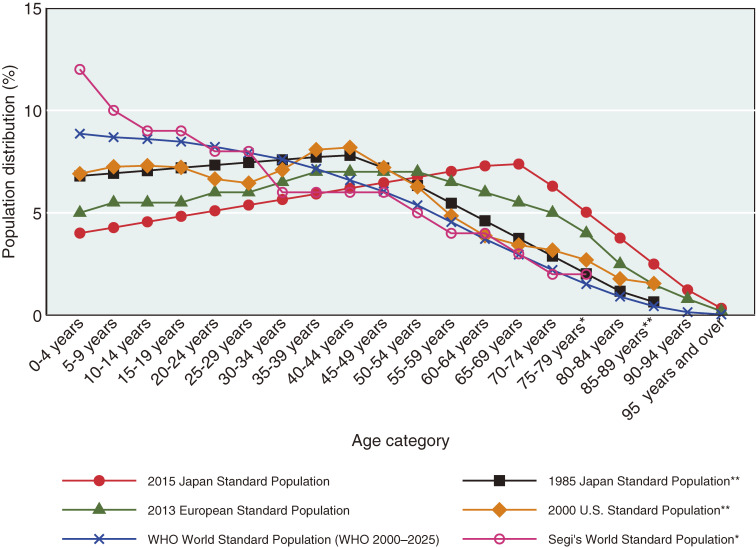
The 2015 Japan Standard Population (JSP) was established in response to changes in the age structure. However, the effects of major updates, especially the recategorization of older age groups, for interpreting various health metrics have not been clarified.
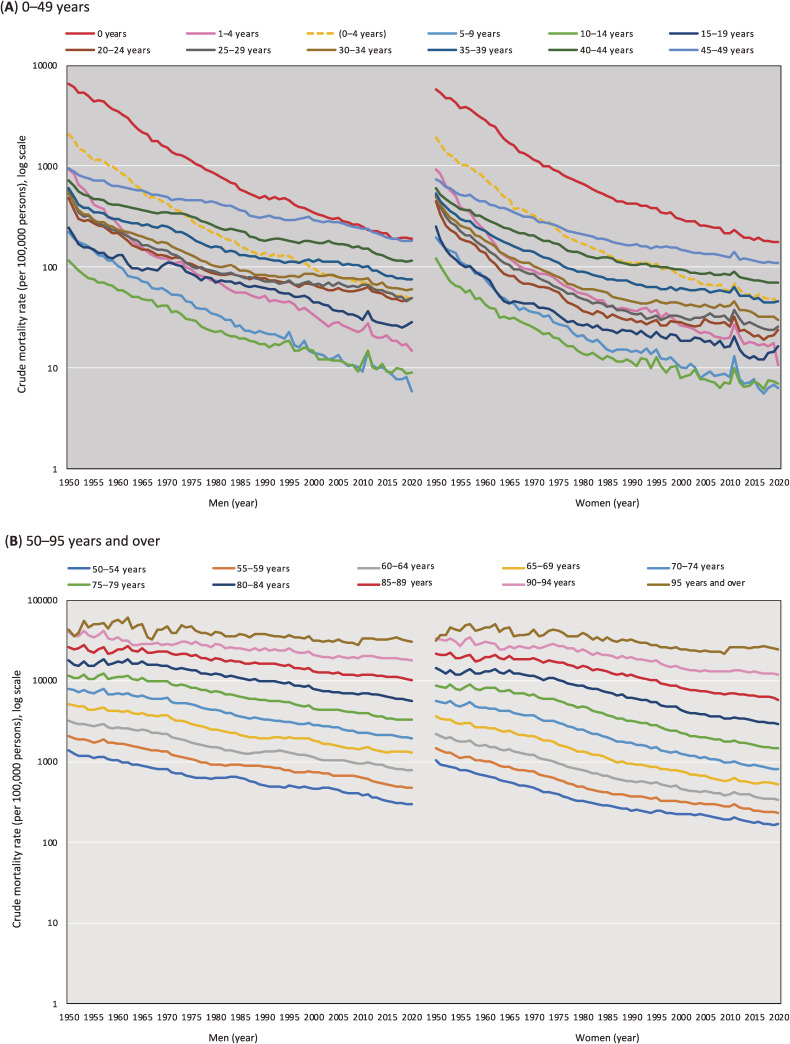
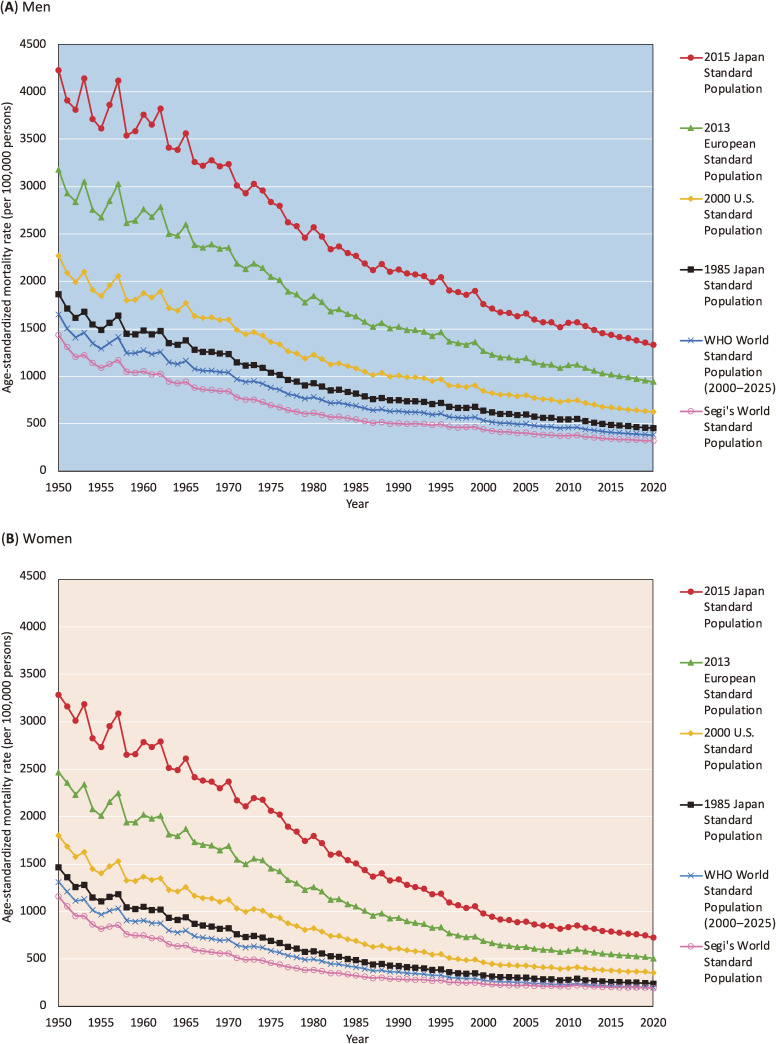
Population data were collected and estimated for older age categories (85-89, 90-94, and ≥95 years). Data on the number of deaths were also collected from the Vital Statistics. We recalculated the all-cause and leading cause-specific age-standardized mortality rate (ASMR) using the 2015 JSP by the direct standardization method for data from 1950 to 2020. We compared ASMRs calculated using the 2015 JSP with those calculated using the 1985 JSP. Pearson's correlation coefficients were used to evaluate the consistency of mortality trends between the 2015 and 1985 JSPs.
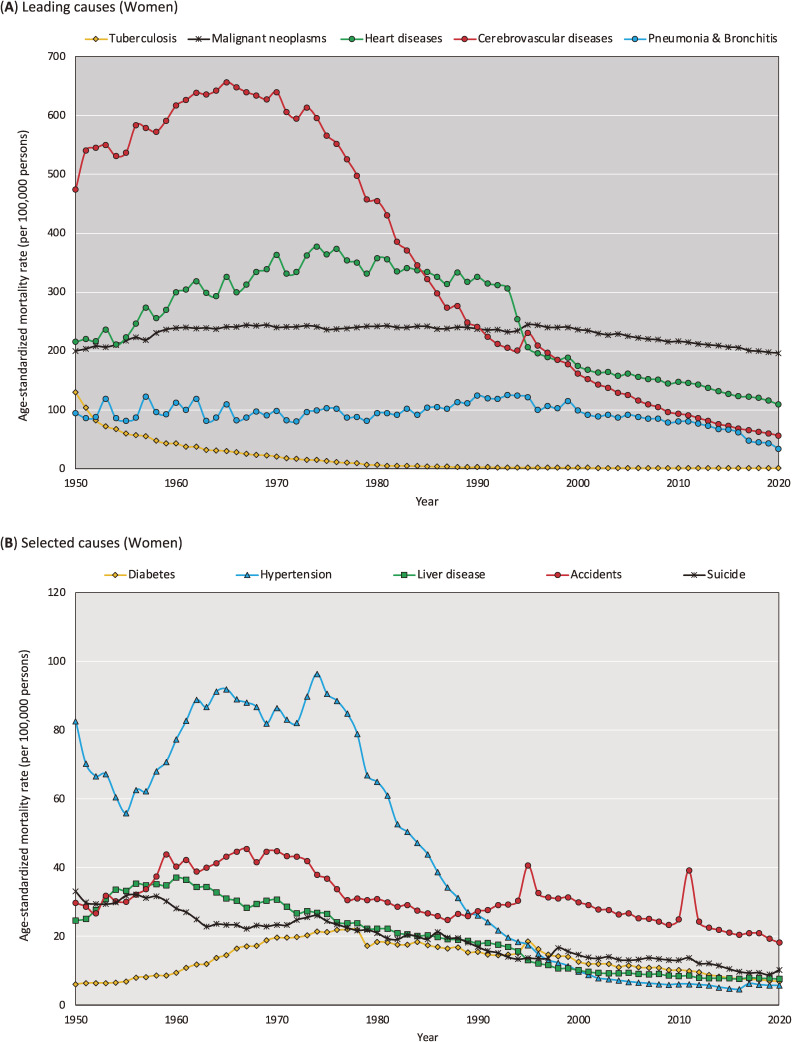
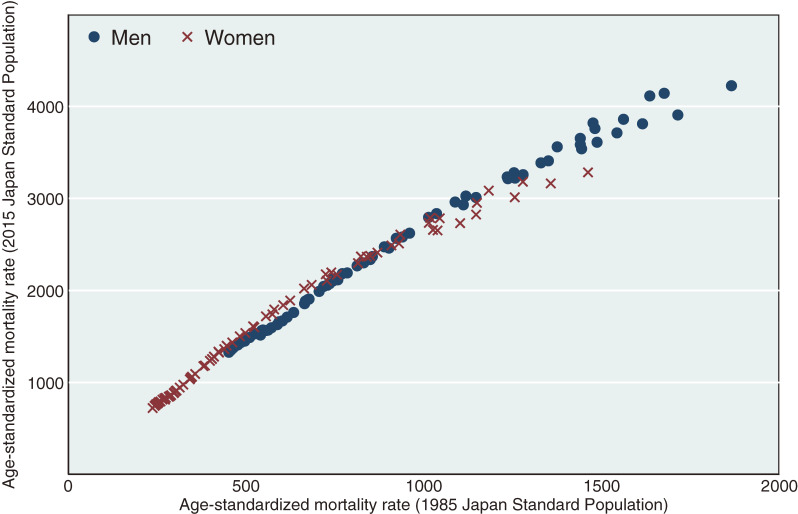
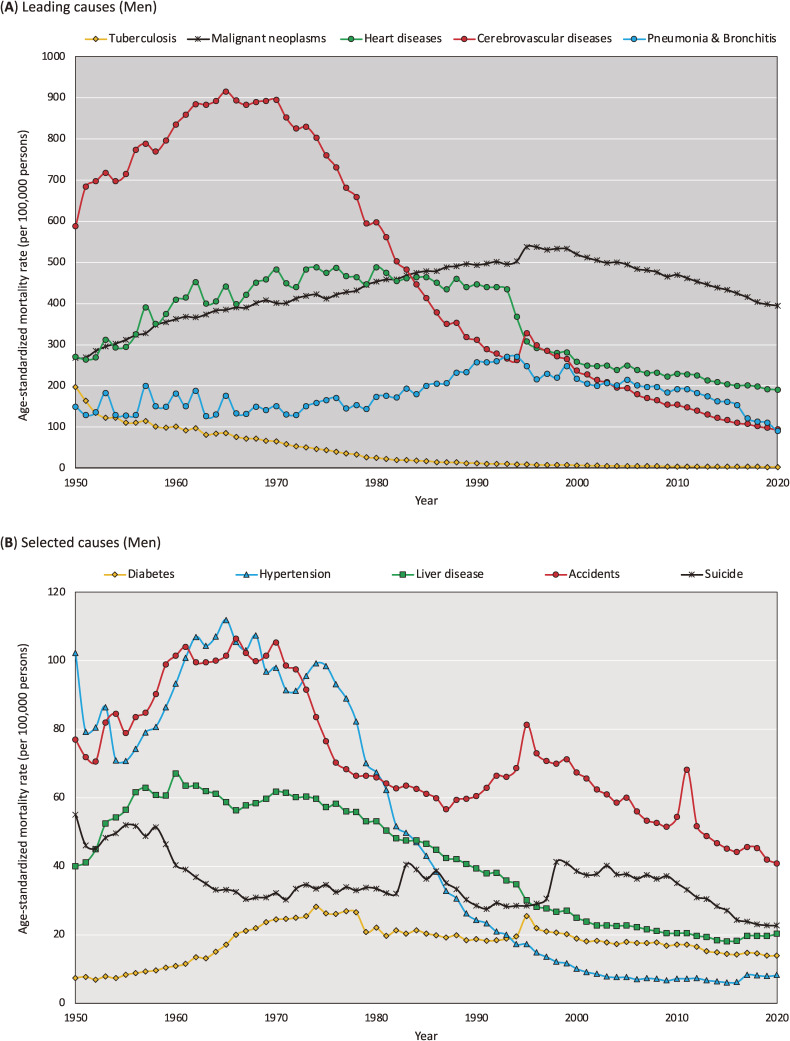
The absolute all-cause ASMRs calculated using the 2015 JSP were 2.22-3.00 times higher than those calculated using the 1985 JSP. The ASMR ratios increased gradually over time. While trends in all-cause and cause-specific ASMRs calculated using the 2015 JSP and 1985 JSP were generally highly correlated (Pearson's correlation coefficient [r] = 0.993 for all-cause), correlations were relatively low for malignant neoplasms (r = 0.720 for men and r = 0.581 for women) and pneumonia/bronchitis (r = 0.543 for men and r = 0.559 for women) due to non-monotonous trends over time and fluctuations in earlier time periods.
The effect of introducing the new JSP for interpreting trends in all-cause mortality was considered minimal. However, caution is needed when interpreting trends in some cause-specific mortality rates.
2015 年日本标准人口(JSP)的建立是为了应对年龄结构的变化。然而,对于解释各种健康指标,主要更新的影响,特别是更老年龄组的重新分类,尚未得到明确。
收集和估计了更老年龄组(85-89、90-94 和≥95 岁)的人口数据。还从生命统计数据中收集了死亡人数数据。我们使用直接标准化方法,根据 2015 年 JSP 重新计算了 1950 年至 2020 年的全因和主要死因特异性年龄标准化死亡率(ASMR)。我们比较了使用 2015 年 JSP 和 1985 年 JSP 计算的 ASMR。使用 Pearson 相关系数评估了 2015 年和 1985 年 JSP 之间死亡率趋势的一致性。
使用 2015 年 JSP 计算的绝对全因 ASMR 是使用 1985 年 JSP 计算的 2.22-3.00 倍。随着时间的推移,ASMR 比值逐渐增加。虽然使用 2015 年和 1985 年 JSP 计算的全因和死因特异性 ASMR 趋势总体上高度相关(全因的 Pearson 相关系数[r]为 0.993),但由于时间上的非单调趋势和早期时期的波动,恶性肿瘤(男性为 r = 0.720,女性为 r = 0.581)和肺炎/支气管炎(男性为 r = 0.543,女性为 r = 0.559)的相关性相对较低。
考虑到引入新 JSP 来解释全因死亡率趋势的影响可以忽略不计。然而,在解释某些死因特异性死亡率趋势时需要谨慎。