Cloney Michael Brendan, Roumeliotis Anastasios G, Azad Hooman A, Prasad Nikil, Shlobin Nathan A, Hopkins Benjamin S, Jahromi Babak S, Potts Matthew B, Dahdaleh Nader S
Department of Neurological Surgery, Feinberg School of Medicine, Northwestern University, Chicago, Illinois, USA.
J Craniovertebr Junction Spine. 2022 Oct-Dec;13(4):410-414. doi: 10.4103/jcvjs.jcvjs_111_22. Epub 2022 Dec 7.
Traumatic vertebral artery dissections (tVADs) occur in up to 20% of patients with head trauma, yet data on their presentation and associated sequelae are limited.
To characterize the tVAD population and identify factors associated with clinical outcomes.
We retrospectively analyzed all cases of tVAD at our institution from January 2004 to December 2018 with respect to mechanism of injury, clinical presentation, anatomic factors, associated pathologies, and relevant outcomes.
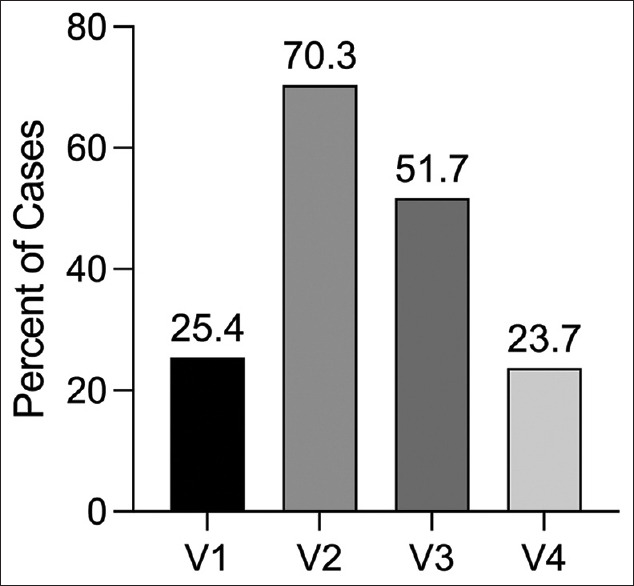
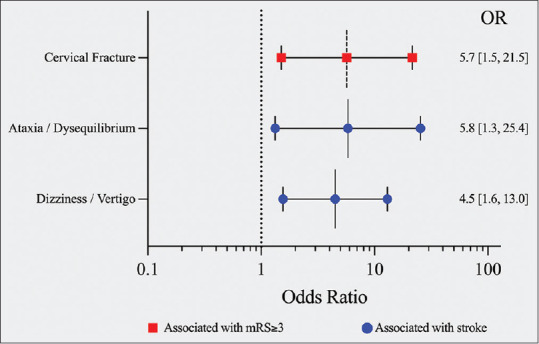
Of the 123 patients with tVAD, the most common presenting symptoms were neck pain (n=76, 67.3%), headache (57.5%), and visual changes (29.6%). 101 cases (82.1%) were unilateral, and 22 cases (17.9%) were bilateral. V2 was the most involved anatomic segment (83 cases, 70.3). 30 cases (25.4%) led to stroke, and 39 cases (31.7%) had a concomitant cervical fracture. The anatomic segment and number of segments involved, and baseline clinical and demographic characteristics were not associated with risk of stroke. Patients with associated fractures were older (50.3 years v. 36.4 years, p=0.0233), had a higher comorbid disease burden (CCI 1 vs. CCI 1, p<0.0007), were more likely to smoke (OR 3.0 [1.2178, 7.4028], p=0.0202), be male (OR 7.125 [3.0181, 16.8236], p<0.0001), and have mRS≥3 at discharge (OR 3.0545 [1.0937, 8.5752], p=0.0449). On multivariable regression, only fracture independently predicted mRS≥3 at discharge (OR 5.6898 [1.5067, 21.4876], p=0.010).
tVADs may be associated with stroke and/or cervical fracture. Presenting symptoms predict stroke, but baseline demographic and clinical characteristics do not. Comorbid cervical fractures, not stroke, drive negative outcomes.
创伤性椎动脉夹层(tVADs)在高达20%的头部创伤患者中出现,但关于其临床表现及相关后遗症的数据有限。
描述tVAD患者群体特征并确定与临床结局相关的因素。
我们回顾性分析了2004年1月至2018年12月在我院发生的所有tVAD病例,内容包括损伤机制、临床表现、解剖因素、相关病理情况及相关结局。
在123例tVAD患者中,最常见的症状为颈部疼痛(n = 76,67.3%)、头痛(57.5%)和视觉改变(29.6%)。101例(82.1%)为单侧,22例(17.9%)为双侧。V2是最常受累的解剖节段(83例,70.3%)。30例(25.4%)导致中风,39例(31.7%)伴有颈椎骨折。受累的解剖节段和节段数量,以及基线临床和人口统计学特征与中风风险无关。伴有骨折的患者年龄更大(50.3岁对36.4岁,p = .0233),合并疾病负担更高(CCI 1对CCI 1,p < .0007),更可能吸烟(OR 3.0 [1.2178, 7.4028],p = .0202),为男性(OR 7.125 [3.0181, 16.8236],p < .0001),出院时mRS≥3(OR 3.0545 [1.0937, 8.5752],p = .0449)。在多变量回归分析中,只有骨折可独立预测出院时mRS≥3(OR 5.6898 [1.5067, 21.4876],p = .010)。
tVADs可能与中风和/或颈椎骨折相关。临床表现可预测中风,但基线人口统计学和临床特征不能。合并颈椎骨折而非中风导致不良结局。