Kretschmer Simon, Perry Nicholas, Zhang Yang, Kortemme Tanja
Department of Bioengineering and Therapeutic Sciences, University of California, San Francisco, CA 94158, USA.
California Quantitative Biosciences Institute (QBI) at UCSF, San Francisco, CA 94158, USA.
bioRxiv. 2023 Feb 1:2023.02.01.526549. doi: 10.1101/2023.02.01.526549.
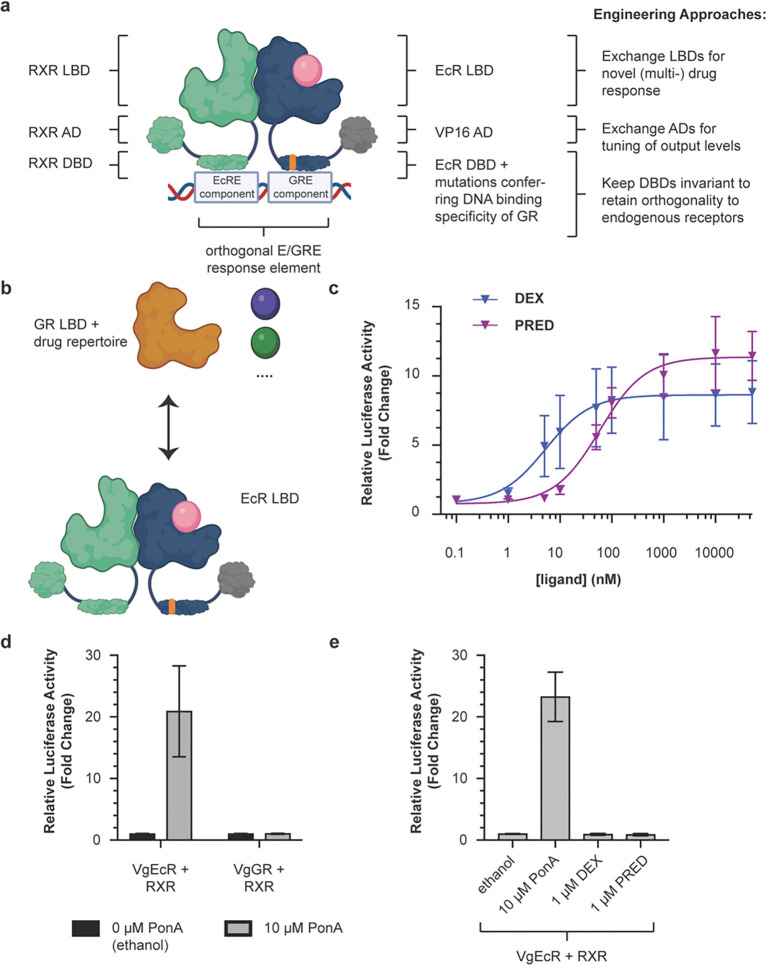
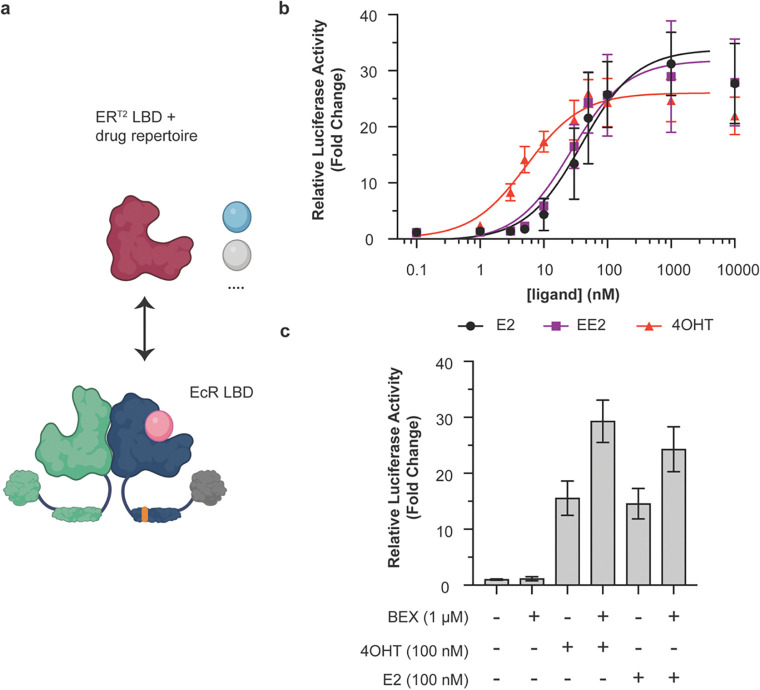
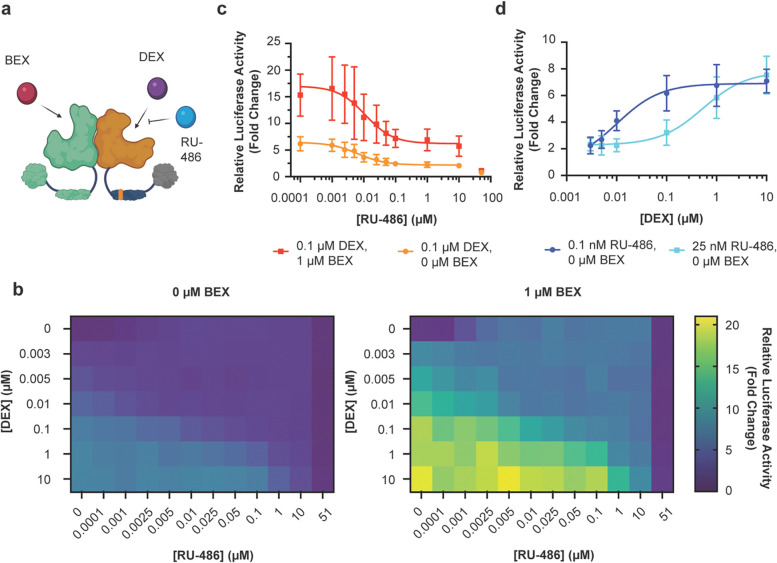
Protein-based switches that respond to different inputs to regulate cellular outputs, such as gene expression, are central to synthetic biology. For increased controllability, multi-input switches that integrate several cooperating and competing signals for the regulation of a shared output are of particular interest. The nuclear hormone receptor (NHR) superfamily offers promising starting points for engineering multi-input-controlled responses to clinically approved drugs. Starting from the VgEcR/RXR pair, we demonstrate that novel (multi-)drug regulation can be achieved by exchange of the ecdysone receptor (EcR) ligand binding domain (LBD) for other human NHR-derived LBDs. For responses activated to saturation by an agonist for the first LBD, we show that outputs can be boosted by an agonist targeting the second LBD. In combination with an antagonist, output levels are tunable by up to three simultaneously present small-molecule drugs. Such high-level control validates NHRs as a versatile, engineerable platform for programming multi-drug-controlled responses.
基于蛋白质的开关可响应不同输入以调节细胞输出,如基因表达,是合成生物学的核心。为了提高可控性,整合多个协同和竞争信号以调节共享输出的多输入开关尤其受关注。核激素受体(NHR)超家族为工程化对临床批准药物的多输入控制反应提供了有前景的起点。从VgEcR/RXR对开始,我们证明通过将蜕皮激素受体(EcR)配体结合域(LBD)替换为其他源自人类NHR的LBD,可以实现新型(多)药物调节。对于被第一个LBD的激动剂激活至饱和的反应,我们表明靶向第二个LBD的激动剂可以增强输出。与拮抗剂联合使用时,输出水平可通过同时存在的多达三种小分子药物进行调节。这种高级控制验证了NHR作为用于编程多药物控制反应的通用、可工程化平台的有效性。