Maness Eden B, Blumenthal Sarah A, Burk Joshua A
VA Boston Healthcare System and Department of Psychiatry, Harvard Medical School, West Roxbury, MA, 02132, USA.
Department of Psychological Sciences, College of William and Mary, Williamsburg, VA, 23187, USA.
bioRxiv. 2023 Feb 5:2023.02.05.527043. doi: 10.1101/2023.02.05.527043.
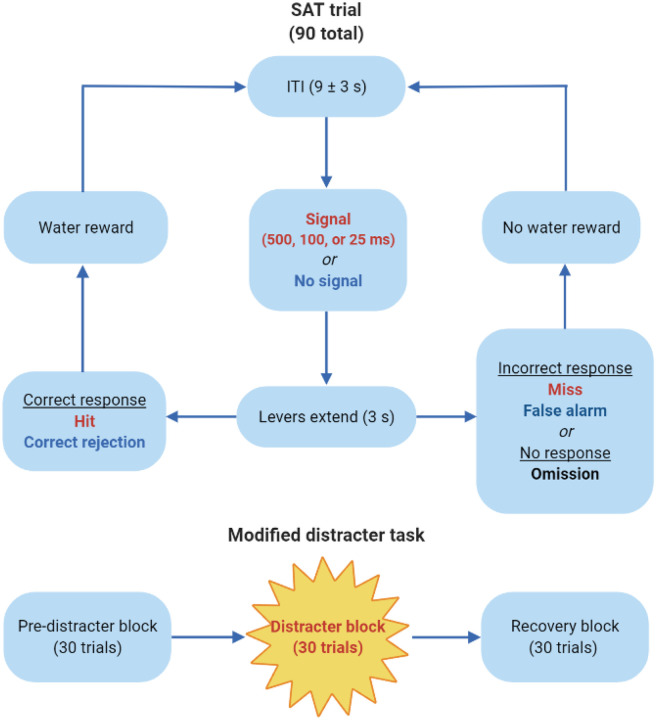
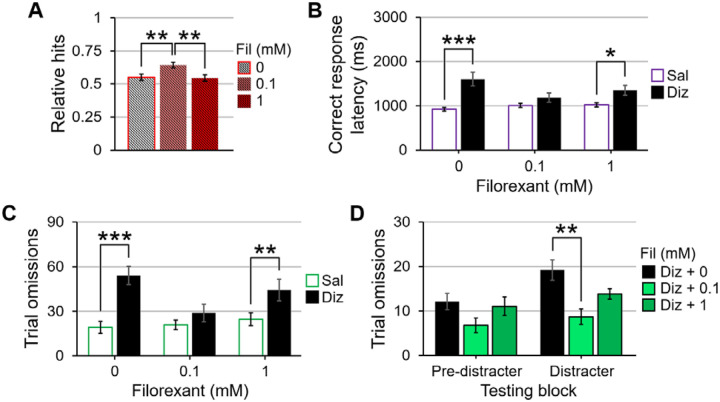
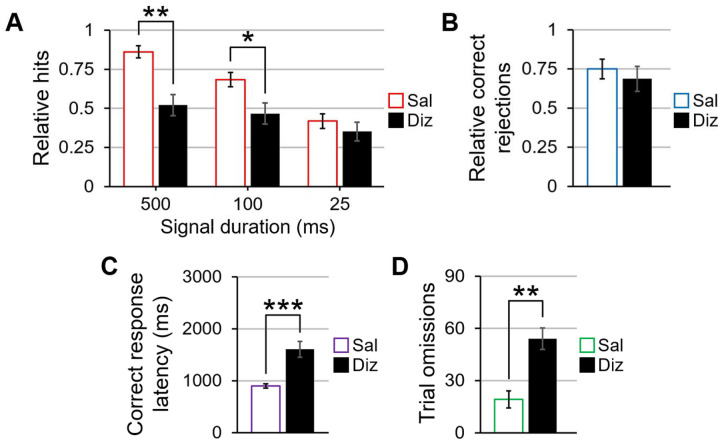
Schizophrenia is a neuropsychiatric condition that is associated with impaired attentional processing and performance. Failure to support increasing attentional load may result, in part, from abnormally overactive basal forebrain projections to the prefrontal cortex, and available antipsychotics often fail to address this issue. Orexin/hypocretin receptors are expressed on corticopetal cholinergic neurons, and their blockade has been shown to decrease the activity of cortical basal forebrain outputs and prefrontal cortical cholinergic neurotransmission. In the present experiment, rats (N = 14) trained in a visual sustained attention task that required discrimination of trials which presented a visual signal from trials during which no signal was presented. Once trained, rats were then co-administered the psychotomimetic N-methyl-D-aspartate (NMDA) receptor antagonist dizocilpine (MK-801: 0 or 0.1 mg/kg, intraperitoneal injections) and the dual orexin receptor antagonist filorexant (MK-6096: 0, 0.1, or 1 mM, intracerebroventricular infusions) prior to task performance across six sessions. Dizocilpine impaired overall accuracy during signal trials, slowed reaction times for correctly-responded trials, and increased the number of omitted trials throughout the task. Dizocilpine-induced increases in signal trial deficits, correct response latencies, and errors of omission were reduced following infusions of the 0.1 mM, but not 1 mM, dose of filorexant. Orexin receptor blockade, perhaps through anticholinergic mechanisms, may improve attentional deficits in a state of NMDA receptor hypofunction.
Schizophrenia is associated with attentional deficits that may stem from abnormally reactive BF projections to the prefrontal cortexOrexin receptor antagonists decrease acetylcholine release and reduce prefrontal cortical activityThe dual orexin receptor antagonist filorexant alleviated impairments of attention following NMDA receptor blockade.
精神分裂症是一种神经精神疾病,与注意力加工和表现受损有关。无法支持注意力负荷的增加可能部分源于基底前脑向前额叶皮质的投射异常活跃,而现有的抗精神病药物往往无法解决这个问题。食欲素/下丘脑泌素受体在向皮质的胆碱能神经元上表达,其阻断已被证明可降低皮质基底前脑输出和前额叶皮质胆碱能神经传递的活性。在本实验中,对14只大鼠进行视觉持续注意力任务训练,该任务要求区分呈现视觉信号的试验和未呈现信号的试验。一旦训练完成,在六个实验环节的任务执行前,给大鼠联合腹腔注射拟精神病药物N-甲基-D-天冬氨酸(NMDA)受体拮抗剂地佐环平(MK-801:0或0.1mg/kg)和脑室内注射双食欲素受体拮抗剂菲洛雷生(MK-6096:0、0.1或1mM)。地佐环平损害了信号试验期间的总体准确性,减慢了正确反应试验的反应时间,并增加了整个任务中遗漏试验的数量。在注射0.1mM而非1mM剂量的菲洛雷生后,地佐环平引起的信号试验缺陷增加、正确反应潜伏期延长和遗漏错误减少。食欲素受体阻断可能通过抗胆碱能机制改善NMDA受体功能低下状态下的注意力缺陷。
精神分裂症与注意力缺陷有关,可能源于基底前脑向前额叶皮质的异常反应性投射;食欲素受体拮抗剂减少乙酰胆碱释放并降低前额叶皮质活性;双食欲素受体拮抗剂菲洛雷生减轻了NMDA受体阻断后的注意力损害。