Interdisciplinary Department of Medicine, Section of Internal Medicine, Geriatrics, Endocrinology and Rare Diseases, School of Medicine, University of Bari "Aldo Moro", Bari, Italy.
Department of Emergency and Organ Transplantation, Section of Pathological Anatomy, University of Bari "Aldo Moro", Bari, Italy.
Front Endocrinol (Lausanne). 2023 Jan 27;13:1080159. doi: 10.3389/fendo.2022.1080159. eCollection 2022.
The detection of thyroid nodules has been increasing over time, resulting in an extensive use of fine-needle aspiration (FNA) and cytology. Tailored methods are required to improve the management of thyroid nodules, including algorithms and web-based tools.
To assess the performance of the Thyroid Nodule App (TNAPP), a web-based, readily modifiable, interactive algorithmic tool, in improving the management of thyroid nodules.
One hundred twelve consecutive patients with 188 thyroid nodules who underwent FNA from January to December 2016 and thyroid surgery were retrospectively evaluated. Neck ultrasound images were collected from a thyroid nodule registry and re-examined to extract data to run TNAPP. Each nodule was evaluated for ultrasonographic risk and suitability for FNA. The sensitivity, specificity, positive and negative predictive values, and overall accuracy of TNAPP were calculated and compared to the diagnostic performance of the other two algorithms by the American Association of Clinical Endocrinology/American College of Endocrinology/Associazione Medici Endocrinologi AACE/ACE/AME), which it was derived from the American College of Radiology Thyroid Imaging Reporting and Data System (ACR TI-RADS).
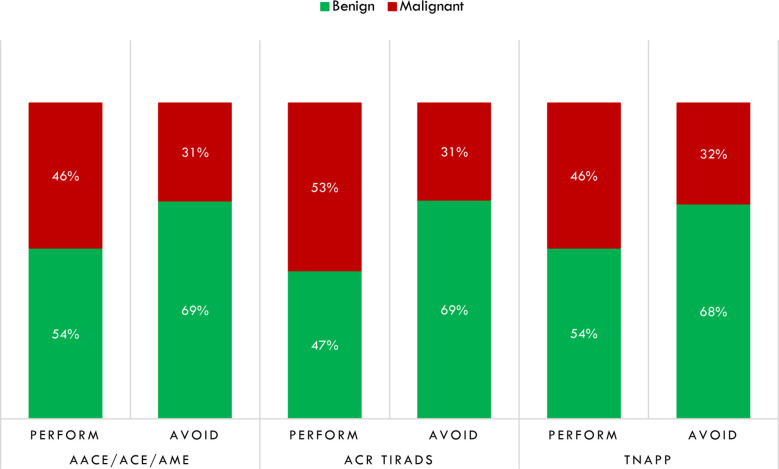
TNAPP performed better in terms of sensitivity (>80%) and negative predictive value (68%) with an overall accuracy of 50.5%, which was similar to that found with the AACE/ACE/AME algorithm. TNAPP displayed a slightly better performance than AACE/ACE/AME and ACR TI-RADS algorithms in selectively discriminating unnecessary FNA for nodules with benign cytology (TIR 2 - Bethesda class II: TNAPP 32% vs. AACE/ACE/AME 31% vs. ACR TI-RADS 29%). The TNAPP reduced the number of missed diagnoses of thyroid nodules with suspicious and highly suspicious cytology (TIR 4 + TIR 5 - Bethesda classes V + VI: TNAPP 18% vs. AACE/ACE/AME 26% vs. ACR TI-RADS 20.5%). A total of 14 nodules that would not have been aspirated were malignant, 13 of which were microcarcinomas (92.8%).
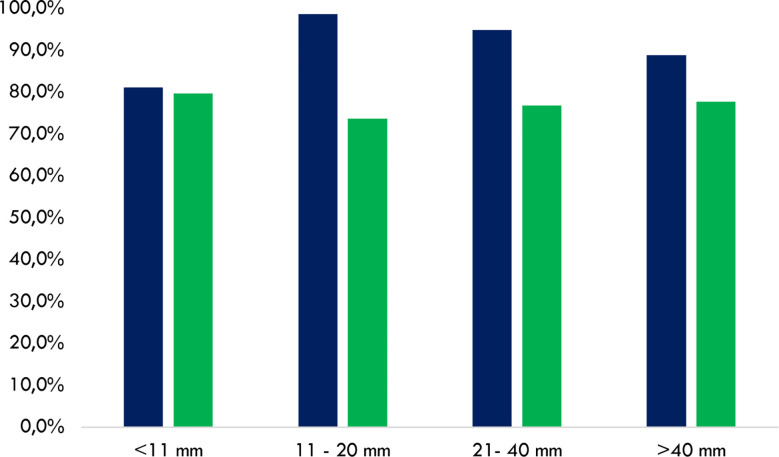
The TNAPP algorithm is a reliable, easy-to-learn tool that can be readily employed to improve the selection of thyroid nodules requiring cytological characterization. The rate of malignant nodules missed because of inaccurate characterization at baseline by TNAPP was lower compared to the other two algorithms and, in almost all the cases, the tumors were microcarcinomas. TNAPP's use of size >20 mm as an independent determinant for considering or recommending FNA reduced its specificity.
TNAPP performs well compared to AACE/ACE/AME and ACR-TIRADS algorithms. Additional retrospective and, ultimately, prospective studies are needed to confirm and guide the development of future iterations that incorporate different risk stratification systems and targets for diagnosing malignancy while reducing unnecessary FNA procedures.
随着时间的推移,甲状腺结节的检出率一直在增加,导致细针抽吸(FNA)和细胞学检查广泛应用。需要制定有针对性的方法来改善甲状腺结节的管理,包括算法和基于网络的工具。
评估 Thyroid Nodule App(TNAPP)的性能,这是一种基于网络的、易于修改的、交互式算法工具,用于改善甲状腺结节的管理。
回顾性评估了 2016 年 1 月至 12 月期间接受 FNA 检查的 112 例连续患者的 188 个甲状腺结节和甲状腺手术。从甲状腺结节登记处收集颈部超声图像,并重新检查以提取数据运行 TNAPP。对每个结节进行超声风险评估和是否适合进行 FNA。计算 TNAPP 的敏感性、特异性、阳性和阴性预测值以及总准确率,并与其他两种算法(美国临床内分泌医师协会/美国内分泌学会/意大利内分泌医师协会 AACE/ACE/AME)的诊断性能进行比较,该算法源自美国放射学会甲状腺成像报告和数据系统(ACR TI-RADS)。
TNAPP 在敏感性(>80%)和阴性预测值(68%)方面表现更好,总准确率为 50.5%,与 AACE/ACE/AME 算法相似。TNAPP 在选择性区分良性细胞学(TIR 2- Bethesda 分类 II)的结节中不必要的 FNA 方面的性能略优于 AACE/ACE/AME 和 ACR TI-RADS 算法(TNAPP 32%对 AACE/ACE/AME 31%对 ACR TI-RADS 29%)。TNAPP 减少了可疑和高度可疑细胞学(TIR 4+TIR 5- Bethesda 分类 V+VI)的甲状腺结节漏诊数量(TNAPP 18%对 AACE/ACE/AME 26%对 ACR TI-RADS 20.5%)。总共 14 个原本不会进行抽吸的结节是恶性的,其中 13 个是微癌(92.8%)。
TNAPP 算法是一种可靠的、易于学习的工具,可用于改善需要细胞学特征的甲状腺结节的选择。与其他两种算法相比,TNAPP 基线特征不准确导致恶性结节漏诊的比例较低,而且在几乎所有情况下,肿瘤都是微癌。TNAPP 将大小>20mm 作为考虑或推荐 FNA 的独立决定因素,降低了其特异性。
与 AACE/ACE/AME 和 ACR-TIRADS 算法相比,TNAPP 表现良好。需要进行额外的回顾性和最终的前瞻性研究,以确认和指导开发未来的迭代,该迭代将纳入不同的风险分层系统和诊断恶性肿瘤的目标,同时减少不必要的 FNA 程序。