Scientific Institute for Quality of Healthcare, Radboudumc, Nijmegen, The Netherlands.
Netherlands Comprehensive Cancer Center (IKNL), Utrecht, The Netherlands.
Cancer Res. 2023 Apr 4;83(7):1147-1157. doi: 10.1158/0008-5472.CAN-22-1336.
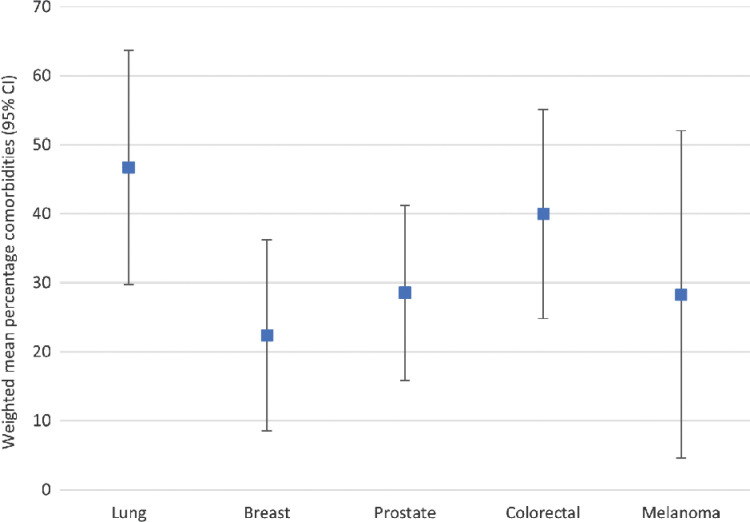
Comorbidities can have major implications for cancer care, as they might impact the timing of cancer diagnosis, compromise optimal care, affect treatment outcomes, and increase healthcare costs. Thus, it is important to comprehensively evaluate cancer comorbidities and examine trends over time. Here, we performed a systematic literature review on the prevalence and types of comorbidities for the five most common forms of cancer. Observational studies from Organisation for Economic Co-operation and Development countries published between 1990 and 2020 in English or Dutch that used routinely collected data from a representative population were included. The search yielded 3,070 articles, of which, 161 were eligible for data analyses. Multilevel analyses were performed to evaluate determinants of variation in comorbidity prevalence and trends over time. The weighted average comorbidity prevalence was 33.4%, and comorbidities were the most common in lung cancer (46.7%) and colorectal cancer (40.0%), followed by prostate cancer (28.5%), melanoma cancer (28.3%), and breast cancer (22.4%). The most common types of comorbidities were hypertension (29.7%), pulmonary diseases (15.9%), and diabetes (13.5%). After adjusting for gender, type of comorbidity index, age, data source (patient records vs. claims), and country, a significant increase in comorbidities of 0.54% per year was observed. Overall, a large and increasing proportion of the oncologic population is dealing with comorbidities, which could be used to inform and adapt treatment options to improve health outcomes and reduce healthcare costs.
Comorbidities are frequent and increasing in patients with cancer, emphasizing the importance of exploring optimal ways for uniform comorbidity registration and incorporating comorbidity management into cancer care.
合并症可能对癌症治疗产生重大影响,因为它们可能影响癌症诊断的时间、影响最佳治疗、影响治疗结果和增加医疗保健成本。因此,全面评估癌症合并症并研究随时间的趋势很重要。在这里,我们对五种最常见癌症的合并症患病率和类型进行了系统的文献回顾。纳入了经济合作与发展组织国家在 1990 年至 2020 年间发表的、使用代表性人群的常规收集数据的英文或荷兰文观察性研究。搜索结果产生了 3070 篇文章,其中 161 篇符合数据分析条件。进行了多层次分析,以评估合并症患病率和随时间变化趋势的变异决定因素。加权平均合并症患病率为 33.4%,在肺癌(46.7%)和结直肠癌(40.0%)中最常见,其次是前列腺癌(28.5%)、黑色素瘤(28.3%)和乳腺癌(22.4%)。最常见的合并症类型是高血压(29.7%)、肺部疾病(15.9%)和糖尿病(13.5%)。在调整性别、合并症指数类型、年龄、数据源(患者记录与索赔)和国家后,观察到每年合并症增加 0.54%,具有统计学意义。总体而言,越来越多的肿瘤患者存在合并症,这可以用来为改善健康结果和降低医疗保健成本提供信息并调整治疗选择。
癌症患者的合并症很常见且在增加,这强调了探索统一的合并症登记方法和将合并症管理纳入癌症治疗的重要性。